
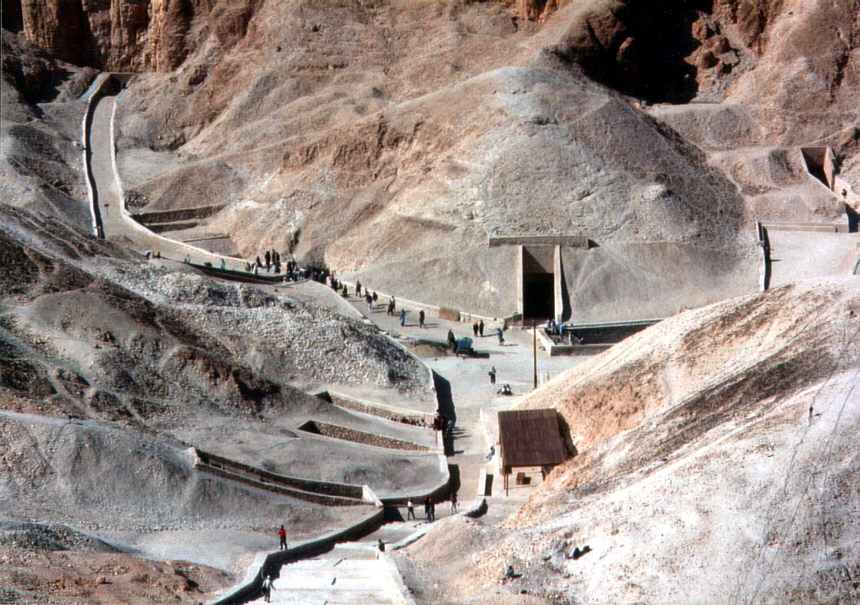
Photo: EditorfromMars · CC BY-SA 4.0 · Wikimedia Commons
Tomb of Tutankhamun is a tomb of Tutankhamun. Recorded as KV62, the sixty-second tomb in the valley. The free Lokali audio guide runs 7 minutes.
✓ Published October 2026 · how we write these guides
Visitor facts
| Lokali audio guide | 7 min · free |
|---|---|
| Type | Monument |
| Location | Luxor, Egypt |
| Coordinates | 25.7404, 32.6014 |
| Languages | 50+, in the Lokali app |
The story
The air changes as you go down. Outside, the Valley of the Kings is bright and dry, with pale limestone cliffs and white heat coming off the stones. A few steps below ground, the light softens and the air feels heavier. The passage is narrow and plain, cut straight into the bedrock. It does not look like the entrance to the most famous tomb in the world. That plainness is part of its story.
This is the Tomb of Tutankhamun. Archaeologists call it KV62, which simply means the sixty-second tomb recorded in the Valley of the Kings. Its owner was a young pharaoh who ruled in the fourteenth century BCE. He came to the throne as a boy. He died young, probably still in his late teens. By the standards of ancient Egypt, he was a minor king with a short reign. Yet today, his name is better known than almost any other ruler of the ancient world.
To understand why, it helps to know what came just before him. His likely father was Akhenaten, the pharaoh who turned away from Egypt's traditional gods. Akhenaten promoted the worship of a single sun disc, called the Aten. The young king was first named Tutankhaten, a name that honoured that sun disc. Early in his reign, his name changed to Tutankhamun, honouring the old god Amun instead. That single change in a name marks a return to the old religion and the old priesthood.
Now, a surprise. Compared with the great royal tombs nearby, this one is small. It has only four modest rooms: an antechamber, a side room called the annex, the burial chamber, and a small room known as the treasury. Many scholars think the tomb may not have been planned for a king at all. It may have been adapted in a hurry after his sudden death. The tomb was cramped, quickly finished, and almost forgotten.
Forgetting saved it. Tomb robbers did break in during ancient times, probably not long after the burial. Officials discovered the damage and sealed the tomb again. Later, when workers cut the much larger tomb of Ramesses the Sixth into the cliff nearby, their debris and rough huts covered this entrance. Over the centuries, the location disappeared from memory. While almost every other royal tomb in the valley was emptied, this one stayed hidden under rubble.
In November 1922, the British archaeologist Howard Carter found a step cut into the rock. His patron was Lord Carnarvon, who had funded years of searching that had produced very little. Carter's workers cleared a staircase down to a sealed doorway. When he made a small opening and looked through by candlelight, he saw the glint of gold. The story goes that Carnarvon asked whether he could see anything. Carter's widely repeated answer was: wonderful things.
The antechamber was packed with objects. There were gilded couches, chariots, chests, statues, and boxes stacked against the walls. Carter and his team spent about ten years recording and removing everything. They photographed and numbered thousands of items before moving them. That patient method is one reason this discovery still matters to archaeologists. The famous gold mask, the coffins, and the treasures are no longer here. They are now in Cairo, in the Grand Egyptian Museum.
You may hear about the curse. Lord Carnarvon died in Cairo in 1923, just months after the tomb was opened. Newspapers quickly spread the idea that the dead king had taken revenge. It made a thrilling headline, but it is legend, not history. Howard Carter himself, the man who actually opened the tomb, lived for many more years. Most people who worked here lived long, ordinary lives.
Now look at the walls of the burial chamber. This is the only room in the tomb that was painted. The background is a warm golden yellow. On one wall, a figure wearing a leopard skin performs a ritual called the Opening of the Mouth. This ceremony was believed to restore the senses of the dead in the afterlife. The figure is Ay, the older official who became pharaoh after Tutankhamun. Painting himself here helped show that he was the rightful successor.
On another wall, find the rows of baboons. They come from a funerary text about the sun's journey through the night, the hours of darkness before dawn. Look closely at the paint, and you will notice small brown spots across many of the scenes. For years, people worried they were spreading. Conservators from the Getty Conservation Institute studied them closely. They found the spots were old microbial growth, now dead and no longer growing. Removing them would damage the paint, so they remain.
That conservation work, finished in the late 2010s, changed how you visit. It added a new ventilation system to control heat and moisture from visitors' breath. It also added barriers and a viewing platform to keep people away from the fragile walls. In the burial chamber, the large stone sarcophagus still sits where it was placed more than three thousand years ago. Few visitors realise how much of what they see here depends on careful daily control of the air.
Then comes the moment that stops many people. In the antechamber, inside a climate-controlled glass case, lies the mummy of Tutankhamun himself. Unlike almost all of the treasure, the king never left his valley. You can see the dark, fragile face and the thin outline of his body. Studies over the years have given scholars clues about his health and his early death. But many questions remain open. Standing here, he becomes less a legend and more a young man.
Before you climb back toward the light, take one more look around. Notice how close the walls are, how short the distance is from the entrance to the king. Then, as you step outside, look up at the cliffs above the valley. The bright stone and the open sky are the same view the burial workers saw. A small tomb, nearly forgotten, kept its secrets here for more than three thousand years.
Key facts
What to look for
Practical tips
Common questions
Is there a free audio guide to Tomb of Tutankhamun?
Yes — the Lokali app narrates Tomb of Tutankhamun free of charge in 50+ languages. The guide runs about 7 minutes, covers the history, what to look for on site and practical tips, and works offline once downloaded.
Where is Tomb of Tutankhamun?
Tomb of Tutankhamun is near Luxor, Egypt, at 25.7404, 32.6014. Tap the map link on this page for directions from where you are.
What is Tomb of Tutankhamun known for?
Recorded as KV62, the sixty-second tomb in the valley. Howard Carter found the first step in November 1922.
What should you look for at Tomb of Tutankhamun?
Golden yellow background on the burial chamber walls. Ay in a leopard skin performing the ritual. Rows of painted baboons on the burial chamber wall.
What should you know before visiting Tomb of Tutankhamun?
Buy the separate ticket this tomb requires at the valley. Check the current photography rules before you enter.
When is the best time to visit Tomb of Tutankhamun?
Arrive early to avoid crowds in the small chambers.
On the map
Opens directions to Tomb of Tutankhamun from your location.
More to see in Luxor


Hear Tomb of Tutankhamun in your language
The full story, narrated, in 50+ languages. Download it before you go and it plays offline, at your own pace, with no ticket and no tour group.