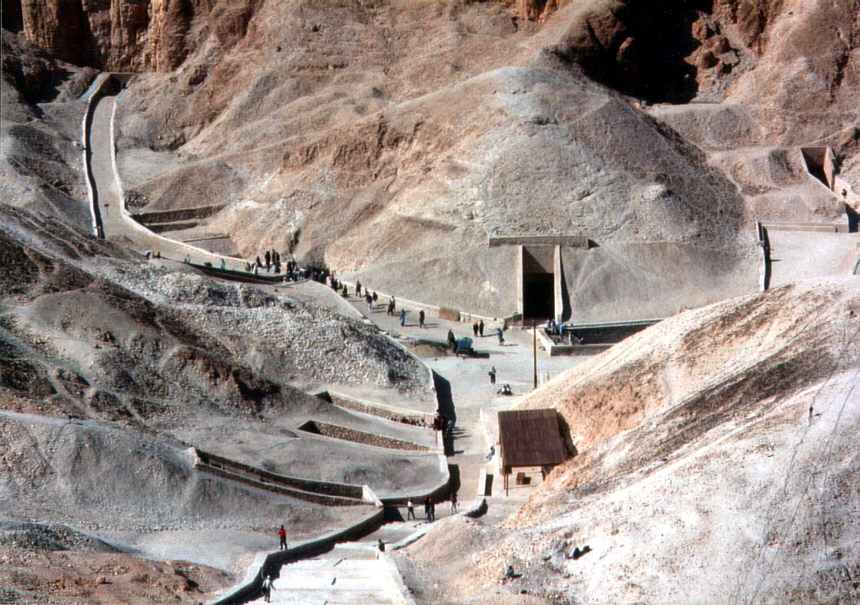
Valley of the Kings
25.7402° N · 32.6024° E · Archaeological Site
Photo: Fotograf/Photographer: Peter J. Bubenik (1995) · CC BY-SA 2.0 · Wikimedia Commons
Valley of the Kings is a necropolis in ancient Egypt. It is near Luxor, Egypt. Royal burial ground for New Kingdom pharaohs of ancient Thebes. The free Lokali audio guide runs 7 minutes.
✓ Published October 2026 · how we write these guides
Visitor facts
| Lokali audio guide | 7 min · free |
|---|---|
| Type | Archaeological Site |
| Location | Luxor, Egypt |
| Coordinates | 25.7402, 32.6024 |
| Languages | 50+, in the Lokali app |
The story
Listen for a moment. Under the hot sun, the valley is almost silent. Gravel crunches under your shoes. A fly hums near your ear. The pale limestone cliffs throw the light back at you, so bright that you squint even in the shade. Very little grows here. The air smells of dust and warm stone. This is a valley of rock, heat and quiet, and that quiet was part of its purpose.
You are on the West Bank of the Nile, across the river from modern Luxor. In ancient times this city was called Thebes. The Egyptians linked the east bank with the living and the rising sun. The west bank, where the sun went down each evening, was the land of the dead. For about five centuries of the New Kingdom, Egypt's pharaohs chose this dry side valley for their final resting places.
Why here, after the age of the pyramids? A pyramid announced a burial to everyone, including thieves. Egypt's earlier royal tombs had been robbed again and again. So the kings of the New Kingdom tried a different idea. They cut their tombs deep into the rock, in a remote valley, and built their temples for worship separately, out on the plain near the river. The tomb was hidden. The temple was public.
Now lift your eyes to the highest peak above the valley. Its shape looks a little like a pyramid, formed by nature rather than by human hands. Today it is called al-Qurn, which means the horn. Many scholars think the peak made this valley feel sacred. The ancient Egyptians connected the summit with a cobra goddess named Meretseger. Her name is usually translated as she who loves silence. She was believed to guard the tombs below.
The people who actually built these tombs did not live in the valley. They lived just over the ridge, in the village now called Deir el-Medina. It was a planned settlement for a skilled community of quarrymen, plasterers, scribes, draughtsmen and painters. On working days, many of them walked to the valley along a path over the hills. Parts of that footpath can still be followed today. When you think about these tombs, picture those families too.
Here is something most visitors never hear. The villagers of Deir el-Medina left behind an enormous paper trail. They did not write mainly on papyrus. They used ostraca, which are flakes of limestone and broken pottery. On them, scribes noted work rosters, food rations, loans, and even why a man missed work. Some excuses mention illness, a family festival, or brewing beer. Thousands of these notes have survived, and they give us everyday voices from ancient Egypt.
Those same records tell a dramatic story. During the reign of Ramesses the Third, the workmen's grain rations arrived late, again and again. The workers stopped work and protested. A papyrus now kept in Turin, in Italy, records the event. It is often described as the earliest strike in recorded history. So the valley where pharaohs were buried also holds a story about ordinary workers who demanded their wages.
As you walk, notice the small doorways cut into the slopes. Each one carries a code made of letters and a number, such as K V 62. K V simply stands for Kings' Valley. The numbers follow the order in which the tombs were recorded in modern times, not the order in which they were built. More than sixty tombs and pits have been numbered here. Not all of them belong to kings. Some were made for queens, princes or high officials, and some are small, plain chambers.
The most famous number is 62, the tomb of Tutankhamun. The British archaeologist Howard Carter found it in 1922, and its burial goods were still largely in place. Here is the surprise: it is a small tomb for a king. Tutankhamun probably died young, before a larger tomb could be prepared. His tomb also survived partly by luck. Later builders cut a much bigger tomb nearby for Ramesses the Sixth. The stone chips and debris from that work helped cover the smaller entrance.
When you go down into a tomb, the noise of the valley fades quickly. A long corridor slopes into the rock. The walls are covered with rows of figures, columns of hieroglyphs, and deep blue ceilings scattered with yellow stars. These are not scenes from the king's daily life. They are religious texts and maps for a journey. Ancient Egyptians believed the sun travelled through a dangerous underworld every night, and the king hoped to travel with it and be reborn at dawn.
Notice how unfinished some walls look. In several tombs you can see red outline sketches, sometimes corrected in black ink, where painters never filled in the colour. These marks show the working method step by step. A draughtsman drew the first lines. A senior artist corrected them. Then the carvers and painters followed. When a king died suddenly, work simply stopped, and the half-finished wall stayed exactly as it was.
The hiding strategy did not fully work. Ancient papyri describe official trials of tomb robbers in the later New Kingdom. Over time, priests moved many royal mummies away from their damaged tombs to keep them safe. They gathered them together in secret group burials. In the nineteenth century, modern discoveries of these hidden caches returned many famous kings to the light. Today, a number of those royal mummies are displayed in a museum in Cairo, not here.
Modern life brings new challenges. Every visitor adds breath, humidity and warmth to these narrow passages. Over time, that can harm the ancient paint. This is one reason why tombs open and close in rotation. It is also why replicas have been made for some of the most delicate spaces. When you see a tomb closed, think of it as a rest period. The goal is to keep these walls readable for centuries more.
Before you leave, stand still near one of the entrances and look around once more. Look at the bare cliffs, the bright gravel, and the dark doorways in the rock. Somewhere over that ridge to the west, the workmen's village waits. Their footsteps once crossed these same hills every working day. As you walk back toward the gate, listen to the crunch of stone beneath your feet. It is the same sound they heard.
Key facts
What to look for
Practical tips
Common questions
Is there a free audio guide to Valley of the Kings?
Yes — the Lokali app narrates Valley of the Kings free of charge in 50+ languages. The guide runs about 7 minutes, covers the history, what to look for on site and practical tips, and works offline once downloaded.
Where is Valley of the Kings?
Valley of the Kings is near Luxor, Egypt, at 25.7402, 32.6024. Tap the map link on this page for directions from where you are.
What is Valley of the Kings known for?
Royal burial ground for New Kingdom pharaohs of ancient Thebes. Tomb builders lived nearby in the village of Deir el-Medina.
What should you look for at Valley of the Kings?
The pyramid-shaped peak of al-Qurn above the valley. KV numbers painted beside each tomb entrance. Blue tomb ceilings painted with rows of yellow stars.
What should you know before visiting Valley of the Kings?
Arrive early, before the valley's reflected heat becomes intense. Carry plenty of water and wear a wide-brimmed hat.
When is the best time to visit Valley of the Kings?
Arrive early, before the valley's reflected heat becomes intense.
On the map
Opens directions to Valley of the Kings from your location.
More to see in Luxor


Hear Valley of the Kings in your language
The full story, narrated, in 50+ languages. Download it before you go and it plays offline, at your own pace, with no ticket and no tour group.