
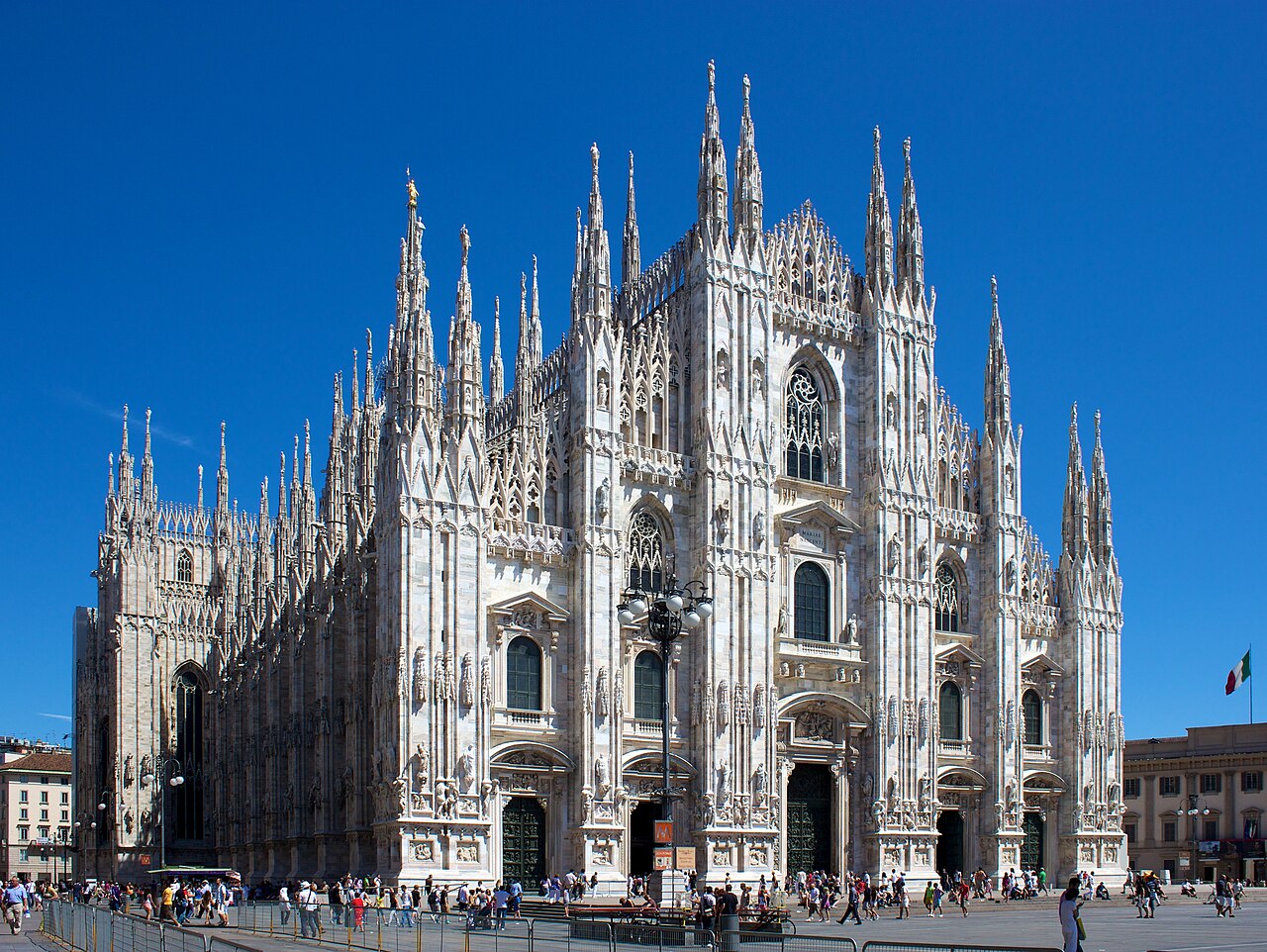
Photo: Emanuela Terzi · CC BY-SA 4.0 · Wikimedia Commons
Museo del Novecento is a museum of twentieth-century art in Milan, Italy. The museum opened in December 2010 inside the Arengario. The free Lokali audio guide runs 7 minutes.
✓ Published October 2026 · how we write these guides
Visitor facts
| Lokali audio guide | 7 min · free |
|---|---|
| Type | Museum |
| Location | Milan, Italy |
| Coordinates | 45.4634, 9.1903 |
| Official website | museodelnovecento.org |
| Languages | 50+, in the Lokali app |
The story
Stand for a moment at the edge of Piazza del Duomo and listen. Pigeons, tram bells, a hundred conversations in a dozen languages. To your right, the cathedral climbs in pale marble lace. But turn the other way. Facing it is a severe, symmetrical building in creamy stone, with tall arches and square lines. It looks almost silent next to the Duomo. That building is the Arengario, and inside it is Milan's museum of twentieth-century art, the Museo del Novecento.
Novecento simply means the nineteen-hundreds in Italian. The museum opened in December 2010, and it gathers the city's civic collection of modern art under one roof. For decades, much of this work sat in storage or in scattered rooms. Now it follows one route, roughly in time order, through a century of Italian painting and sculpture. It is a story of speed, war, doubt, and invention. And it is told in a building that carries its own complicated past.
The Arengario was built in the 1930s, during the Fascist era, by a team of architects that included Piero Portaluppi and Giovanni Muzio. The two matching blocks were meant to frame the piazza and to hold a balcony for public speeches. That is where the name comes from. An arengario was the medieval word for a place of public address. Look at the arches and the stone reliefs on the facade. Their clean, heavy forms are typical of official architecture from that decade.
The modern conversion was led by the architect Italo Rota. His most memorable move is right at the entrance. Instead of a grand staircase, you walk up a long spiral ramp that winds inside the tower. Many visitors compare it to the Guggenheim in New York. As you climb, the noise of the square fades. The curve of the walls slows your pace. It works like a decompression chamber between the street and the art.
At the top of the ramp, the first painting waits for you. It is The Fourth Estate by Giuseppe Pellizza da Volpedo, finished in 1901. It is very wide, and it shows a crowd of farm workers walking straight toward you. A man, a woman with a baby, and the people behind them, all moving forward in warm, golden light. The painting stands at the opening of the century. It asks a simple question: who will this new century belong to?
The next rooms answer with energy. This is the territory of Futurism, the movement founded in Italy just before the First World War. The Futurists loved machines, cities, and speed. They wanted to break with the past completely. Here you will find work by Umberto Boccioni, Giacomo Balla, Carlo Carrà, and Gino Severini. Look for Boccioni's striding bronze figure, Unique Forms of Continuity in Space. The body seems to tear through the air like a flag in the wind.
Here is a detail many visitors miss. A version of that striding figure appears on the Italian twenty-cent euro coin. So if you have Italian change in your pocket, you may already be carrying this sculpture. Take out a coin and hold it up next to the bronze. It is a small, surprising moment, and a reminder of how deeply this movement shaped the way Italy pictures itself as modern.
After the noise of Futurism, the mood changes. The war ended many of those dreams, and some artists turned inward. You will meet the strange, quiet squares of Giorgio de Chirico, a style called metaphysical painting. It shows empty piazzas, long shadows, and objects that seem out of place. Nearby are the still lifes of Giorgio Morandi from Bologna. He painted the same bottles and jars again and again, in soft dusty colours. Stand close. The stillness is the point.
The museum also holds an international section, built largely from a private collection donated to the city. Here Italian work sits beside names from the wider European story. Depending on the current display, you may see paintings by Picasso, Braque, Kandinsky, Klee, Matisse, and Modigliani. It is a useful reminder that Milan was never isolated. Its artists travelled, read foreign journals, and argued with what was happening in Paris and beyond.
Then comes the moment many people remember most. On the upper floor, a room is dedicated to Lucio Fontana, an artist born in Argentina who worked in Milan. Above your head hangs a looping line of white neon, like a drawing made of light. Fontana created this kind of light structure for the Milan Triennale in 1951. And through the tall glass wall, the cathedral fills the view. Old marble and new light, in one frame.
Fontana is also known for his slashed canvases. He cut clean lines into a painted surface to open it toward the space behind. Look for them in the rooms nearby. At first they can feel like an act of damage. Look again. The cuts are calm and precise, almost like calligraphy. Fontana wanted painting to step out of the flat picture and into real space. That idea shaped much of the art that followed.
The final sections carry the story into the decades after the Second World War. You will find Piero Manzoni, a Milanese artist who questioned what art could be, and his white Achromes, surfaces with no colour at all. Later rooms touch on Arte Povera, which means poor art. Its artists used simple materials like earth, cloth, and wood. Be ready for work that challenges you. That challenge was always part of the plan.
Before you leave, look for the passage that links the museum to the neighbouring Palazzo Reale, the old royal palace. And step back out toward the piazza slowly. The light will feel sharper after the quiet rooms. Turn once more toward the Arengario's arches. A building made for speeches now holds a century of arguments, painted and sculpted. Then look across at the cathedral, and notice how differently you see it now... after a hundred years of looking.
Key facts
What to look for
Practical tips
Common questions
Is there a free audio guide to Museo del Novecento?
Yes — the Lokali app narrates Museo del Novecento free of charge in 50+ languages. The guide runs about 7 minutes, covers the history, what to look for on site and practical tips, and works offline once downloaded.
Where is Museo del Novecento?
Museo del Novecento is in Milan, Italy, at 45.4634, 9.1903. Tap the map link on this page for directions from where you are.
What is Museo del Novecento known for?
The museum opened in December 2010 inside the Arengario. The Arengario was built in the 1930s on Piazza del Duomo.
What should you look for at Museo del Novecento?
The long spiral ramp curving inside the entrance tower. Workers walking toward you in The Fourth Estate. Fontana's looping white neon line above the top floor.
What should you know before visiting Museo del Novecento?
Walk the spiral ramp slowly instead of rushing upward. Save the Fontana room for late afternoon light on the Duomo.
When is the best time to visit Museo del Novecento?
Save the Fontana room for late afternoon light on the Duomo.
On the map
Opens directions to Museo del Novecento from your location.
More to see in Milan



Hear Museo del Novecento in your language
The full story, narrated, in 50+ languages. Download it before you go and it plays offline, at your own pace, with no ticket and no tour group.