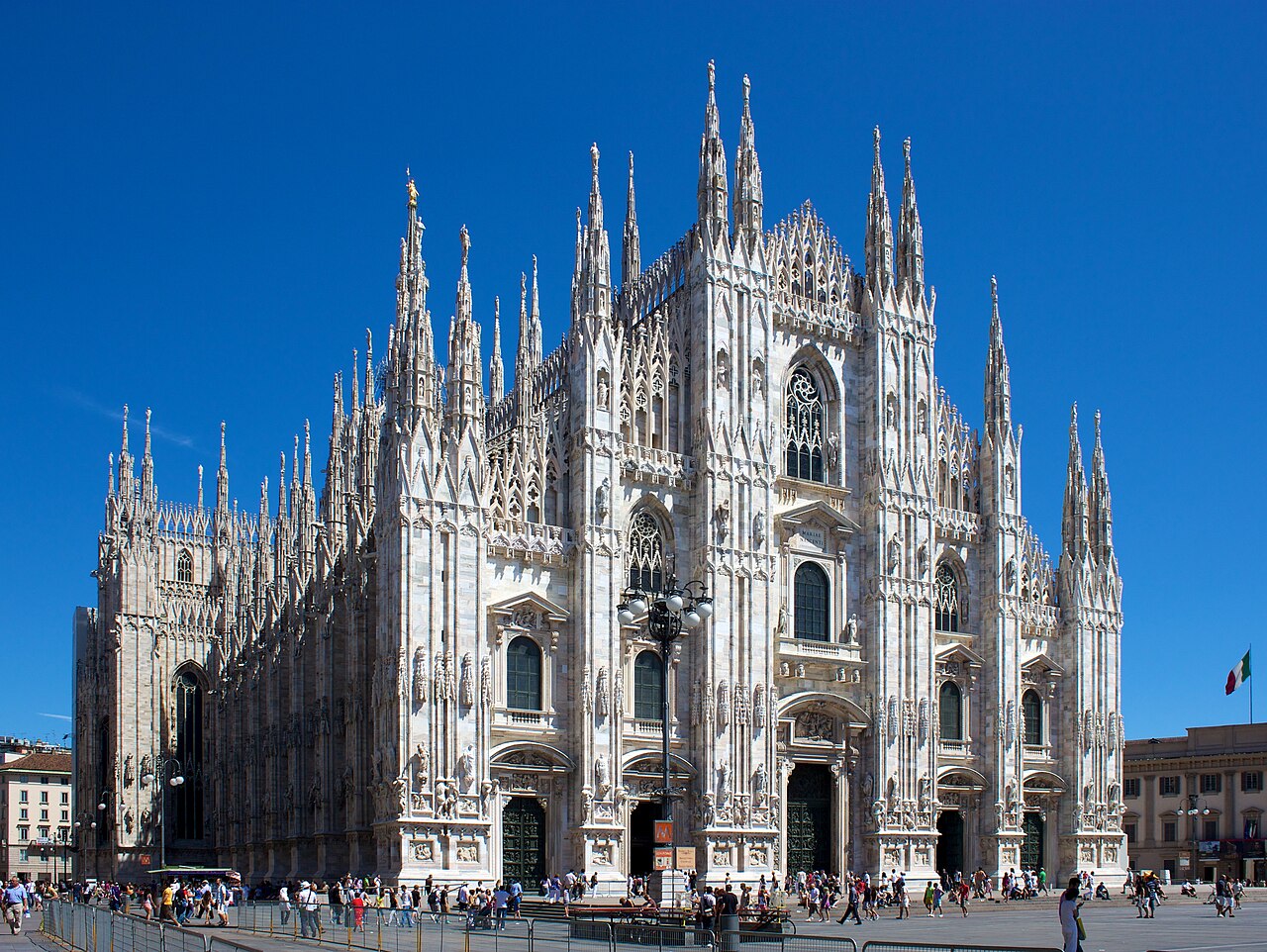
Duomo di Milano is a cathedral in Milan, Italy. Construction began in 1386 and took nearly six centuries. The Madonnina statue stands 108 metres above street level. Most visitors spend 1-2 hours here. The free Lokali audio guide runs 6 minutes.
✓ Verified October 2026 · how we write these guides
Visitor facts
| Time needed | 1-2 hours |
|---|---|
| Lokali audio guide | 6 min · free |
| Type | Cathedral |
| Best for | Editors’ pick |
| Location | Milan, Italy |
| Coordinates | 45.4642, 9.192 |
| Languages | 45, in the Lokali app |
The story
Stand in the piazza and tilt your head back. The Duomo's white marble facade rises like a forest of stone—hundreds of spires, thousands of statues, each one carved with a precision that feels impossible at this scale. The marble is Candoglia stone, quarried from the Alps north of the city, and it catches the light differently depending on the hour. Early morning, it glows pale pink. Midday, it turns almost blinding white. Late afternoon, it softens to cream.
This cathedral took nearly six centuries to complete. Work began in 1386, when Milan's ruler ordered the old church demolished to make way for something grander. Architects came from across Europe—French, German, Italian—each bringing their own ideas about what a Gothic cathedral should be. The result is a hybrid, a structure that borrows from northern Gothic traditions but bends them to Italian tastes. The layout is cruciform, the nave soaring, but the proportions feel broader, more horizontal than the needle-thin cathedrals of France.
The facade you see today was not finished until the eighteen hundreds. Napoleon ordered it completed when he crowned himself King of Italy here in 1805, and workers scrambled to install the central doors and lower tier of statues in time for the ceremony. The topmost spire, crowned with a golden statue of the Virgin Mary, was added in the seventeen hundreds. Locals call her the Madonnina, and she stands one hundred and eight metres above the pavement, the highest point in the old city for centuries.
Step inside and the temperature drops. The interior is dim, the light filtered through stained glass windows that span five centuries of craftsmanship. The oldest date from the late fourteen hundreds, their colours deeper and more saturated than the later panels. The nave is supported by fifty-two columns, one for each week of the year, and the floor is patterned with inlaid marble in geometric designs that guide your eye toward the altar.
The crypt beneath the main floor holds the remains of Saint Charles Borromeo, a sixteenth-century cardinal who reformed the Church during the Counter-Reformation. His body lies in a crystal casket, dressed in full vestments, and pilgrims have been visiting the spot for over four hundred years. The treasury nearby contains relics and liturgical objects, including a nail said to be from the crucifixion, displayed once a year in September during a ceremony that draws thousands.
If you take the stairs—or the lift—to the rooftop terraces, you will walk among the spires. Up close, the statues reveal their individuality. Saints, prophets, gargoyles, mythical creatures—each one different, each one positioned where almost no one at street level would ever see the detail. The sculptors carved them anyway, working in a tradition that valued the act of creation as much as the final view. From the terraces, you can see across Milan to the Alps on clear days, the same mountains that provided the stone beneath your feet.
The Duomo has survived wars, fires, and centuries of pollution that turned the white marble gray. A restoration project that began in the late twentieth century is still ongoing, cleaning the facade panel by panel, revealing the original brightness of the stone. Scaffolding is almost always present somewhere on the building, a reminder that a structure this complex is never truly finished, only maintained.
The piazza in front of the cathedral was redesigned in the eighteen sixties, cleared of the medieval buildings that once crowded against the church. Today it is one of the largest public squares in Italy, a gathering place for protests, celebrations, and the everyday rhythm of the city. Pigeons swarm the pavement, tourists cluster near the central doors, and Milanese cut through on their way to work, barely glancing up.
Inside, the light shifts as clouds pass overhead. The stained glass throws patches of colour onto the marble floor—blue, red, gold—and the air smells faintly of incense and old stone. This is a working cathedral, not a museum. Masses are held daily, and the building fills with the sound of hymns and the shuffle of feet on worn marble.
Notice the sundial on the floor near the entrance, a brass line inlaid into the stone. At noon on the summer solstice, sunlight streams through a small hole in the roof and strikes the line at a specific point, marking the longest day of the year. It has been doing this since the seventeen hundreds, a quiet marriage of astronomy and faith.
When you step back outside, the scale of the building reasserts itself. It is easy to focus on the details—the statues, the spires, the glass—but step back and take in the whole. This is a monument built across generations, by people who knew they would never see it completed, working toward a vision that outlasted them all. The Madonnina still glows at the top, watching over the city, the same way she has for two and a half centuries.
Key facts
What to look for
Practical tips
Common questions
How long do you need at Duomo di Milano?
Plan 1-2 hours. That is the time most visitors spend at Duomo di Milano. The free Lokali audio guide runs 6 minutes and is made to listen to while you walk.
Is there a free audio guide to Duomo di Milano?
Yes — the Lokali app narrates Duomo di Milano free of charge in 50+ languages. No ticket, tour group or subscription, and it works offline once downloaded.
Where is Duomo di Milano?
Duomo di Milano is in Milan, Italy, at 45.4642, 9.192. Tap the map link on this page for directions.
What should you know before visiting Duomo di Milano?
Visit the rooftop terraces to walk among the spires
What is Duomo di Milano known for?
Construction began in 1386 and took nearly six centuries
What is the best time to visit Duomo di Milano?
Arrive early morning when the marble glows pink
On the map
Opens directions to Duomo di Milano from your location.
More to see in Milan




Hear Duomo di Milano in your language
The full story, narrated, in 50+ languages. Download it before you go and it plays offline, at your own pace, with no ticket and no tour group.