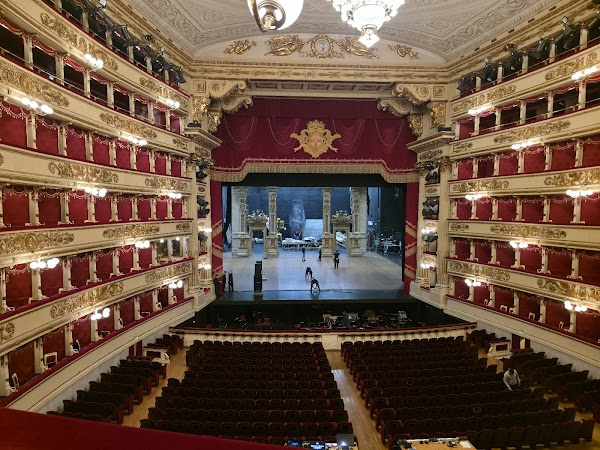
La Scala Opera House is a theater in Milan, Italy. Italy's most prestigious opera house, opened in 1778. Most visitors spend 45–90 min here. The free Lokali audio guide runs 5 minutes.
✓ Verified August 2026 · how we write these guides
Visitor facts
| Time needed | 45–90 min |
|---|---|
| Lokali audio guide | 5 min · free |
| Type | Theater |
| Best for | History |
| Location | Milan, Italy |
| Coordinates | 45.4681, 9.1888 |
| Languages | 45, in the Lokali app |
The story
From the street, the building looks almost modest. A neat stone front, a few columns, the place where carriages once pulled up to the door. Then you step inside, and the hall opens in red velvet and gold, ringed with tiers of boxes rising toward a great chandelier. This is La Scala, one of the most famous opera houses in the world.
Its full name is Teatro alla Scala. It opened in 1778. An older theatre had burned down, and the city needed a new one. The empress Maria Theresa, who ruled Milan at the time, approved the plan. The architect Giuseppe Piermarini designed it in the clean neoclassical style of the day.
The name comes from a church that once stood on this spot, Santa Maria alla Scala. That church took its name from Beatrice Regina della Scala, a noblewoman of the fourteenth century. The church was taken down to make room for the theatre, but its name stayed, and so the opera house is called La Scala to this day.
On opening night the audience heard a new opera by Antonio Salieri, written for the occasion. From the start, La Scala was more than a theatre. It was the center of social life in Milan. The boxes were owned by noble families, who decorated them as small private rooms and came as much to meet and talk as to listen.
The shape of the hall is a horseshoe, designed so that sound carries and so that the audience can see one another as well as the stage. There are several tiers of boxes, and above them the gallery, called the loggione. The people who sit up there are the most devoted and the most demanding listeners in the house.
These gallery regulars are famous, and feared. They know every note. When a singer is in fine voice, the applause is enormous. When a singer falls short, the same crowd will whistle and jeer without mercy. Many great careers have been tested in this room, and a few have been broken in a single evening.
La Scala is bound up with the history of Italian opera. The composer Giuseppe Verdi made his name here. His opera Nabucco had its first performance in this hall in 1842, and its chorus of exiles became a song the whole country took to heart. Later works of his, Otello and Falstaff, also opened on this stage.
In the twentieth century, the house drew the finest singers of the age. The soprano Maria Callas sang some of her most famous roles on this stage in the 1950s, and her name stayed tied to La Scala ever after. The theatre also keeps a ballet company and a school for young dancers and singers, so it trains new artists as well as presenting famous ones.
The war reached even here. In 1943, bombing badly damaged the theatre. The people of Milan were determined to rebuild it, and they did so quickly. In 1946, the hall reopened with a concert led by the conductor Arturo Toscanini, who had been linked to La Scala for much of his life. For the city, the reopening was a sign that ordinary life could return.
The traditional season opens each year on the seventh of December, the feast day of Saint Ambrose, the patron of Milan. Opening night is one of the great events of the Italian calendar. Tickets are scarce and prized, and the evening draws attention far beyond the world of music.
Next to the theatre is a museum. There you can see portraits of composers and singers, old instruments, costumes, and posters from past seasons. From the museum, when no rehearsal is underway, you can often look into the empty hall itself and take in its scale from one of the boxes. Even empty, the hall holds a presence.
If you cannot attend a full performance, it is worth trying for a seat high in the house, where prices are lower. The view is distant, but the sound is true, and you will be among the listeners who care most. Dress with some care; this is a house with long habits of its own.
Sit for a moment and imagine the hall full and dark, the chandelier dimmed, a single voice rising into the silence. For more than two centuries, people have gathered in this room to be moved by music together. The velvet has been replaced many times. The listening, and the hush before the first note, have not.
Key facts
What to look for
Practical tips
Common questions
How long do you need at La Scala Opera House?
Plan 45–90 min. That is the time most visitors spend at La Scala Opera House. The free Lokali audio guide adds about 5 minutes of narration you can listen to as you walk, so it fits inside your visit rather than adding to it.
Is there a free audio guide to La Scala Opera House?
Yes — the Lokali app narrates La Scala Opera House free of charge in 50+ languages. It covers the history, what to look for on site and practical tips, and it works offline once downloaded.
Where is La Scala Opera House?
La Scala Opera House is in Milan, Italy, at 45.4681, 9.1888. Tap the map link on this page for directions from where you are.
What should you know before visiting La Scala Opera House?
Book ahead; opening night sells out fast.
What is La Scala Opera House known for?
Teatro alla Scala opened in 1778.
What is the best time to visit La Scala Opera House?
Even without a ticket, peek into the foyer to see the staircase and chandelier.
On the map
Opens directions to La Scala Opera House from your location.
More to see in Milan


Hear La Scala Opera House in your language
The full story, narrated, in 50+ languages. Download it before you go and it plays offline, at your own pace, with no ticket and no tour group.