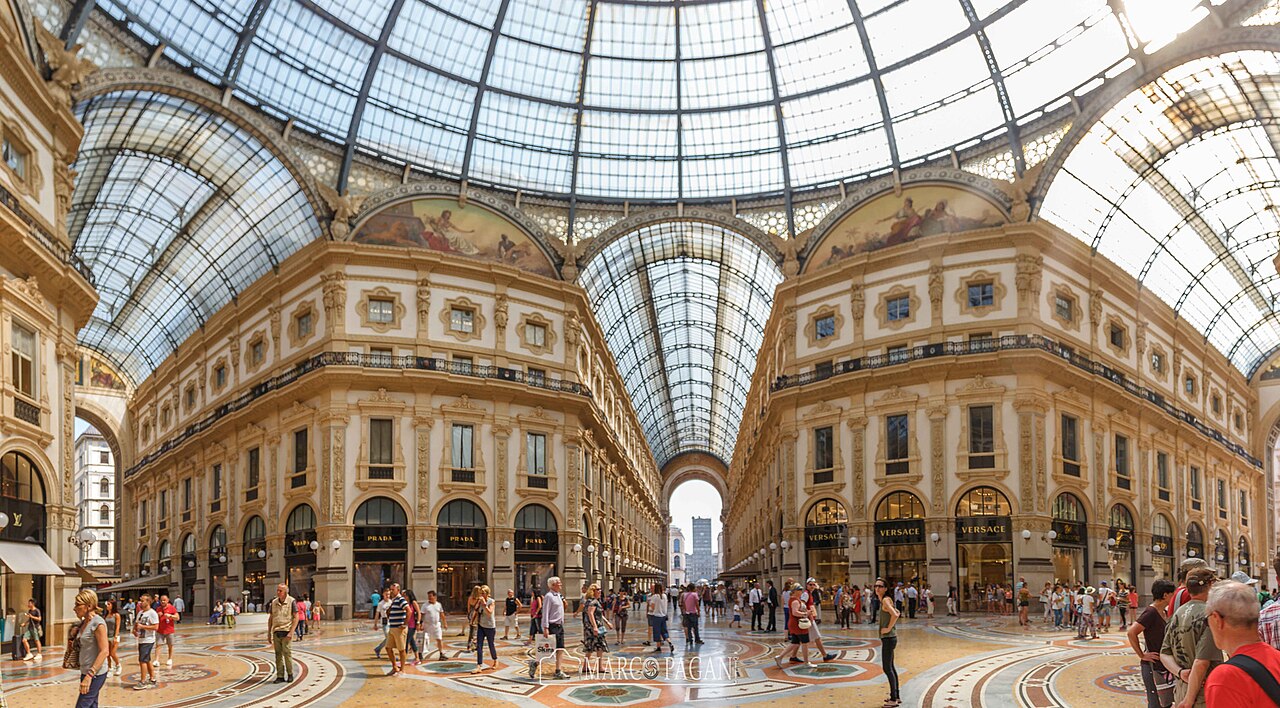
Galleria Vittorio Emanuele II
45.4656° N · 9.1900° E · Arcade
Galleria Vittorio Emanuele II is a 19th-century covered shopping arcade connecting Piazza del Duomo to Piazza della Scala. It is in Milan, Italy. Most visitors spend 30–60 min here. The free Lokali audio guide runs 6 minutes.
✓ Verified August 2026 · how we write these guides
Visitor facts
| Time needed | 30–60 min |
|---|---|
| Lokali audio guide | 6 min · free |
| Type | Arcade |
| Best for | Editors' pick |
| Location | Milan, Italy |
| Coordinates | 45.4656, 9.1900 |
| Languages | 45, in the Lokali app |
The story
Look up as you enter. Far above your head, a great roof of glass and iron lets the daylight pour straight down. Your footsteps ring on the polished marble floor. Around you, voices rise and blend into a soft hum under the high ceiling. The air smells of coffee and stone. You are standing inside the Galleria Vittorio Emanuele II, the covered heart of Milan, where the whole city seems to pass through.
This long arcade joins two of the most important squares in the city. At one end, the doors open toward the great cathedral and its wide stone square. At the other end, the passage leads to the square of the famous opera house. For more than a century, people have crossed the center of Milan simply by walking straight through this bright and sheltered hall, out of the sun and out of the rain.
An architect named Giuseppe Mengoni drew the plans for this place. Work on the building began in 1865. The arcade opened to the public in 1867, though the smaller details took several more years to finish. The city of Milan wanted a grand indoor street, something modern and proud. They wanted a space that felt both like a market and like a palace. Mengoni gave them exactly that.
The plan of the building is shaped like a cross. Four long arms reach out, and they all meet at a single central point. Above that meeting point rises a wide and graceful dome of glass. Stand directly beneath it and turn around slowly. The light keeps changing above you as clouds drift across the sky. On a bright day, the iron frame throws thin shadows down onto the floor.
The walls rise in four tall levels above the shops. Look closely at the carved stone, the slender columns, and the painted scenes set near the roofline. The decoration honors four ideas: art, science, farming, and industry. There are also painted images of distant lands and continents. Together they were meant to celebrate Italy as a young, united, and hopeful nation, proud of its talent and its work.
The arcade carries a royal name for a reason. Vittorio Emanuele II was the first king of a newly united Italy. For many centuries before him, the land had been divided into many separate states. The building was made to honor this king and the new country he helped to lead. Its grand size was a message in itself. It said that Milan, and Italy, had stepped onto a larger stage.
Now look down and find the floor at the very center. Among the colored stone mosaics, there is a small white bull set on a red background. The bull is an old symbol of the rival city of Turin. For many years, visitors have placed one heel on the bull and spun around in a full circle. People say the little turn brings good luck, or a safe return to Milan. The stone there is worn smooth from the habit.
People who live here call this place the drawing room of Milan. It is where the city comes to meet, to talk, and to quietly watch one another pass by. The cafes set their small tables out under the glass roof. A single cup of coffee can hold a table for a full hour, and no one will rush you. Couples meet here. Old friends argue here. Tourists rest their feet here.
Some of the shops and cafes are very old indeed. One well-known restaurant has served its guests since the arcade's earliest years. A famous Milanese fashion house opened its very first store right here in 1913. Today the windows display the newest designs and the highest prices in the city. New luxury and long tradition stand quietly side by side, sharing the same marble floor and the same soft light.
The story of this place holds a sad turn. In 1877, only days before the grand final celebration, the architect Mengoni climbed the high wooden scaffolding near the dome. He fell from that great height, and he died. He never saw his finished work fully honored by the crowds. The building you walk through today is, in a quiet way, also his monument.
Come back at different hours and the whole feeling changes. In the early morning, the light arrives soft and gray, and the floor is nearly empty. By midday, crowds fill every arm of the cross. After dark, the shop windows glow warm and gold, and the great glass roof turns to deep black above the lamps. Each version of the Galleria feels like a different room.
The Galleria is far more than a place to shop. It is a room without true walls, open to the sky and yet safe from the weather. It has welcomed kings, shoppers, soldiers, and strangers for many generations. Stand here just a moment longer before you go. Listen to the soft river of footsteps and voices moving through, the same sound this hall has held for so very long.
Key facts
What to look for
Practical tips
Common questions
How long do you need at Galleria Vittorio Emanuele II?
Plan 30–60 min. That is the time most visitors spend at Galleria Vittorio Emanuele II. The free Lokali audio guide adds about 6 minutes of narration you can listen to as you walk, so it fits inside your visit rather than adding to it.
Is there a free audio guide to Galleria Vittorio Emanuele II?
Yes — the Lokali app narrates Galleria Vittorio Emanuele II free of charge in 50+ languages. It covers the history, what to look for on site and practical tips, and it works offline once downloaded.
Where is Galleria Vittorio Emanuele II?
Galleria Vittorio Emanuele II is in Milan, Italy, at 45.4656, 9.1900 Tap the map link on this page for directions from where you are.
What should you know before visiting Galleria Vittorio Emanuele II?
Visit early in the morning before the crowds arrive.
What is Galleria Vittorio Emanuele II known for?
Designed by architect Giuseppe Mengoni, opened in 1867.
What is the best time to visit Galleria Vittorio Emanuele II?
Stand in the centre of the floor mosaic and look up through the glass dome.
On the map
Opens directions to Galleria Vittorio Emanuele II from your location.
Reference
More to see in Milan



Hear Galleria Vittorio Emanuele II in your language
The full story, narrated, in 50+ languages. Download it before you go and it plays offline, at your own pace, with no ticket and no tour group.