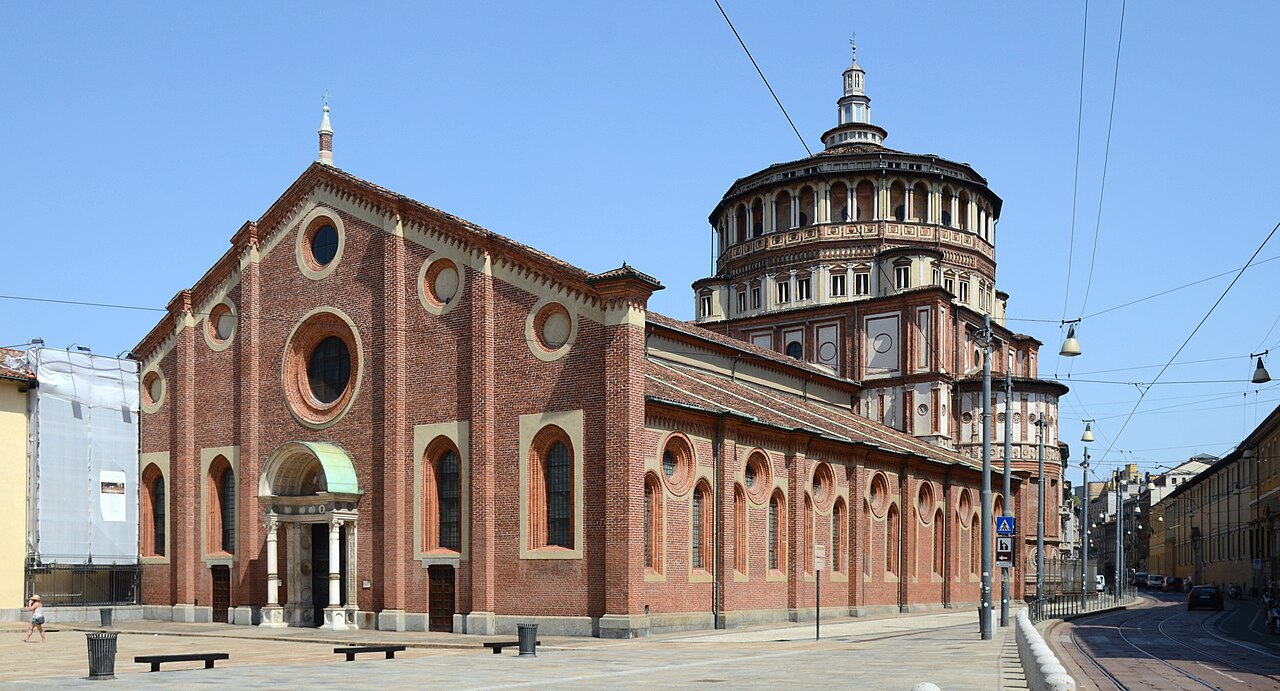
Santa Maria delle Grazie is a Renaissance church and Dominican convent housing Leonardo da Vinci's 'The Last Supper' in the refectory. It is in Milan, Italy. Most visitors spend 1–2 hours here. The free Lokali audio guide runs 5 minutes.
✓ Verified August 2026 · how we write these guides
Visitor facts
| Time needed | 1–2 hours |
|---|---|
| Lokali audio guide | 5 min · free |
| Type | Church |
| Best for | Editors' pick |
| Location | Milan, Italy |
| Coordinates | 45.4656, 9.1699 |
| Languages | 45, in the Lokali app |
The story
A plain brick church stands at the end of a quiet street, its rounded apse warm and red in the afternoon light. From outside it does not look like much. Yet inside, one wall of this place holds a painting that people cross the world to see for fifteen minutes: Leonardo da Vinci's Last Supper.
The church is called Santa Maria delle Grazie, Saint Mary of the Graces. It was built in the fifteenth century for the Dominican friars, an order of preachers. The duke of Milan, Ludovico Sforza, took a special interest in it. He wanted the church and its convent to hold the tombs of his family.
The architect Donato Bramante is thought to have shaped the eastern end of the church, the large domed space behind the altar. Look at its clean curves and calm proportions. This was the new style of the Renaissance arriving in Milan, lighter and more balanced than the Gothic work that came before.
The painting that draws the crowds is not inside the church itself. It is next door, in the refectory, the long hall where the friars once ate their meals together. Ludovico Sforza asked Leonardo to paint the far wall. Between 1495 and 1498, Leonardo created The Last Supper, the moment when Christ tells his followers that one of them will betray him.
Leonardo painted the faces at the instant the words land. Each apostle reacts in his own way. Some pull back. Some lean in. Some raise their hands or turn to a neighbor. The whole table moves with shock and confusion, while Christ sits calm at the center. Leonardo studied real people for years to capture these gestures.
There is a sadness in the painting's history. Leonardo did not use the usual fresco method, where paint is laid into wet plaster. He wanted more time to work and richer color, so he painted onto dry plaster instead. The result was beautiful but fragile. Within his own lifetime, the surface began to flake and fade.
Over the centuries it grew worse. Damp seeped through the wall. At one point the friars cut a doorway through the bottom of the painting, removing the feet of Christ. Later, soldiers were housed in the hall. Many people who came to admire the work were really looking at a ghost of what Leonardo made.
Then came the war. On a night in August 1943, Allied bombs fell on this part of Milan. The refectory was hit. Much of the building collapsed into rubble. But the wall holding The Last Supper still stood, protected by sandbags and timber that the people of Milan had stacked against it. Photographs from the time show the painting open to the sky.
A long and careful restoration, finished in 1999, removed centuries of dirt and earlier repairs. What you see now is faint and quiet, much of it Leonardo's own hand brought back to light. Because the painting is so delicate, only small groups enter at a time, for about fifteen minutes, after passing through sealed chambers that filter the air.
This means you must plan ahead. Tickets are limited and often sell out weeks in advance. When your turn comes, use the short time well. Stand back first to take in the whole scene, then look closely at single faces and hands. The longer you look, the more movement you find.
When you step back into the church, take a moment there too. Santa Maria delle Grazie is named on the list of World Heritage sites, recognized as one of the treasures of humankind. It is still a living church, with services and prayer, not only a museum around a single wall.
Take time for the church itself, which is free to enter. Side chapels hold old frescoes and quiet altars, and the light falls softly through the high windows. Beyond the church lies a small cloister, a square of calm with a garden at its center, its gentle arches also linked to Bramante. Few of the visitors hurrying to the painting ever step into it. Sit there a while. The noise of the city falls away, and the old stone keeps its quiet.
Outside again, the street is calm. It is strange to think that one of the most studied paintings ever made has survived here through neglect, war, and time, hanging on by threads. Leonardo gambled on a fragile method and nearly lost. What remains is faint, but it is still his, and it still holds the room in silence.
Key facts
What to look for
Practical tips
Common questions
How long do you need at Santa Maria delle Grazie?
Plan 1–2 hours. That is the time most visitors spend at Santa Maria delle Grazie. The free Lokali audio guide adds about 5 minutes of narration you can listen to as you walk, so it fits inside your visit rather than adding to it.
Is there a free audio guide to Santa Maria delle Grazie?
Yes — the Lokali app narrates Santa Maria delle Grazie free of charge in 50+ languages. It covers the history, what to look for on site and practical tips, and it works offline once downloaded.
Where is Santa Maria delle Grazie?
Santa Maria delle Grazie is in Milan, Italy, at 45.4656, 9.1699 Tap the map link on this page for directions from where you are.
What should you know before visiting Santa Maria delle Grazie?
Book Last Supper tickets weeks ahead online.
What is Santa Maria delle Grazie known for?
Built in the fifteenth century for Dominican friars.
What is the best time to visit Santa Maria delle Grazie?
Visits are timed and limited to 15 minutes per group.
On the map
Opens directions to Santa Maria delle Grazie from your location.
More to see in Milan




Hear Santa Maria delle Grazie in your language
The full story, narrated, in 50+ languages. Download it before you go and it plays offline, at your own pace, with no ticket and no tour group.