La Scala is a theater in Milan, Italy. One of the world's most prestigious opera houses, opened in 1778. Most visitors spend 1–1.5 hours here. The free Lokali audio guide runs 5 minutes.
✓ Verified August 2026 · how we write these guides
Visitor facts
| Time needed | 1–1.5 hours |
|---|---|
| Lokali audio guide | 5 min · free |
| Type | Theater |
| Best for | Editors' pick |
| Location | Milan, Italy |
| Coordinates | 45.4672, 9.1895 |
| Languages | 45, in the Lokali app |
The story
Stand in the small square outside and look at the front of the building. It is calm, almost plain. You see pale stone, a row of neat columns, and tall quiet windows. Carriages once stopped here on opera evenings. Today people gather on the steps before the doors open. From the street, you would never guess the grand world that waits inside. This is La Scala, the most celebrated opera house in Italy.
The theatre opened in 1778. It was built on the site of an old church called Santa Maria alla Scala. That church gave the opera house its short and famous name. An architect named Giuseppe Piermarini designed the building. The very first opera performed here was written by the composer Antonio Salieri. From that opening night, the people of Milan took the theatre into their hearts.
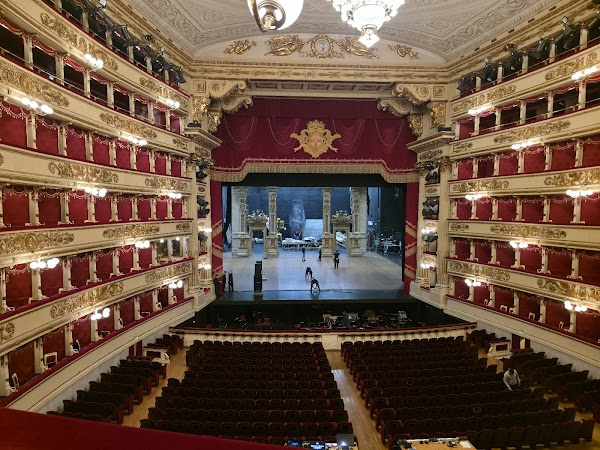
Step inside and the mood changes at once. The plain front gives way to red velvet and soft gold. The main hall is shaped like a horseshoe. Six curved levels of boxes rise from the floor toward the ceiling. Hundreds of seats face a single stage. Hanging in the center is a large chandelier, bright with many small lights. Every surface seems made to carry sound and to catch the eye.
The boxes were once owned by noble families. Each box was a small private room, with chairs and a mirror and a door that could close. Families came not only to hear the music. They came to meet, to talk business, and to be seen by the rest of the city. The opera house was a stage in two directions at once: one on the platform, and one in the seats.
The sound inside this hall is famous among singers. The curved walls and the wooden surfaces carry the voice gently to the farthest seats. A singer does not need to force the voice here. Even a soft note can travel to the top level. Musicians say a hall like this is rare and precious. It rewards control, and it punishes any small mistake, because every ear can hear it.
Many great composers are tied to this stage. The composer Giuseppe Verdi became closely linked with La Scala in the nineteenth century. One of his early operas had its first performance here in 1842, and it made him famous across the land. Over the years, the works of Rossini, Bellini, Donizetti, and Puccini also filled this hall. To have an opera open at La Scala was a great honor.
The theatre has known hard times too. During the Second World War, in 1943, bombs fell on Milan and badly damaged the building. Much of the hall was destroyed. After the war, the city chose to rebuild it quickly and faithfully. The theatre opened its doors again in 1946 with a great concert. A beloved conductor led the music that night, and the people of Milan wept and cheered.
There is a strong tradition tied to the calendar. The opera season here opens each year on the seventh of December. That date is the feast day of Saint Ambrose, the patron saint of Milan. Opening night is one of the largest events in the city. Tickets are rare and costly. Famous guests arrive in their finest clothes, and the whole country watches to see what will be performed.
Connected to the theatre is a museum. Inside it you can see portraits of composers and singers, old instruments, costumes, and printed scores. The museum tells the long story of opera in Milan. From certain rooms, when no rehearsal is underway, visitors can look into the great hall itself. It is a quiet way to see the famous space, even when the seats are empty and dark.
Think of the work hidden behind one single night. Singers train for many years to reach this stage. An orchestra rehearses each piece again and again. Painters build the scenery. Tailors sew the costumes. Stagehands move great sets in the dark between scenes. The few hours of music you might hear rest on months of patient, unseen effort by hundreds of people.
Even if you never attend a performance, you can feel the weight of the place. Stand in the square and picture the evenings. The lights, the crowd, the hush before the first note. For more than two centuries, this building has gathered the city for one shared purpose: to listen together, in the dark, to the human voice raised in song.
La Scala is not only a building of stone and velvet. It is a meeting point between the artist and the listener. It holds the memory of every voice that has ever filled it. Stand here a little longer and imagine that sound. Then carry the thought with you as you go: a single song, in a great room, shared by many strangers at once.
Key facts
What to look for
Practical tips
Common questions
How long do you need at La Scala?
Plan 1–1.5 hours. That is the time most visitors spend at La Scala. The free Lokali audio guide adds about 5 minutes of narration you can listen to as you walk, so it fits inside your visit rather than adding to it.
Is there a free audio guide to La Scala?
Yes — the Lokali app narrates La Scala free of charge in 50+ languages. It covers the history, what to look for on site and practical tips, and it works offline once downloaded.
Where is La Scala?
La Scala is in Milan, Italy, at 45.4672, 9.1895 Tap the map link on this page for directions from where you are.
What should you know before visiting La Scala?
Visit the theatre museum to see the famous interior.
What is La Scala known for?
The opera house first opened in 1778.
What is the best time to visit La Scala?
The museum traces La Scala's 250-year history through costumes, set designs, and memorabilia.
On the map
Opens directions to La Scala from your location.
Reference
More to see in Milan


Hear La Scala in your language
The full story, narrated, in 50+ languages. Download it before you go and it plays offline, at your own pace, with no ticket and no tour group.