
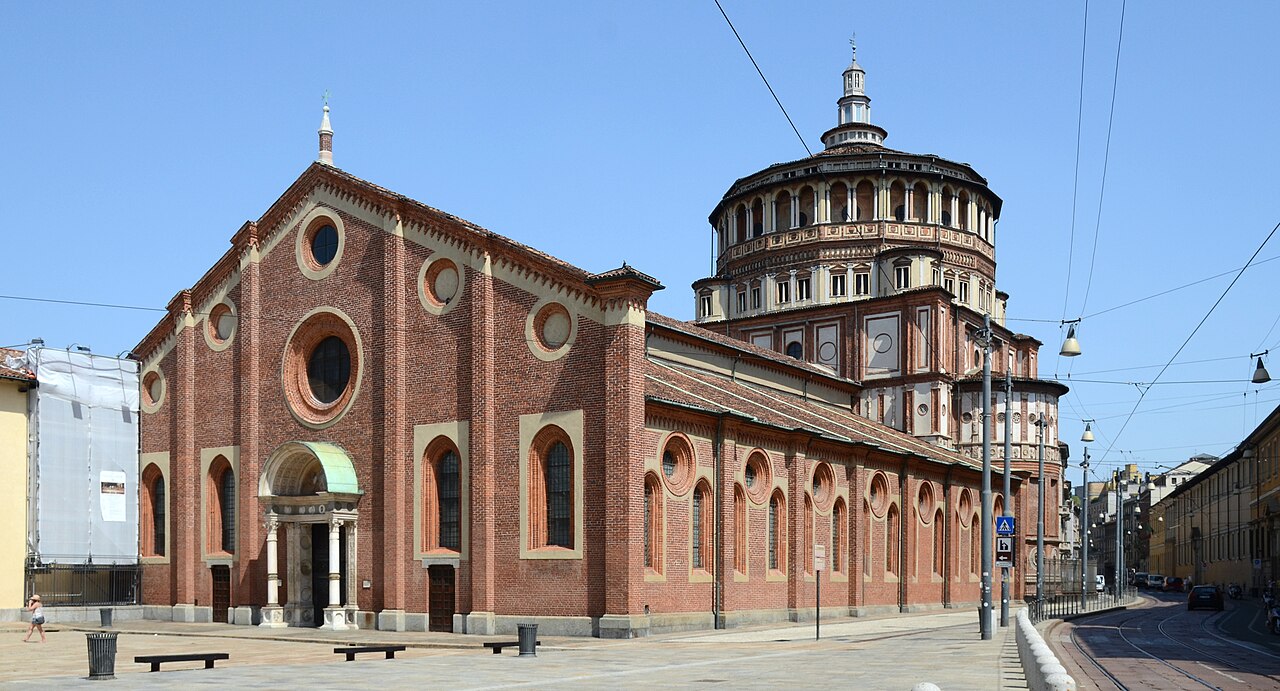
Photo: Photograph by Mike Peel (www.mikepeel.net). · CC BY-SA 4.0 · Wikimedia Commons
Triennale di Milano is a cultural organization and museum in Milan, Italy. Palazzo dell'Arte designed by architect Giovanni Muzio. The free Lokali audio guide runs 8 minutes.
✓ Published October 2026 · how we write these guides
Visitor facts
| Lokali audio guide | 8 min · free |
|---|---|
| Type | Museum |
| Location | Milan, Italy |
| Coordinates | 45.4718, 9.1737 |
| Official website | triennale.org |
| Languages | 50+, in the Lokali app |
The story
Listen for a moment. Behind you, the trees of Sempione Park move in the wind, and somewhere a bicycle bell rings on the gravel path. In front of you stands a long, low building of warm red brick, broken by tall arched openings. The surface is matte and slightly rough, the colour of baked earth. It does not shout for attention. It waits, calm and orderly, at the edge of the green. This is the Triennale di Milano, one of the most important homes for design in Italy.
The building has its own name: the Palazzo dell'Arte, the Palace of Art. It was designed by the Milanese architect Giovanni Muzio and opened in 1933. Look at the rhythm of the façade. Arch follows arch, brick follows brick, with almost no decoration at all. Muzio worked in a style that looked back to Roman and Lombard building traditions, but stripped them down to clean geometry. The result feels both ancient and modern at the same time — a temple for exhibitions, built from humble material.
Here is the first surprise. The Triennale did not begin in Milan. Its story starts in 1923, in the nearby town of Monza, where a decorative arts exhibition was held every two years. At that time it was a biennial, not a triennial. Only in 1933 did the event move here, into this purpose-built palace, and take on the rhythm of every three years. The name of the institution still carries that old schedule, even though today it runs exhibitions all year long.
Why build such a building at all? The idea was to give Milan a permanent stage for the decorative and industrial arts. The construction was made possible by a donation from the Bernocchi family, local industrialists from the textile trade. That detail matters. Milan has always been a city of makers, merchants and factories. The Triennale grew from that world. It treats a chair, a lamp or a typeface with the same seriousness that other museums give to painting.
Over the decades, the great Triennale exhibitions became meeting points for architects and designers from across the world. Countries sent pavilions. Young designers showed furniture, glass, ceramics and new ideas about housing. After the Second World War, these shows helped shape what people abroad began to call Italian design — elegant, practical objects made for everyday life. Many of the names that later filled design history books first showed their work in these halls.
Now turn and look up, toward the park. Rising above the trees is a slender steel tower. That is the Torre Branca, designed by Gio Ponti, one of the most influential Italian architects of the twentieth century. It was built in 1933 for the same exhibition that opened this palace. So the brick building and the steel tower are siblings — born in the same year, for the same event. One is heavy and grounded, the other is light and vertical. Together they frame this corner of the park.
Step inside, and the scale changes. The interior is a sequence of large, open spaces, wide stairs and generous halls. Muzio designed the building to be flexible, so that each exhibition could reshape the rooms. Light enters through the tall windows and falls across the floors in long bands. Walls can be built, painted and removed. In a sense, the architecture is a frame. It is meant to step back, so that the objects inside can take the front of the stage.
In 2007, the Triennale opened a permanent design museum within these walls. Before that, the institution had mostly shown temporary exhibitions. The museum gave Italian design a lasting place to tell its own story, from early modern furniture to everyday household objects. Displays rotate and change over time, so the collection you see today may look different from the one a friend saw last year. That is part of the character of this place: it keeps moving.
The building also holds a theatre, the Teatro dell'Arte. Here the Triennale presents performance, dance, music and talks. This is easy to miss. Many visitors come for an exhibition and never realise that, on the same evening, a contemporary dance piece may be playing a few rooms away. The Triennale sees design broadly — not only as objects, but as a way of thinking about how people live, move and gather together.
Now walk out into the garden behind the building. Here is the second surprise. Among the lawns sits a strange, dreamlike fountain. It is called the Mysterious Baths, and it was created by the painter Giorgio de Chirico for the Triennale of 1973. De Chirico was famous for his empty, silent piazzas and long shadows. In this fountain, his painted world becomes real: a shaped pool, a cabin, a figure, and a rippled floor that looks like water frozen into stone.
The fountain is worth a slow look. Notice how the surface imitates waves, but stays perfectly still. Notice the bright colours against the grey and green of the garden. It feels a little uncanny, as if you have walked into a painting by mistake. Children often walk around it in curiosity. Adults tend to stop and wonder what it means. De Chirico never offered a simple answer, and perhaps that is the point.
The Triennale also sits within a larger landscape. Sempione Park stretches away from here toward the Sforza Castle, the great fortress of the city's Renaissance rulers. At the opposite end stands the Arch of Peace, a neoclassical triumphal arch. So in one walk you can move from medieval and Renaissance power, through nineteenth century monuments, to twentieth century design. The Triennale is the modern voice in that conversation, and it sits comfortably among the trees.
Many Milanese come here not only for exhibitions. They come for a coffee, a meal, or a quiet hour with a book in the bookshop. The building works as a civic living room. On a warm day, the terraces and garden fill with people talking, students sketching, and families resting after a long walk through the park. Design, here, is not something behind glass. It is the chair you sit on and the view you look at.
Before you leave, stand back once more and look at the brick façade. Watch how the light moves across those arches as the clouds pass. Listen to the park again — the footsteps, the voices, the birds in the plane trees. This building was made to hold ideas about the future, almost a century ago. As you walk away, look closely at the objects around you: a bench, a lamp, a door handle. Someone, somewhere, designed each one.
Key facts
What to look for
Practical tips
Common questions
Is there a free audio guide to Triennale di Milano?
Yes — the Lokali app narrates Triennale di Milano free of charge in 50+ languages. The guide runs about 8 minutes, covers the history, what to look for on site and practical tips, and works offline once downloaded.
Where is Triennale di Milano?
Triennale di Milano is in Milan, Italy, at 45.4718, 9.1737. Tap the map link on this page for directions from where you are.
What is Triennale di Milano known for?
Palazzo dell'Arte designed by architect Giovanni Muzio. The building opened in 1933 inside Sempione Park.
What should you look for at Triennale di Milano?
The repeating red brick arches along the façade. Torre Branca's steel lattice rising above the trees. The frozen wave floor of de Chirico's fountain.
What should you know before visiting Triennale di Milano?
Check the current exhibition programme before your visit. Combine your visit with a walk to Sforza Castle.
When is the best time to visit Triennale di Milano?
Look at the theatre listings for evening performances.
On the map
Opens directions to Triennale di Milano from your location.
More to see in Milan



Hear Triennale di Milano in your language
The full story, narrated, in 50+ languages. Download it before you go and it plays offline, at your own pace, with no ticket and no tour group.