
Mary, Queen of the World Cathedral
45.4991° N · 73.5683° W · Cathedral
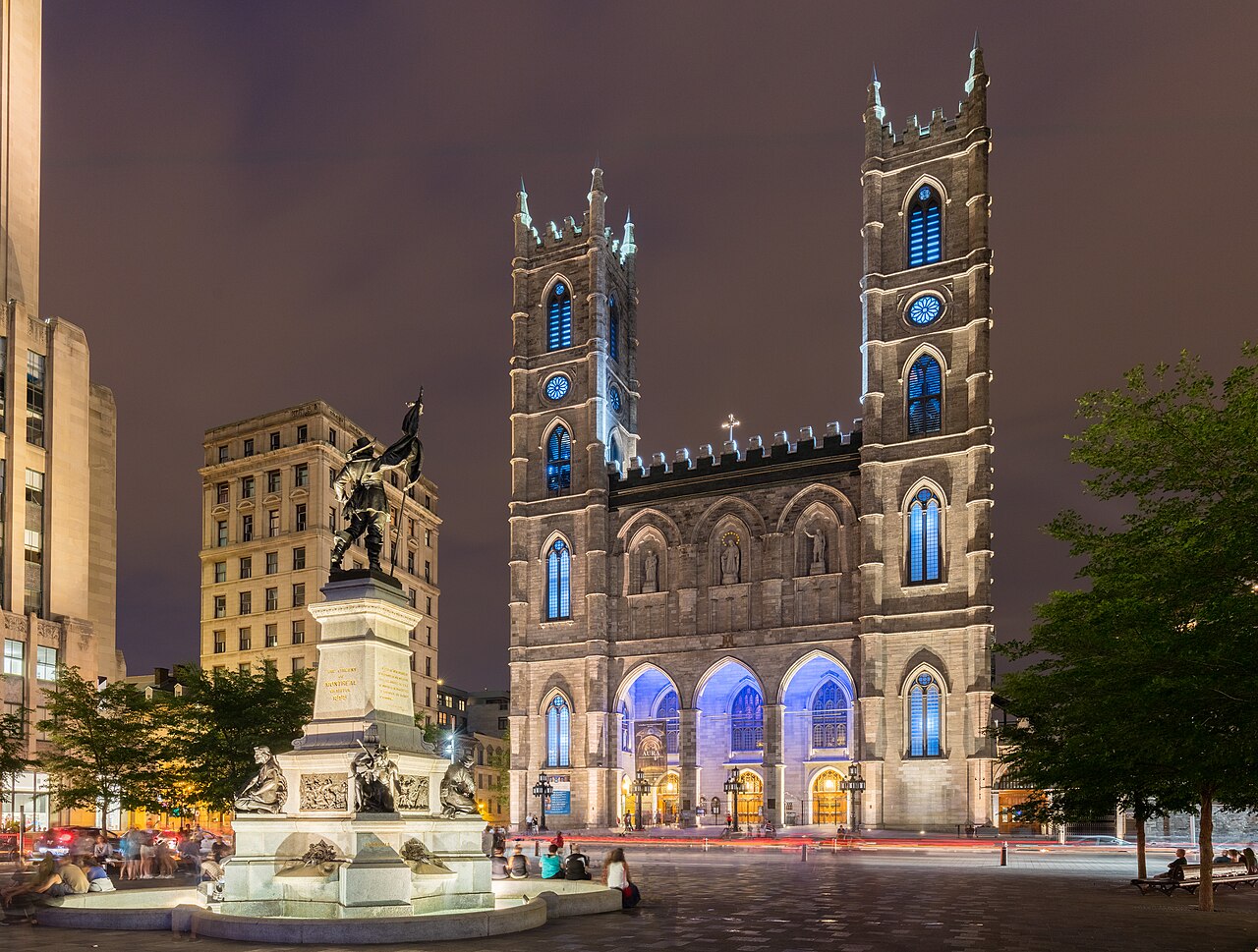
Photo: Wilfredor · CC BY-SA 4.0 · Wikimedia Commons
Mary, Queen of the World Cathedral is a cathedral in Montreal, Quebec, Canada. Designed as a scaled-down copy of Saint Peter's Basilica. The free Lokali audio guide runs 7 minutes.
✓ Published October 2026 · how we write these guides
Visitor facts
| Lokali audio guide | 7 min · free |
|---|---|
| Type | Cathedral |
| Location | Montreal, Canada |
| Coordinates | 45.4991, -73.5683 |
| Official website | mariereinedumonde.org |
| Languages | 50+, in the Lokali app |
The story
Stand on the pavement of René-Lévesque Boulevard for a moment and listen. Traffic hums, office towers rise in glass and steel, and then, between them, a grey stone facade appears with a row of saints along its roofline. Above it sits a green copper dome. The contrast feels almost unreal. It looks as if a piece of Rome has been placed in the middle of downtown Montreal, and in a sense, that is exactly what happened.
This is Mary, Queen of the World Cathedral, the seat of the Roman Catholic Archbishop of Montreal. Many visitors walk past and feel that the building looks familiar without knowing why. The answer is simple. The cathedral was designed as a scaled-down copy of Saint Peter's Basilica in Vatican City. It is often described as roughly one third of the original's size. Even so, standing at its base, it still feels large.
The story begins with a fire. In 1852, a great fire swept through Montreal and destroyed the city's earlier cathedral, which stood in the east of the city. The bishop of the time, Ignace Bourget, had to decide how and where to rebuild. His choice was bold. He wanted a new cathedral that would show Montreal's loyalty to the Pope in Rome, and he wanted it built in a very particular place.
That place was here, in the western part of the city. In the nineteenth century, this district was largely English-speaking and Protestant. Wealthy merchant families lived nearby, and their churches stood in the surrounding streets. Bourget chose to place a large Catholic cathedral right in their neighbourhood. Many people at the time thought the location was a mistake. It was far from the French-speaking Catholic heart of the city. Bourget did not change his mind.
His choice of design also carried a message. In those years, the Catholic Church in Quebec followed a movement often called ultramontanism, a word that means looking beyond the mountains, toward Rome. Supporters of this movement wanted strong ties to the Pope. Building a copy of Saint Peter's Basilica made that loyalty visible in stone. The cathedral was not only a place of prayer. It was a statement about where Montreal's Catholics placed their faith.
The architect was Victor Bourgeau, one of the busiest church designers in Quebec in that era. Construction started in the 1870s and continued for many years. The work was finished in the 1890s, long after the fire that had made it necessary. Bourget himself did not live to see the building fully complete. Today, a bronze statue of the bishop stands outside, near the entrance, so he still watches over the project he began.
Now look up at the roofline above the entrance. That row of statues is one of the details most visitors miss. The figures are saints, and each one is linked to a parish of the diocese. The parishes helped pay for them. So these are not random saints. They are a map of local communities, placed high on the facade. When you look at them, you are looking at the names of neighbourhoods and villages from across the region.
When you step inside, the noise of the boulevard falls away. The air is cooler and quieter. Your eyes go first to the centre of the church, under the dome. There stands a tall canopy over the main altar, held up by twisting columns. It is a copy of the famous bronze canopy that the sculptor Bernini created for Saint Peter's in Rome. Here, the gold catches the light from the windows above.
This is the second surprise. Many people assume the canopy is solid metal, like the original in Rome. In fact, it is carved and gilded, made to look like the Roman version from a distance. Walk around it slowly. Notice the angels at the top and the spiral shape of the columns. The design leads your eye upward, toward the dome, just as it does in the Vatican, but on a more personal, human scale.
Around the walls, look for large paintings that show scenes from the early history of Montreal. They tell the story of the city's founding by French settlers in the seventeenth century, when it was called Ville-Marie. That name lives on today in this borough and in many places around you. The paintings connect this Roman-style building to a very local story, the story of a small mission settlement that grew into a major city.
As you walk, look also for the side chapels. One holds the tombs of bishops and archbishops of Montreal, including Bourget himself. It is a quiet corner, and many visitors never find it. Elsewhere, look for memorials to the Papal Zouaves. These were young men from Quebec who travelled to Italy in the nineteenth century to defend the Pope's territories. Their story is little known today, but this cathedral remembers them.
The building's name has also changed over time. For many years, it was known as the Cathedral of Saint James, after the earlier cathedral that burned. In the 1950s, it received the name it carries today, Mary, Queen of the World. Some longtime Montrealers still use the older name. The cathedral is also recognised as a national historic site of Canada, which reflects its importance in the country's religious and architectural history.
When you leave, pause on the steps and look at the view in front of you. Across the street is Dorchester Square and Place du Canada, green spaces with trees and benches. Nearby stand a large hotel and the tall office towers of downtown. Below your feet runs part of Montreal's underground city, a network of tunnels and shopping passages. The cathedral is surrounded by modern life on every side.
That is perhaps the best way to remember this place. A nineteenth-century bishop chose this spot when many people thought it was wrong. Today, the city has grown up all around it. Before you walk on, look once more at the saints on the roof and the copper dome against the sky. Then listen again to the traffic and the voices around you. Rome and Montreal, side by side, on one busy corner.
Key facts
What to look for
Practical tips
Common questions
Is there a free audio guide to Mary, Queen of the World Cathedral?
Yes — the Lokali app narrates Mary, Queen of the World Cathedral free of charge in 50+ languages. The guide runs about 7 minutes, covers the history, what to look for on site and practical tips, and works offline once downloaded.
Where is Mary, Queen of the World Cathedral?
Mary, Queen of the World Cathedral is in Montreal, Canada, at 45.4991, -73.5683. Tap the map link on this page for directions from where you are.
What is Mary, Queen of the World Cathedral known for?
Designed as a scaled-down copy of Saint Peter's Basilica. Seat of the Roman Catholic Archbishop of Montreal.
What should you look for at Mary, Queen of the World Cathedral?
Row of parish saints standing along the roofline. Gilded canopy with twisting columns over the main altar. Bronze statue of Bishop Bourget near the entrance.
What should you know before visiting Mary, Queen of the World Cathedral?
Visit outside Mass times to walk around the church freely. Keep voices low and dress respectfully inside.
On the map
Opens directions to Mary, Queen of the World Cathedral from your location.
More to see in Montreal



Hear Mary, Queen of the World Cathedral in your language
The full story, narrated, in 50+ languages. Download it before you go and it plays offline, at your own pace, with no ticket and no tour group.