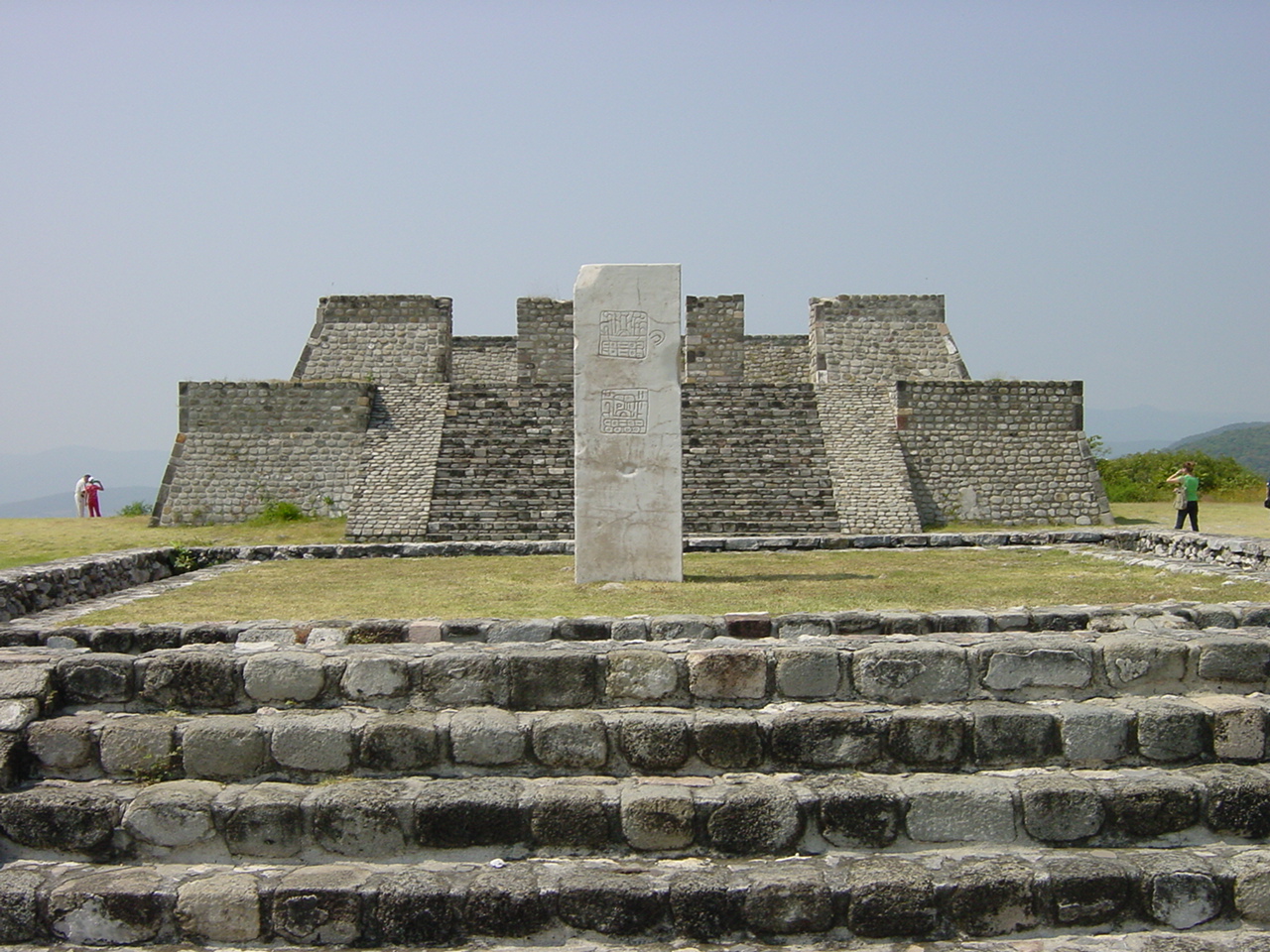
Photo: Maxtreiber · Public domain · Wikimedia Commons
Xochicalco is an UNESCO World Heritage Site. It is near Morelos, Mexico. Peaked roughly between the seventh and tenth centuries. The free Lokali audio guide runs 7 minutes.
✓ Published October 2026 · how we write these guides
Visitor facts
| Lokali audio guide | 7 min · free |
|---|---|
| Type | Archaeological Site |
| Location | Morelos, Mexico |
| Coordinates | 18.8043, -99.2966 |
| Languages | 50+, in the Lokali app |
The story
Listen first. Up here, the wind moves steadily across the hilltop. It carries dry grass, warm stone, and somewhere far below, a dog barking in a village. Under your feet, the ground is a mix of packed earth and grey volcanic rock, worn smooth by many visitors. All around you, the hills of Morelos roll away in shades of green and brown. This is Xochicalco, a city built on a mountain, and for a few centuries it was one of the most important places in central Mexico.
The name comes from Nahuatl, the language of the Aztecs. It is usually translated as "the place of the house of flowers." There is a twist, though. The Aztecs did not build this city. By the time they arrived in the region, Xochicalco had already been empty for centuries. They gave a name to ruins they found. So the people who actually lived here, and what they called their home, remain open questions for archaeologists today.
What we do know is the timing. Xochicalco reached its peak in what scholars call the Epiclassic period, roughly between the seventh and tenth centuries. That was an unsettled time. The great city of Teotihuacan, to the north near modern Mexico City, had lost its power. Its long trade networks were breaking apart. New regional centres rose to fill the gap, and Xochicalco was one of the strongest. It grew rich, connected, and very careful about defence.
Look at the shape of the land around you. The builders did not simply place a city on a hill. They reshaped the hill itself. They cut it into terraces, levelled platforms, and raised walls. They dug ditches and built ramparts along the slopes. Visitors climbing up today often feel this as tired legs and a racing heart. That effort was the point. An army approaching from below would face the same climb, under watch the whole way.
Now make your way toward the heart of the site, the main plaza near the top. Here stands the structure most people come to see: the Temple of the Feathered Serpent. It is not tall. It is low and wide, and you might walk past it if you did not know. But stop and look closely at its sides. They are covered in carved relief, and the carving is some of the finest in all of ancient Mexico.
Great feathered serpents wrap around the base of the building. Their bodies rise and fall in long, curving waves. Between the curves sit human figures, cross-legged, wearing large headdresses. Some of them have speech scrolls in front of their mouths, a symbol for words or song. The style mixes influences from far away. Specialists see links to the Maya world in the south, to Oaxaca in the southwest, and to Teotihuacan in the north.
Why would a city in Morelos mix all these styles? One popular interpretation is that the temple records a meeting. Scholars have suggested that the seated figures may be priests or calendar experts from different regions, gathered to agree on a shared calendar. This is a theory, not a proven fact. Still, the mix of styles fits the picture of Xochicalco as a crossroads, a place where ideas, goods, and people from many cultures came together.
Here is something many visitors miss. Look at the colour of the stone in the carvings. In places you may see faint traces of red. Ancient Mexican buildings were not grey, as we often imagine them. They were painted, often brightly. Picture this plaza with red walls, plastered floors, and painted serpents under a bright sky. The quiet ruin around you once looked loud, colourful, and very much alive.
Now for the second surprise, and it is underground. On the northern side of the site, the builders worked inside natural caves in the hill. One of these is known as the Observatory. A narrow vertical shaft runs down from the surface into a dark chamber. For part of the year, around the middle of the day, sunlight falls straight down this shaft. It makes a bright beam of light on the cave floor.
This effect is strongest around the days when the sun passes directly overhead at this latitude. That happens in May and again in late July. Between those dates the beam appears for a period of weeks, and then it fades. For a farming people, tracking the sun this precisely mattered. It helped mark the seasons for planting and harvest. Standing in that cool, dim chamber, you feel how closely these people watched the sky.
As you walk, count the ball courts. Xochicalco has more than one, which is unusual for a city of its size. The courts are long, narrow spaces shaped like a capital letter I, with sloping side walls. In some courts, a stone ring was set high on the wall. The ballgame was played across Mesoamerica, the cultural region stretching from central Mexico into Central America. It mixed sport, politics, and religion in ways we only partly understand.
The story of Xochicalco ends suddenly. Around the tenth century, the city was abandoned. Archaeologists have found signs of burning and destruction in several buildings. Whether this came from outside enemies, inside conflict, or both, is still debated. In 1999 the site was added to the UNESCO World Heritage list. Before you leave, the site museum at the entrance is worth time. It holds many carved pieces found here, close enough to study each line.
Before you head back down, find a quiet edge of the plaza and turn slowly in a full circle. Notice the valleys spreading out below, and the far hills in the haze. The people who lived here saw this same view every morning. Feel the stone under your hand, still warm from the sun. As you walk down the terraces, pay attention to each step. Every one of them was placed here by human hands.
Key facts
What to look for
Practical tips
Common questions
Is there a free audio guide to Xochicalco?
Yes — the Lokali app narrates Xochicalco free of charge in 50+ languages. The guide runs about 7 minutes, covers the history, what to look for on site and practical tips, and works offline once downloaded.
Where is Xochicalco?
Xochicalco is near Morelos, Mexico, at 18.8043, -99.2966. Tap the map link on this page for directions from where you are.
What is Xochicalco known for?
Peaked roughly between the seventh and tenth centuries. Name means place of the house of flowers.
What should you look for at Xochicalco?
Feathered serpents curving around the low temple base. Seated figures with speech scrolls before their mouths. Faint traces of red paint on carved stone.
What should you know before visiting Xochicalco?
Arrive early to climb the terraces before midday heat. Bring a hat, sunscreen, and plenty of water.
When is the best time to visit Xochicalco?
Arrive early to climb the terraces before midday heat.
On the map
Opens directions to Xochicalco from your location.
More to see near Xochicalco

Hear Xochicalco in your language
The full story, narrated, in 50+ languages. Download it before you go and it plays offline, at your own pace, with no ticket and no tour group.