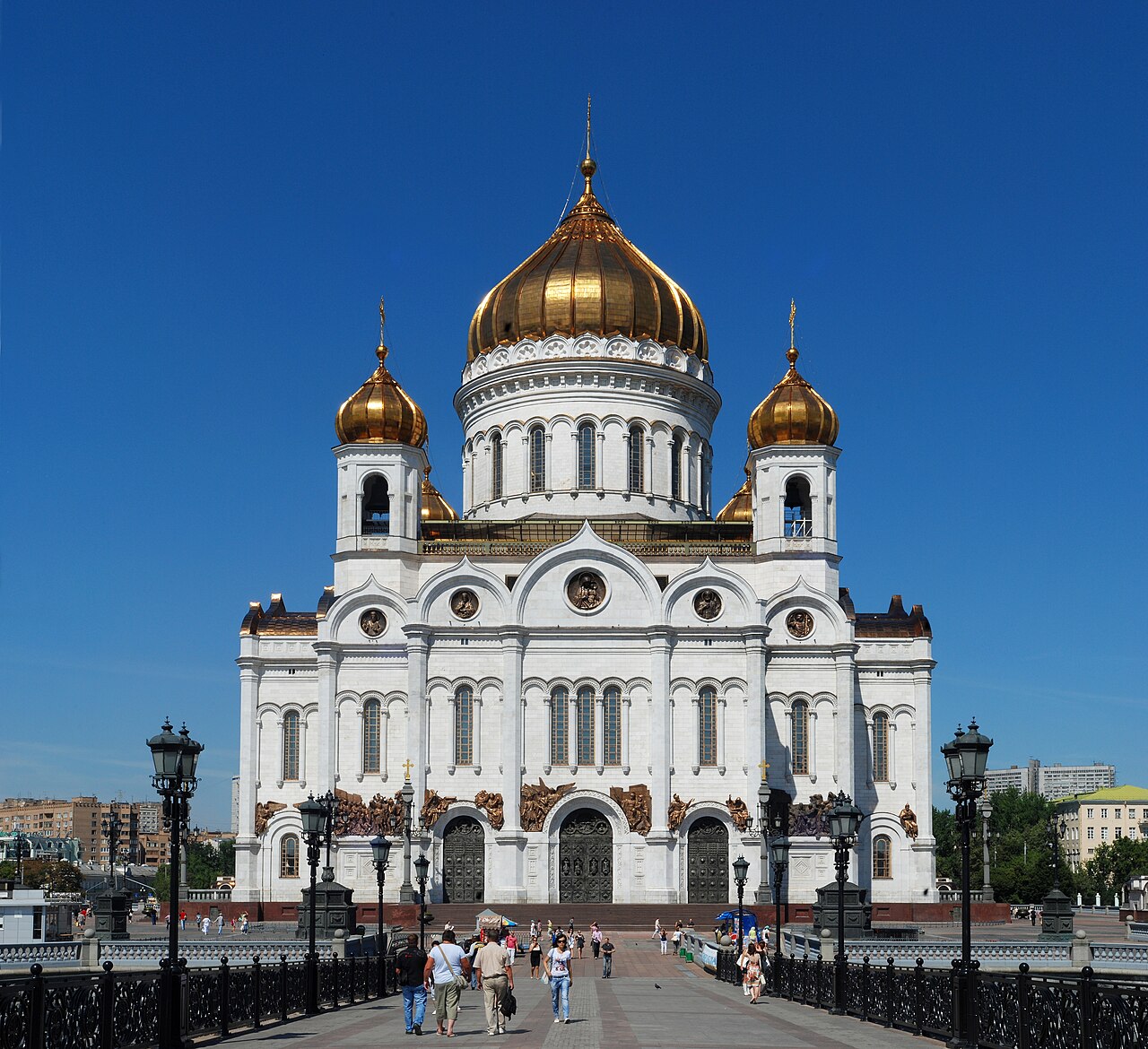
Christ the Saviour Cathedral
55.7393° N · 37.6061° E · Cathedral
Christ the Saviour Cathedral is a massive Russian Orthodox cathedral completed in 1997 on the banks of the Moskva River, rebuilt after Stalin's original 1883 structure was demolished in 1931. It is in Moscow, Russia. Most visitors spend 60–90 min here. The free Lokali audio guide runs 5 minutes.
✓ Verified August 2026 · how we write these guides
Visitor facts
| Time needed | 60–90 min |
|---|---|
| Lokali audio guide | 5 min · free |
| Type | Cathedral |
| Best for | Romantic |
| Location | Moscow, Russia |
| Coordinates | 55.7393, 37.6061 |
| Languages | 45, in the Lokali app |
The story
You walk along the river, and a wall of white stone rises ahead of you. Above it floats a golden dome, so bright in the sun that it seems to burn. Smaller domes cluster around it. Bells may be ringing as you arrive. This is the Cathedral of Christ the Saviour, and its story is one of loss and return.
The idea was born in war. In 1812, the army of Napoleon marched all the way to Moscow and was then driven back across the snow. To give thanks for that escape, the country made a vow to build a great church. It would stand as a monument to the soldiers who had fought and died to save the land.
Building such a church took decades of labor. The design came from the architect Konstantin Thon. Work began in 1839. Stone by stone, the walls climbed slowly beside the river. The cathedral was finally consecrated in 1883, more than seventy years after the war whose memory it was built to hold.
For a time it stood as the tallest Orthodox church in the world. Inside, the walls carried paintings by the leading artists of the age. Marble panels around the lower walls listed the battles and the names of fallen officers. The building was at once a place of prayer and a written record of the war against Napoleon.
There is even music tied to this place. The composer Tchaikovsky wrote his 1812 Overture to mark the same victory the church remembers. It ends with the roar of cannon fire and the wild ringing of bells. It was first meant to sound out here, in the open, beside the rising cathedral. When you hear those bells, picture this white building by the water.
Then came a sudden and violent turn. After the revolution, the new government wanted the land and rejected the faith the church stood for. In 1931 the cathedral was brought down with explosives. In a few moments, the work of decades fell into rubble and dust. The state planned to raise an enormous tower on the cleared site.
That tower, the Palace of the Soviets, was never finished. The foundations by the river kept flooding. Then war interrupted the work entirely. For years the great empty hole simply sat there. In the end, the site became something far humbler — a large, round, open-air swimming pool, heated against the cold.
People swam here for decades, in the very place where the altar had once stood. Steam rose from the warm water through the winter air. Few of those who came for a swim could picture the huge church that had once filled the sky above them. For a whole generation, the cathedral lived on only in old photographs.
Then the country changed once again. In the 1990s, a decision was made to rebuild the church. Money was gathered from the state and from countless ordinary people. Using the old drawings and photographs, builders raised the cathedral once more on its first site. The new church was completed in 2000, close to a faithful copy of the lost one.
So the building in front of you is at once very old and very new. Its shape is the design from the nineteenth century. Yet its stones were laid within living memory, by people who may still walk past it today. Circle the walls, and you are circling a structure that was destroyed, mourned for years, and then called back into being.
Step inside, if the doors are open. The space lifts your eyes up into a vast dome far overhead. Light falls from the high windows onto gold and painted figures along the walls. The sheer scale is meant to make a single person feel small. Voices and quiet footsteps echo upward and lose themselves in the height.
There is a viewing platform set high on the building. From up there you can look out over the river, the towers of the Kremlin, and the spreading roofs of the city. The cathedral stands at a bend in the water, in clear view from many of the bridges and streets around it. After dark, light washes up the white stone and the dome glows above the water.
So stand here a moment and take in the white walls and the gold above them. This place was lost within a single lifetime and rebuilt within the next. It is a quiet reminder that even what seems most solid can fall — and that what is gone is not always gone for good.
Key facts
What to look for
Practical tips
Common questions
How long do you need at Christ the Saviour Cathedral?
Plan 60–90 min. That is the time most visitors spend at Christ the Saviour Cathedral. The free Lokali audio guide adds about 5 minutes of narration you can listen to as you walk, so it fits inside your visit rather than adding to it.
Is there a free audio guide to Christ the Saviour Cathedral?
Yes — the Lokali app narrates Christ the Saviour Cathedral free of charge in 50+ languages. It covers the history, what to look for on site and practical tips, and it works offline once downloaded.
Where is Christ the Saviour Cathedral?
Christ the Saviour Cathedral is in Moscow, Russia, at 55.7393, 37.6061. Tap the map link on this page for directions from where you are.
What should you know before visiting Christ the Saviour Cathedral?
Dress modestly to enter the working church.
What is Christ the Saviour Cathedral known for?
The cathedral honors the 1812 victory over Napoleon.
What is the best time to visit Christ the Saviour Cathedral?
The interior is a forest of white marble columns and gilded iconostasis.
On the map
Opens directions to Christ the Saviour Cathedral from your location.
More to see in Moscow


Hear Christ the Saviour Cathedral in your language
The full story, narrated, in 50+ languages. Download it before you go and it plays offline, at your own pace, with no ticket and no tour group.