
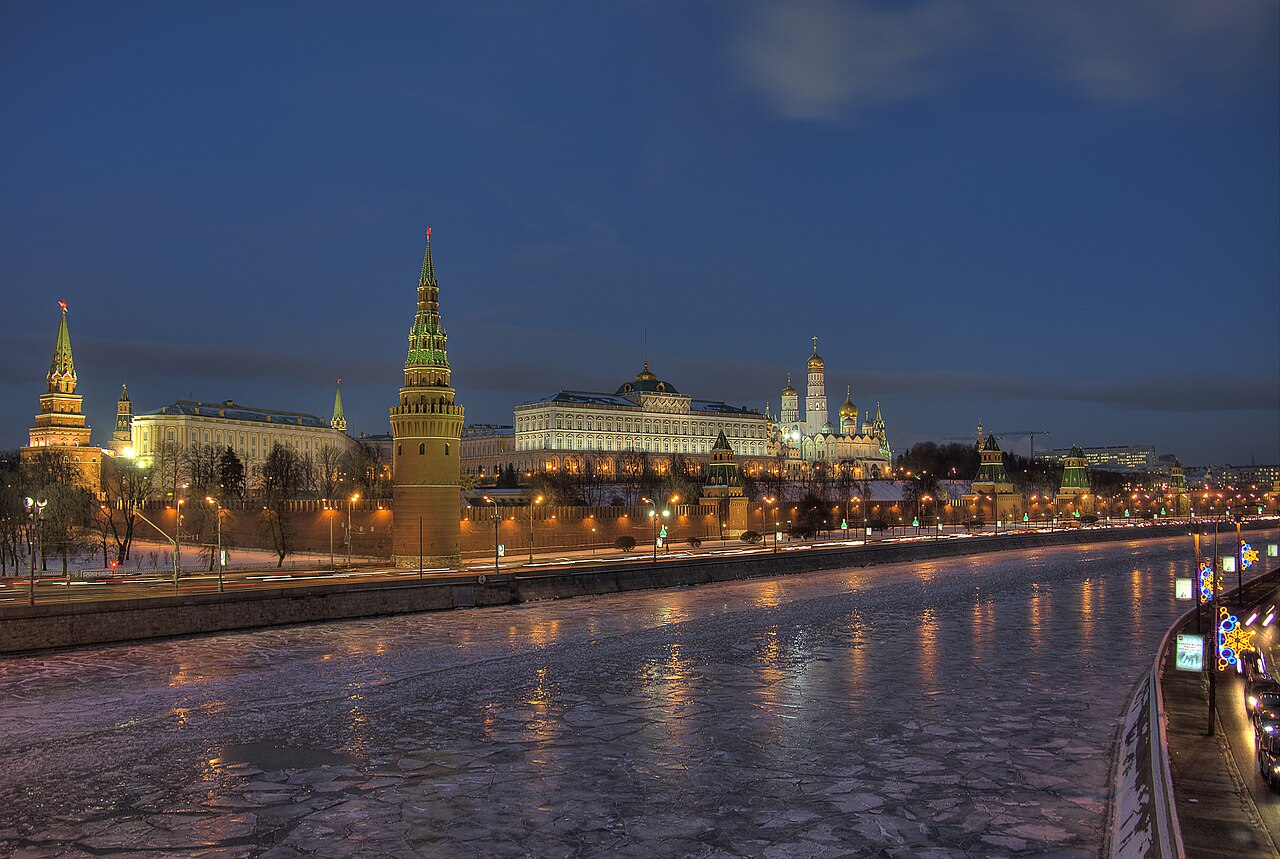
Photo: A.Savin · CC BY-SA 3.0 · Wikimedia Commons
Grand Kremlin Palace is a palace. It is in Moscow, Russia. Built between 1838 and 1849 under Emperor Nicholas I. The free Lokali audio guide runs 7 minutes.
✓ Published October 2026 · how we write these guides
Visitor facts
| Lokali audio guide | 7 min · free |
|---|---|
| Type | Palace |
| Location | Moscow, Russia |
| Coordinates | 55.7500, 37.6158 |
| Official website | kreml.ru |
| Languages | 50+, in the Lokali app |
The story
Stand still for a moment and listen. Behind you, the cathedral bells may be ringing over Cathedral Square. In front of you, a long pale wall in yellow and white runs along the hill above the Moskva River. Its windows sit in neat, repeating rows, and the stone trim catches the light like icing on a cake. This is the Grand Kremlin Palace. It is one of the largest buildings inside the Kremlin walls, and one of the least visited.
That last point matters. Most people who come to the Kremlin walk past this palace on their way to the cathedrals and the Armoury. They glance up, take a photograph, and move on. The palace is still a working state building. It serves as an official ceremonial residence of the Russian president, and its doors open to the public only rarely, through special arrangements. So for most visitors, the experience is exactly this — standing outside, looking in, and imagining.
Let us start with when and why it was built. The palace went up in the middle of the nineteenth century, during the reign of Emperor Nicholas I. Construction began in 1838 and the main work finished in 1849. By then, the capital of the Russian Empire had long since moved to Saint Petersburg. Yet the emperors still came to Moscow for coronations and grand occasions. Nicholas wanted a residence here that matched the dignity of the old capital.
The architect was Konstantin Thon. His name may sound unfamiliar, but his work shaped Moscow. Thon also designed the Cathedral of Christ the Saviour, the large gold-domed church you can see downriver. Nicholas I favoured Thon because his style fit the emperor's political ideas. Those ideas stressed Orthodox faith, autocracy, and a strong sense of Russian national identity. Thon translated that programme into stone.
His style is often called Russian Revival, or Russo-Byzantine. In simple terms, it means a nineteenth-century building that borrows decoration from old Russian churches and palaces. Look at the windows. Many have carved frames with small arches and hanging stone pendants. These details echo the medieval architecture of Moscow, but they are arranged with the strict symmetry of a European palace. The result is a blend — a classical body dressed in Russian ornament.
Here is a detail most visitors miss. Count the rows of windows on the main facade. You will probably count three floors. In fact, the building has only two main storeys. The upper floor holds tall ceremonial halls, and each of those halls has two rows of windows, one above the other. From outside, the eye reads three levels. Inside, the great rooms rise through two rows of light.
The palace did not appear on empty ground. An earlier palace stood on this site, designed in the eighteenth century by Bartolomeo Rastrelli, the architect famous for the Winter Palace in Saint Petersburg. That older building was damaged and altered over time, and it was taken down to make room for Thon's design. So the hill you see has hosted royal residences for a very long time.
The new palace also connects to much older buildings. Thon's complex links to the Terem Palace, where the tsars lived in the seventeenth century, with its low vaulted rooms and painted walls. It also links to the Palace of Facets, a fifteenth-century hall named for the faceted stone blocks on its outer wall. Walking from one part to another inside, a guest moves through several centuries of Russian royal life under one connected roof.
Now to the halls themselves, which are the real treasure of the building. Several of the grand rooms are named after orders of chivalry of the Russian Empire — the Order of Saint George, Saint Andrew, Saint Alexander, Saint Vladimir, and Saint Catherine. Each hall carries the colours and symbols of its order. The idea was simple. Walking through the palace meant walking through the honours of the empire.
The most famous of these rooms is Saint George Hall. It is white and gold, long and bright, with tall columns and heavy chandeliers. On its walls, marble plaques carry the names of military units and of knights who received the Order of Saint George. Today the hall is used for state receptions and award ceremonies. When you see Russian official events on television, there is a good chance you are looking at this room.
The twentieth century changed the palace sharply. After the revolution, the Soviet government took over the Kremlin. In the 1930s, two of the imperial halls, Saint Andrew and Saint Alexander, were combined into one large meeting hall for the Supreme Soviet, the Soviet parliament. Much of the original decoration disappeared. In the 1990s, after the Soviet Union ended, a major restoration recreated those two halls in their imperial form. So part of what guests see inside today is a careful reconstruction.
That history gives the building a layered quality. It was built for emperors, used by Soviet leaders, and now hosts presidential inaugurations and visiting heads of state. The same walls have served three very different systems of power. Standing here, it is worth thinking about how buildings outlive the governments that commission them. The stone stays, while the people inside keep changing.
For the best overall view, many visitors cross the Bolshoy Kamenny Bridge or walk along the embankment on the far side of the river. From there, the palace stretches along the top of the Kremlin hill, framed by the red walls below and the golden domes of the cathedrals above. In late afternoon, the low sun warms the pale facade. At night, floodlights make the long row of windows glow against the dark sky.
Before you move on, take one more look at the facade in front of you. Find the double rows of windows and remember the two-storey secret. Notice how the carved stone frames repeat, one after another, all along the wall. Somewhere behind them, the white and gold of Saint George Hall waits for its next ceremony. And as you walk toward the cathedrals, listen again for the bells. They were ringing here long before this palace was built, and they will ring long after you leave.
Key facts
What to look for
Practical tips
Common questions
Is there a free audio guide to Grand Kremlin Palace?
Yes — the Lokali app narrates Grand Kremlin Palace free of charge in 50+ languages. The guide runs about 7 minutes, covers the history, what to look for on site and practical tips, and works offline once downloaded.
Where is Grand Kremlin Palace?
Grand Kremlin Palace is in Moscow, Russia, at 55.7500, 37.6158. Tap the map link on this page for directions from where you are.
What is Grand Kremlin Palace known for?
Built between 1838 and 1849 under Emperor Nicholas I. Designed by Konstantin Thon, architect of Christ the Saviour.
What should you look for at Grand Kremlin Palace?
Double rows of windows that fake a third storey. Carved window frames with small arches and stone pendants. Pale yellow walls set against white stone trim.
What should you know before visiting Grand Kremlin Palace?
Expect to view the palace mostly from outside. Enter the Kremlin grounds with a separate Kremlin ticket.
On the map
Opens directions to Grand Kremlin Palace from your location.
More to see in Moscow



Hear Grand Kremlin Palace in your language
The full story, narrated, in 50+ languages. Download it before you go and it plays offline, at your own pace, with no ticket and no tour group.