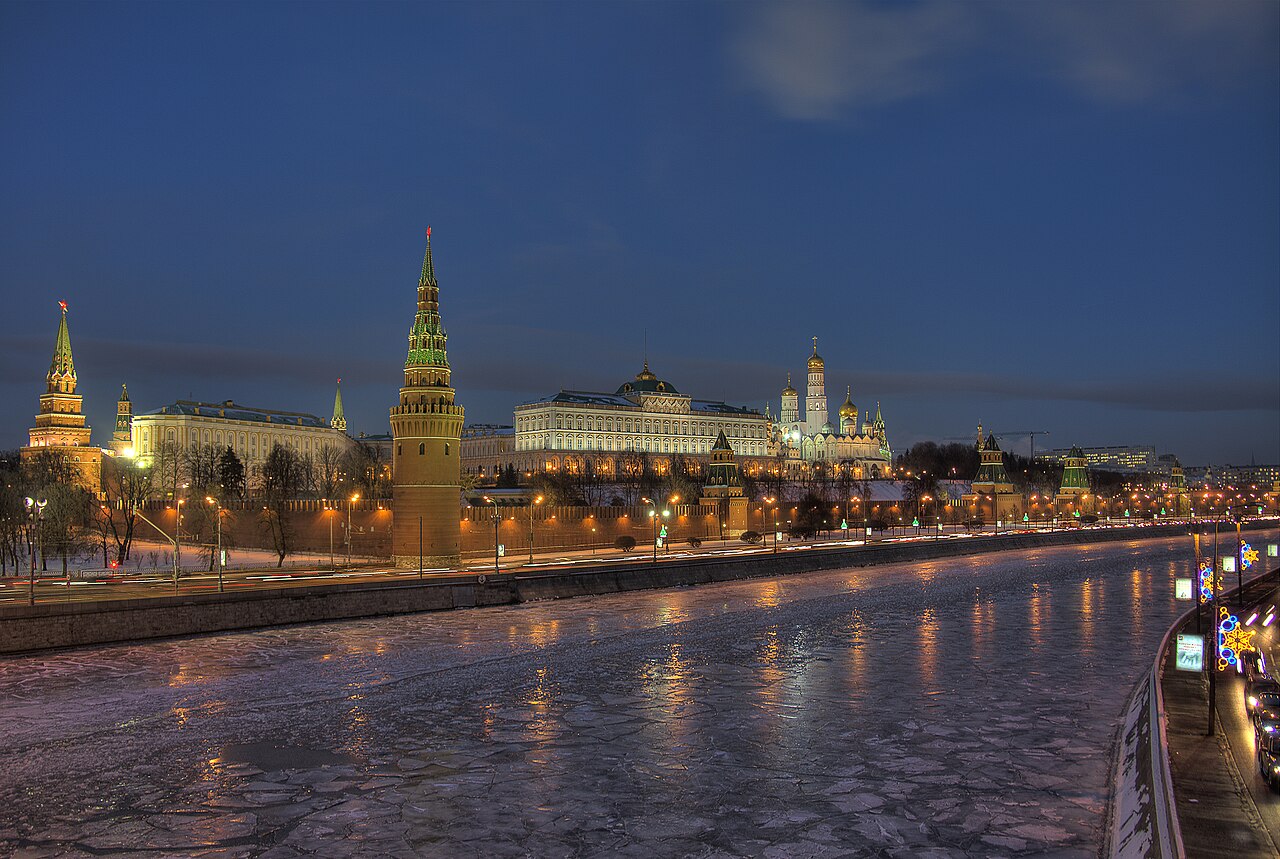
Moscow Kremlin is a fortress in Moscow, Russia. Walls rebuilt by Italian architects in the late fifteenth century. Cathedral Square holds five golden-domed churches. Most visitors spend 2-4 hours here. The free Lokali audio guide runs 7 minutes.
✓ Verified October 2026 · how we write these guides
Visitor facts
| Time needed | 2-4 hours |
|---|---|
| Lokali audio guide | 7 min · free |
| Type | Fortress |
| Best for | History |
| Location | Moscow, Russia |
| Coordinates | 55.752, 37.6175 |
| Languages | 45, in the Lokali app |
The story
Stand at the edge of Red Square and feel the weight of the cobblestones beneath your feet — these are the same stones that have borne the tread of tsars, revolutionaries, and countless ordinary Muscovites across five centuries. The fortress rising before you is not a single building but a walled city within a city, twenty hectares of palaces, cathedrals, and armories enclosed by two kilometres of crenellated brick wall.
The word kremlin simply means fortified citadel, and dozens of Russian towns have one. But this kremlin became the heart of an empire. The first wooden fort stood here in 1156, when Moscow was barely a trading post on the Moskva River. What you see now took shape in the late fifteenth century, when Ivan the Third hired Italian architects — Pietro Antonio Solari and Marco Ruffo among them — to rebuild the walls in brick. They brought Renaissance engineering to a medieval Russian stronghold, and the result is this strange hybrid: towers with names like Spasskaya and Borovitskaya, crowned with pointed tent roofs added in the seventeenth century, their red brick weathered to a deep russet.
Walk along the western wall and you will pass the Kutafya Tower, the only surviving bridgehead tower, squat and round where the others are tall and square. Beyond it, the Trinity Gate opens onto the administrative heart of the complex. The yellow neoclassical building with white columns is the Senate, built for Catherine the Great in the seventeen-eighties and now the official residence of the Russian president. The green copper dome you see rising behind it belongs to the Senate's rotunda, invisible from most angles but a landmark from the air.
The religious core of the Kremlin clusters around Cathedral Square, a cobbled plaza ringed by five golden-domed churches. The largest is the Assumption Cathedral, its five helmet domes gleaming with gold leaf, where tsars were crowned for four centuries. Step inside — if it is open to visitors — and the interior is a blaze of frescoes, floor to ceiling, no bare wall left unpainted. The iconostasis is five tiers high, and the air smells faintly of incense and old wood. Ivan the Terrible married here seven times. Napoleon used it as a stable in 1812, and the Soviets turned it into a museum in 1918.
Beside it stands the Archangel Cathedral, burial place of the tsars before Peter the Great moved the capital to Saint Petersburg. Fifty-four tombs lie beneath the floor, including Ivan the Terrible's, marked by a simple stone slab. The third cathedral, the Annunciation, was the private chapel of the royal family, smaller and more intimate, its floors paved with jasper brought from the Urals.
The Ivan the Great Bell Tower dominates the square, a white octagonal column eighty-one metres tall. For centuries it was the tallest structure in Moscow — a law forbade building anything higher — and it served as a watchtower, its bells ringing to warn of fire or invasion. The largest bell, the Assumption Bell, weighs sixty-four tonnes and hangs in the upper tier. At the tower's base sits the Tsar Bell, a bronze monster weighing two hundred tonnes, cast in the seventeen-thirties and cracked in a fire before it ever rang. A piece the size of a doorway broke off, and the bell has sat silent on its stone pedestal ever since, more sculpture than instrument.
Nearby, the Tsar Cannon squats on a cast-iron carriage, its barrel wide enough to crawl into. It was cast in 1586, designed to fire grapeshot at invaders storming the Kremlin gates, but no evidence suggests it was ever used in battle. The cannonballs stacked beside it are decorative, cast in the nineteenth century, too large to fit the bore.
The Great Kremlin Palace stretches along the southern wall, a sprawling neoclassical complex built in the eighteen-forties for Nicholas the First. Its facade is seven hundred metres long, painted pale yellow, with rows of white pilasters and a balcony overlooking the river. Inside are the state reception halls — the Saint George Hall, the Saint Alexander Hall — where modern Russia holds official ceremonies. Tourists do not enter, but you can glimpse the scale from the outside, the sheer ambition of a building designed to awe visiting diplomats.
The Armoury Museum, housed in a separate building near the Borovitskaya Tower, holds the imperial treasury: Fabergé eggs, coronation gowns, thrones inlaid with ivory and turquoise, carriages that carried Catherine the Great through the snow. The collection is vast and overwhelming, room after room of objects that once signified absolute power and now sit behind glass, beautiful and inert.
The Kremlin's role has shifted with every century. It was a fortress, then a royal residence, then the seat of Soviet power — Lenin governed from here, Stalin lived in a modest apartment inside the walls. The red stars that top the towers replaced the imperial eagles in 1935, each star five metres across, lit from within at night. The Soviet era stripped the Kremlin of much of its religious function, but the cathedrals survived, preserved as museums, and since the nineteen-nineties some have returned to active worship.
Walk the perimeter along the Alexander Garden on the western side, where the Tomb of the Unknown Soldier sits beneath the Kremlin wall, an eternal flame burning for soldiers who died in the Second World War. The changing of the guard happens every hour, a choreographed ritual of slow, high-stepping marches. Muscovites bring flowers, especially on Victory Day in May, and the scent of carnations mixes with the smell of lime trees in summer.
As you leave, look back at the Spasskaya Tower, the main gate facing Red Square, its clock face four storeys tall. The clock chimes every quarter hour, and at noon and midnight it plays a melody — the Kremlin's heartbeat, audible across the square. The red star on top glows against the evening sky, and the walls, floodlit after dark, turn the colour of dried blood. This is the image the world knows, the postcard Moscow, but standing here in person you feel something the photographs never capture: the weight of the place, the layers of history compressed into stone, the sense that power, however it shifts, always returns to this hill above the river.
Key facts
What to look for
Practical tips
Common questions
How long do you need at Moscow Kremlin?
Plan 2-4 hours. That is the time most visitors spend at Moscow Kremlin. The free Lokali audio guide runs 7 minutes and is made to listen to while you walk.
Is there a free audio guide to Moscow Kremlin?
Yes — the Lokali app narrates Moscow Kremlin free of charge in 50+ languages. No ticket, tour group or subscription, and it works offline once downloaded.
Where is Moscow Kremlin?
Moscow Kremlin is in Moscow, Russia, at 55.752, 37.6175. Tap the map link on this page for directions.
What should you know before visiting Moscow Kremlin?
Visit Cathedral Square early to avoid crowds inside churches
What is Moscow Kremlin known for?
Walls rebuilt by Italian architects in the late fifteenth century
What is the best time to visit Moscow Kremlin?
Visit Cathedral Square early to avoid crowds inside churches
On the map
Opens directions to Moscow Kremlin from your location.
More to see in Moscow


Hear Moscow Kremlin in your language
The full story, narrated, in 50+ languages. Download it before you go and it plays offline, at your own pace, with no ticket and no tour group.