
Photo: Matthäus Merian · Public domain · Wikimedia Commons
Kitay-gorod is a historical district of Moscow. Kitay-gorod's wall was built in the 1530s. The free Lokali audio guide runs 7 minutes.
✓ Published October 2026 · how we write these guides
Visitor facts
| Lokali audio guide | 7 min · free |
|---|---|
| Type | Historic District |
| Location | Moscow, Russia |
| Coordinates | 55.7558, 37.6239 |
| Languages | 50+, in the Lokali app |
The story
Start with the ground under your feet. The pavement here slopes gently, rising toward the Kremlin and falling away toward the Moskva River. Around you, bells from small churches mix with traffic and the click of shoes on stone. This is Kitay-gorod, one of the oldest districts of Moscow. For centuries it was the city's busiest trading quarter, crowded into a tight knot of streets just east of Red Square.
First, the name. Kitay is the modern Russian word for China, so many visitors assume this was a Chinese quarter. It was not. Historians still debate where the name comes from. One theory links it to an old word for bundles of wooden poles, used to build early defences. Another points to a Turkic word for a fortress. Nobody knows for certain. But almost all scholars agree that China has nothing to do with it.
What is certain is the wall. In the 1530s, during the regency of Elena Glinskaya, the mother of the young Ivan the Terrible, Moscow built a brick wall around this trading quarter. An Italian architect, known in Russian sources as Petrok Maly, directed the work. The wall was thick and low, built for cannon rather than archers. It joined the Kremlin walls and wrapped the merchants, their warehouses and their churches in a second ring of protection.
That wall stood for about four hundred years. Then, in the 1930s, the Soviet authorities pulled most of it down to widen streets for traffic. Today only fragments survive. You can find one long stretch near the Metropol Hotel, close to Teatralnaya Square. Another section stands near the Kitay-gorod metro station. Run your eye along the old red brick, and you can still imagine the full circuit that once closed this district off.
Three old streets run through the heart of the quarter, roughly parallel, all heading east from Red Square. Their names are Nikolskaya, Ilyinka and Varvarka. Each one takes its name from a church — Saint Nicholas, the Prophet Elijah, and Saint Barbara. Each street also developed its own character. One became the street of books and learning. One became the street of money. And one became the street of foreign merchants and old boyar families.
Nikolskaya was the street of books. In the sixteenth century, the state Printing Yard stood here. In 1564, Ivan Fyodorov and his partner printed the Apostol, a book of New Testament texts, which is often called the first precisely dated printed book in Moscow. Later, the same street held the Slavic Greek Latin Academy, one of the earliest higher schools in Russia. The scientist and poet Mikhail Lomonosov studied there as a young man, after walking to Moscow from the far north.
Today, Nikolskaya is a pedestrian street, often hung with lights overhead. Look for the building of the old Printing Yard, with its pale facade and Gothic-style details. It looks oddly Western for Moscow, and that is a small surprise in itself. Nearby stands the Zaikonospassky Monastery, whose name means roughly the Saviour behind the Icons. Icon sellers once traded in the rows outside its walls.
Ilyinka, the middle street, was the street of money. In the nineteenth century, banks, trading houses and the Moscow stock exchange gathered here. Walk along it and notice the heavy facades, the columns, the large windows of former banking halls. Many of these buildings still house government offices and financial institutions. Some of the power simply stayed in place, even after empires and political systems changed around it.
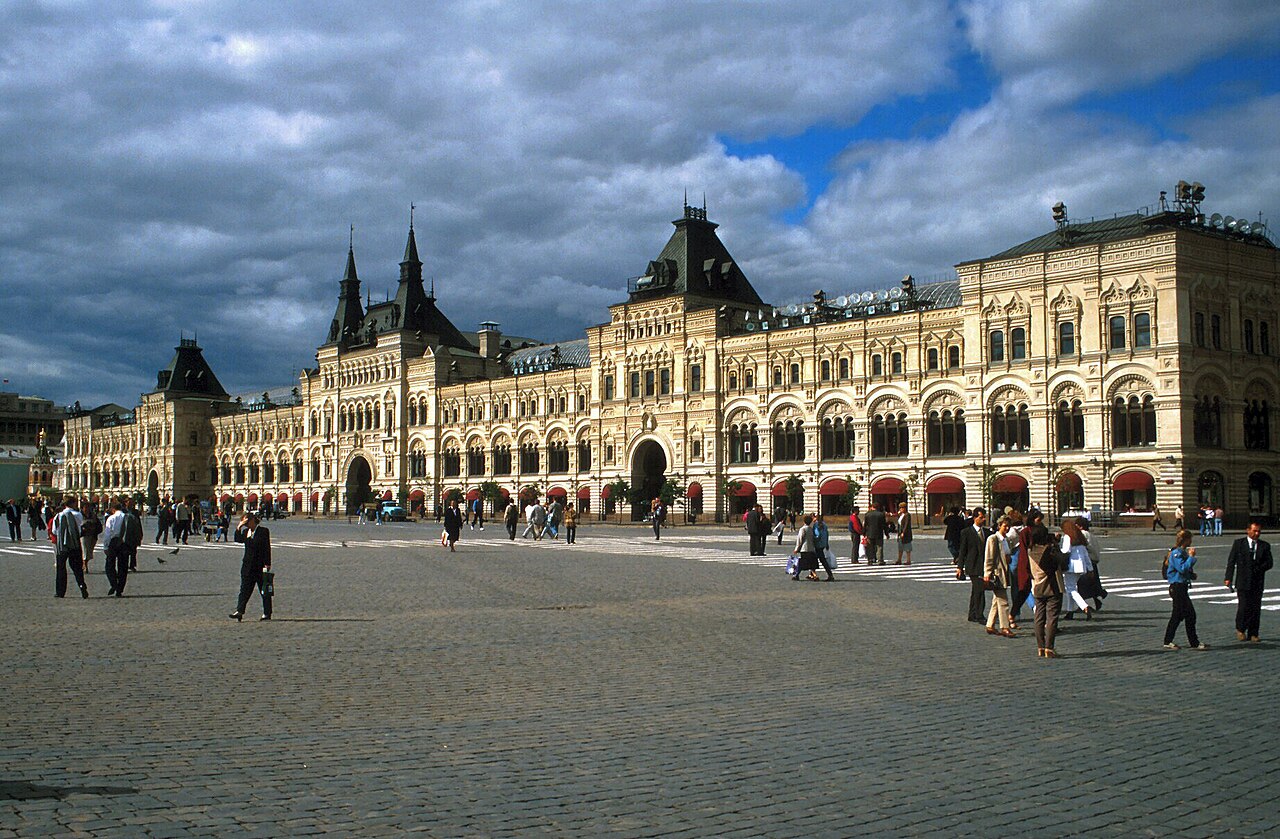
At the corner of Ilyinka and Varvarka stands Gostiny Dvor, a huge trading arcade with long rows of columns. The name means the merchants' court. For generations, traders from other cities and other countries stored and sold goods in courtyards like this one. The building you see today was built much later than the original market, but it keeps the same purpose in its shape: a great open space for buying and selling.
Now the third street — Varvarka. This is perhaps the most surprising street in Kitay-gorod. Along one side, a row of small churches and old stone houses stands in a line. They survived because the Soviet authorities treated them as protected monuments, even as the buildings around them disappeared. Among them are the Church of Saint Barbara, the Church of Saint George, and the Znamensky Monastery with its green domes.
Here is a detail most visitors miss. One modest white building on Varvarka is known as the Old English Court. In the sixteenth century, Ivan the Terrible gave it to English merchants of the Muscovy Company, who traded in furs, wax, rope and cloth. It became one of the first permanent bases of English diplomacy and trade in Russia. A short walk away stand the Chambers of the Romanov Boyars, linked by tradition to the family that later took the Russian throne.
Behind Varvarka, the landscape opens up. For decades, the enormous Rossiya Hotel stood here, a massive Soviet block with thousands of rooms. It was demolished in the 2000s. In its place, Moscow opened Zaryadye Park in 2017. The park mixes meadow, forest and wetland plantings, and it has a floating bridge that reaches out over the river. From there, you can look back at the churches of Varvarka against the Kremlin towers.
Before you leave, find Tretyakovsky Proezd, a short passage near Nikolskaya. Its arched gateway was built in the nineteenth century by the Tretyakov family, the same merchants who founded the famous art gallery. They cut the passage through the old wall to make it easier for shoppers to reach the market streets. Today the lane holds expensive boutiques, which suits its history. It was always a doorway for trade.
Stand still for a moment and look around. In one view, you may see a church from centuries ago, a nineteenth-century bank, and a modern shop window. The wall that once enclosed all this is mostly gone, but the street plan remains almost the same. As you walk away, listen for the bells again. They still mark time in a quarter that has bought, sold, prayed and argued here for nearly five hundred years.
Key facts
What to look for
Practical tips
Common questions
Is there a free audio guide to Kitay-gorod?
Yes — the Lokali app narrates Kitay-gorod free of charge in 50+ languages. The guide runs about 7 minutes, covers the history, what to look for on site and practical tips, and works offline once downloaded.
Where is Kitay-gorod?
Kitay-gorod is in Moscow, Russia, at 55.7558, 37.6239. Tap the map link on this page for directions from where you are.
What is Kitay-gorod known for?
Kitay-gorod's wall was built in the 1530s. An Italian architect, Petrok Maly, directed the wall's construction.
What should you look for at Kitay-gorod?
Red brick wall fragment near the Metropol Hotel. Gothic-style facade of the old Printing Yard. Green domes of the Znamensky Monastery on Varvarka.
What should you know before visiting Kitay-gorod?
Walk Nikolskaya, Ilyinka and Varvarka as one loop. Start at Red Square and finish in Zaryadye Park.
On the map
Opens directions to Kitay-gorod from your location.
More to see in Moscow



Hear Kitay-gorod in your language
The full story, narrated, in 50+ languages. Download it before you go and it plays offline, at your own pace, with no ticket and no tour group.