
Maly Theatre
55.7597° N · 37.6206° E · Tourist Attraction
Photo: Kopchiowski O.P. · CC BY 2.5 · Wikimedia Commons
Maly Theatre is a theatre company in Moscow, Russia. Maly means small, in contrast to the Bolshoi, meaning big. The free Lokali audio guide runs 7 minutes.
✓ Published October 2026 · how we write these guides
Visitor facts
| Lokali audio guide | 7 min · free |
|---|---|
| Type | Tourist Attraction |
| Location | Moscow, Russia |
| Coordinates | 55.7597, 37.6206 |
| Official website | maly.ru |
| Languages | 50+, in the Lokali app |
The story
Stand for a moment on the edge of Theatre Square and listen. Traffic hums along the wide boulevards, fountains splash somewhere behind you, and footsteps cross the paving stones in every direction. In front of you rises a pale, columned facade, calm and classical. This is the Maly Theatre, one of the oldest drama stages in Russia. It does not shout for attention. It simply stands here, as it has for two centuries, waiting for the evening crowd to arrive.
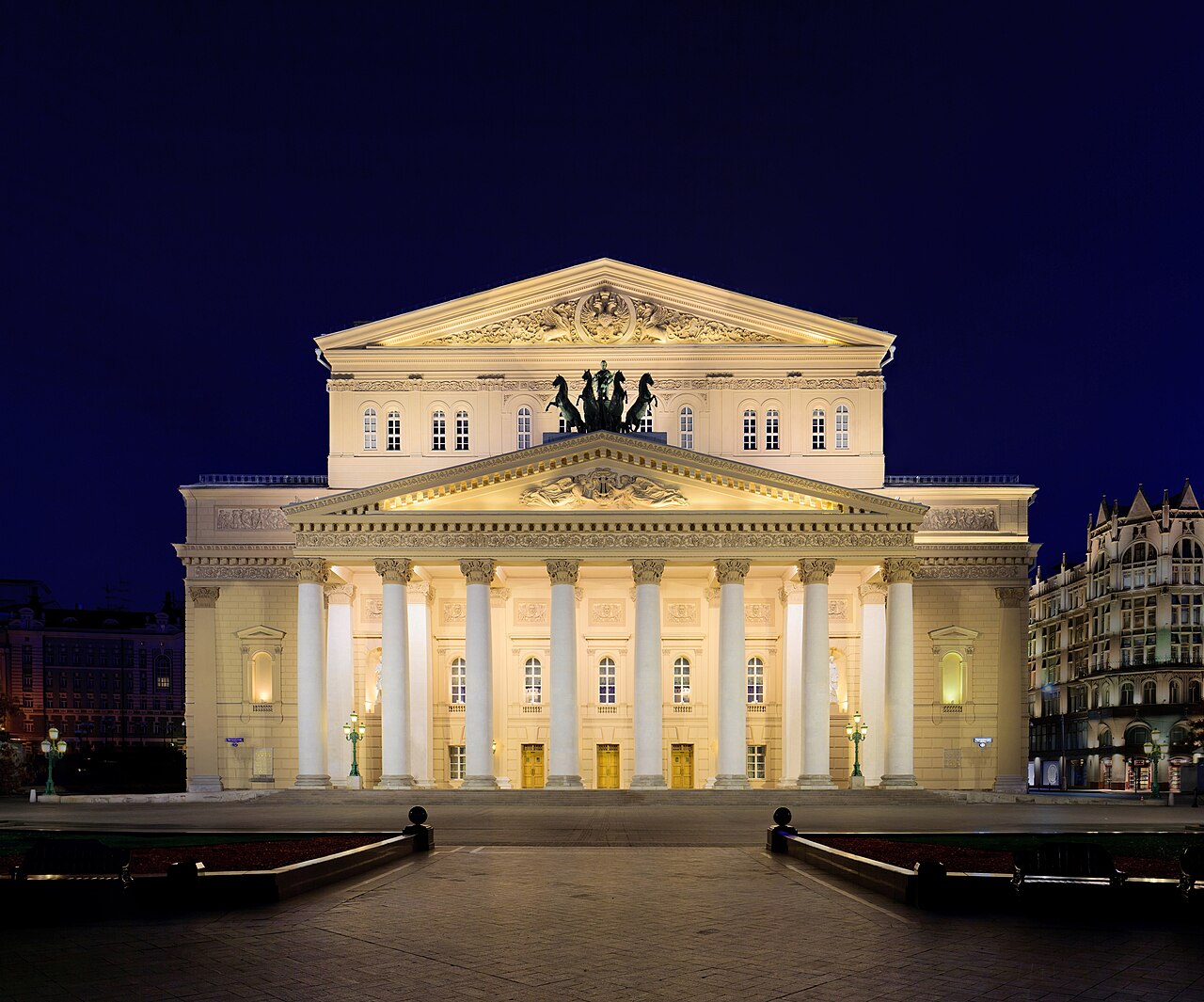
The name itself carries a small joke, and many visitors miss it. Maly means small in Russian. Now look across the square. That much larger building with the bronze chariot on top is the Bolshoi, and Bolshoi means big. So you are standing between the Big Theatre and the Small Theatre. The names describe size, not importance. For generations, Moscow treated these two houses as partners, one for opera and ballet, the other for the spoken word.
The Maly traces its roots to the middle of the eighteenth century. Its early troupe grew out of theatrical activity connected to Moscow University, and the company often cites 1756 as its founding year. At first the actors had no permanent home. They moved between stages and private houses. A drama company without its own walls was common in that era. What made this one different was how long it lasted, and how much it shaped the way Russians learned to act.
The building you see came later, in the 1820s. After the great fire of 1812, when much of Moscow burned during Napoleon's invasion, the city rebuilt its centre on a grand, orderly plan. The architect Osip Bove, who reshaped much of this area, adapted an existing merchant's house into a theatre. It opened in 1824. That is why the facade feels more like a dignified mansion than a palace of spectacle. It was a home turned into a stage.
Look closely at the architecture. The style is Russian Empire classicism, a local version of the Neoclassical fashion that spread across Europe after the French Revolution. It borrows from ancient Greece and Rome: columns, clean horizontal lines, restrained ornament. The building has been repaired and reconstructed several times since the nineteenth century. Yet the basic character stays the same. It is measured and serious, as if the theatre wants you to listen rather than stare.
Now turn your attention to the seated figure in front of the entrance. This is Alexander Ostrovsky, the great Russian playwright of the nineteenth century. The statue is the work of the sculptor Nikolai Andreyev and was unveiled in 1929. Ostrovsky sits in a heavy chair, wrapped in a robe, gazing calmly ahead. He looks less like a monument and more like a man who has just stepped out for some air between rehearsals. Notice how relaxed his posture is.
Ostrovsky's bond with this theatre was deep. Most of his plays had their premieres on the Maly stage. He wrote about merchants, clerks, widows, and dreamers, the ordinary people of Moscow, with sharp humour and real sympathy. Because of this long partnership, the Maly is still called the House of Ostrovsky. His plays remain in the repertoire today. When you watch one here, you are seeing his work performed where it was first spoken aloud.
Here is a second surprise. In the nineteenth century, Muscovites gave the Maly another nickname: the second Moscow University. The idea was that an evening here could educate you as much as a lecture hall. Audiences came to hear the Russian language spoken with clarity and feeling. Students, writers, and ordinary townspeople filled the seats. For many of them, the theatre was a place to think about society, morality, and their own lives.
Much of that reputation came from the actors. Mikhail Shchepkin, who began life as a serf, became one of the founders of realistic acting in Russia. He pushed performers away from stiff, declamatory speech toward natural behaviour on stage. Later, Maria Yermolova became the great tragic actress of her age, adored by Moscow audiences. Pavel Mochalov was famous for his passionate, unpredictable performances. Their names still carry weight in Russian theatre schools.
Think about what this means for the art of acting more broadly. Long before the famous methods of the twentieth century, actors on this stage were already asking a simple question. How does a real person speak, move, and feel? The Maly answered with a tradition of careful attention to the text and to living speech. That tradition is often described as conservative. Here, though, conservative means faithful, a deliberate choice to protect a way of performing.
The theatre has seen Moscow change around it many times. Empires, revolution, war, and rebuilding all passed across this square. Through all of it, the Maly kept performing, keeping the classics alive while also staging new work. Today the company also uses a second stage elsewhere in the city. But this building remains the heart of it. The facade you are looking at has welcomed audiences through almost every chapter of modern Russian history.
If you go inside for a performance, notice the atmosphere. The auditorium follows the traditional horseshoe shape, with tiers of boxes rising around the stalls. Red and gold dominate the interior. Before the curtain rises, the hall fills with quiet conversation and the rustle of programmes. Performances are in Russian, so it helps to know the story beforehand. Even without the language, the rhythm of the voices and the precision of the staging can hold your attention.
Before you leave, take a slow walk around the square. To one side is the Bolshoi, to another the Russian Academic Youth Theatre. Together they make this one of the great theatre districts of Europe. In the evening, the facades light up, and the crowds gather near the doors. Stand by Ostrovsky's statue for a minute and simply watch people arrive.
So look once more at the pale columns and the quiet figure in his chair. The small theatre has outlasted many larger ambitions. Its strength was never size. It was the voice, the human voice speaking clearly to a room full of listeners. As you walk away across the square, listen to the city around you. Somewhere behind those walls, someone is rehearsing a line, and trying to make it sound true.
Key facts
What to look for
Practical tips
Common questions
Is there a free audio guide to Maly Theatre?
Yes — the Lokali app narrates Maly Theatre free of charge in 50+ languages. The guide runs about 7 minutes, covers the history, what to look for on site and practical tips, and works offline once downloaded.
Where is Maly Theatre?
Maly Theatre is in Moscow, Russia, at 55.7597, 37.6206. Tap the map link on this page for directions from where you are.
What is Maly Theatre known for?
Maly means small, in contrast to the Bolshoi, meaning big. The company often cites 1756 as its founding year.
What should you look for at Maly Theatre?
Ostrovsky's seated bronze statue wrapped in a heavy robe. Restrained Empire-style columns on the pale classical facade. The Bolshoi's bronze chariot visible across the square.
What should you know before visiting Maly Theatre?
Read a play summary first since performances are in Russian. Come at dusk to see the facade lit up.
When is the best time to visit Maly Theatre?
Come at dusk to see the facade lit up.
On the map
Opens directions to Maly Theatre from your location.
More to see in Moscow


Hear Maly Theatre in your language
The full story, narrated, in 50+ languages. Download it before you go and it plays offline, at your own pace, with no ticket and no tour group.