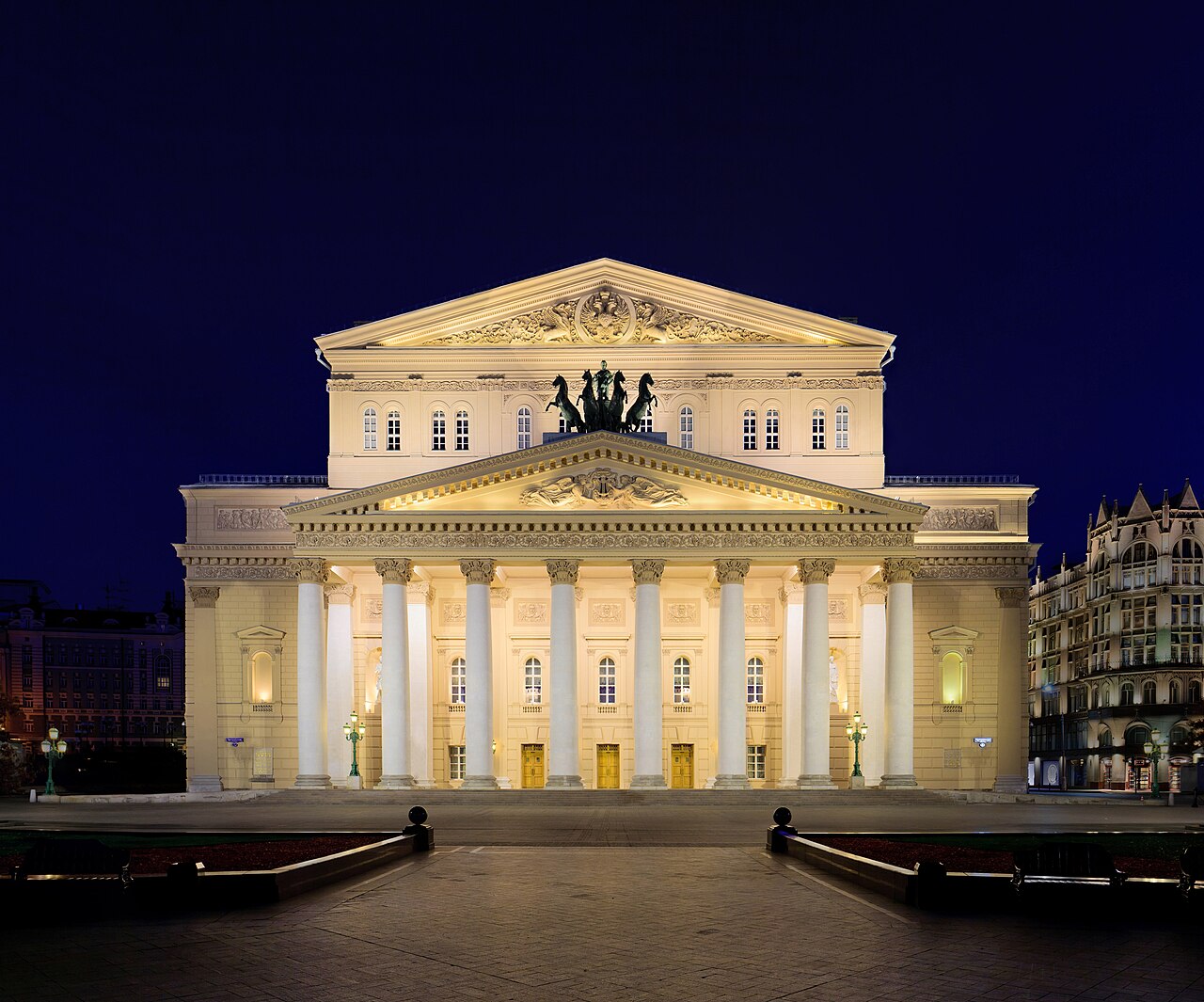
Bolshoi Theatre is a theatre in Moscow, Russia. Apollo quadriga crowns the portico since 1856 rebuild. Third theatre on this site after fires in 1805 and 1853. Most visitors spend 30 min here. The free Lokali audio guide runs 5 minutes.
✓ Verified October 2026 · how we write these guides
Visitor facts
| Time needed | 30 min |
|---|---|
| Lokali audio guide | 5 min · free |
| Type | Theatre |
| Best for | Editors’ pick |
| Location | Moscow, Russia |
| Coordinates | 55.7605, 37.6192 |
| Languages | 45, in the Lokali app |
The story
Stand on Theatre Square and tilt your head back. The Apollo quadriga — four bronze horses pulling the chariot of the god of arts — crowns the portico above you, frozen mid-leap against the Moscow sky. The horses have watched this city transform for nearly two centuries, through revolutions and restorations, while the theatre beneath them became the beating heart of Russian performance.
The building you see today is the third Bolshoi to stand on this spot. Fire consumed the first in 1805, barely three decades after its founding. The second, designed by architect Osip Bove and opened in 1825, burned even more spectacularly in 1853 — the blaze was visible across Moscow, and only the outer walls survived. Architect Albert Cavos rebuilt it within three years, keeping Bove's neoclassical facade but reimagining the interior. That 1856 theatre, with its six tiers of balconies and crimson velvet seats, is essentially what surrounds you when you step inside today.
The name Bolshoi means simply big, and the theatre earned it. The main stage stretches nearly thirty metres deep. The auditorium holds over eighteen hundred people across those stacked tiers, each level trimmed in gold leaf that catches the light from the massive central chandelier. The acoustics are famously unforgiving — a singer's slightest hesitation travels to the uppermost gallery, but so does every note of brilliance.
This stage premiered works that redefined ballet. Tchaikovsky's Swan Lake debuted here in 1877, though that first production flopped and the composer died before seeing it become the cornerstone of classical repertoire. The Nutcracker came later, in 1919, after the revolution. Prokofiev's Romeo and Juliet had its world premiere on this stage in 1940. Generations of dancers — Galina Ulanova, Maya Plisetskaya, Vladimir Vasiliev — built careers in this building, their names now synonymous with Soviet-era artistry.
The Soviet period left deep marks. The imperial double-headed eagle vanished from the curtain, replaced by the hammer and sickle. Performances became state occasions — premieres attended by Politburo members in the central boxes, choreography vetted for ideological correctness. Yet even under that weight, the Bolshoi remained a place where artistry could transcend politics, where a defector like Rudolf Nureyev trained before fleeing west, where audiences wept at beauty the state could not entirely script.
Walk around to the side entrance on Petrovka Street and you will find a smaller building connected by a covered bridge — the New Stage, added in 2002. It hosts experimental work and smaller productions, a counterpoint to the imperial grandeur next door. The contrast tells you something about how the Bolshoi has survived: by holding tradition fiercely in one hand while reaching cautiously forward with the other.
The theatre underwent a six-year restoration that finished in 2011, stripping back Soviet-era modifications to reveal Cavos's original vision. Craftsmen regilded the ornamental plasterwork by hand. They restored the imperial curtain, complete with the double-headed eagle the Soviets had painted over. They rebuilt the underground rehearsal halls and updated the stage machinery, marrying nineteenth-century optics with twenty-first-century engineering. The work cost nearly seven hundred million dollars — a sum that sparked public debate, but the result is undeniable when you see the interior gleam.
Look closely at the facade and you will notice the columns are not quite uniform. Some show darker patches where fire damage went deep, stone that could be cleaned but not erased. The building wears its scars quietly, the way old theatres do — a reminder that survival is never seamless, that history is as much about what endures as what burns away.
Today the Bolshoi runs nearly year-round, dark only in late summer. The repertoire mixes nineteenth-century classics with contemporary commissions, though Swan Lake and Giselle still pack the house. Tickets for prime performances sell out months ahead, but day-of-show standing room sometimes opens for those willing to queue. Even from the back of the upper gallery, the sight lines are clear — Cavos designed the tiers so no pillar blocks the stage.
The square in front of the theatre has become a gathering point, a place where street musicians set up near the fountain and tourists photograph the Apollo horses against the sunset. On winter evenings, when snow dusts the portico and light spills from the arched windows, the building looks almost improbable — too grand, too golden, too stubbornly beautiful for the ordinary city around it. That improbability is part of the point. Theatres like this were built to argue that art matters as much as power, that a society is measured not just by its armies or industries but by what it puts on stage and how carefully it listens.
Key facts
What to look for
Practical tips
Common questions
How long do you need at Bolshoi Theatre?
Plan 30 min. That is the time most visitors spend at Bolshoi Theatre. The free Lokali audio guide runs 5 minutes and is made to listen to while you walk.
Is there a free audio guide to Bolshoi Theatre?
Yes — the Lokali app narrates Bolshoi Theatre free of charge in 50+ languages. No ticket, tour group or subscription, and it works offline once downloaded.
Where is Bolshoi Theatre?
Bolshoi Theatre is in Moscow, Russia, at 55.7605, 37.6192. Tap the map link on this page for directions.
What should you know before visiting Bolshoi Theatre?
Day-of-show standing room sometimes available if you queue early
What is Bolshoi Theatre known for?
Apollo quadriga crowns the portico since 1856 rebuild
What is the best time to visit Bolshoi Theatre?
Day-of-show standing room sometimes available if you queue early
On the map
Opens directions to Bolshoi Theatre from your location.
More to see in Moscow


Hear Bolshoi Theatre in your language
The full story, narrated, in 50+ languages. Download it before you go and it plays offline, at your own pace, with no ticket and no tour group.