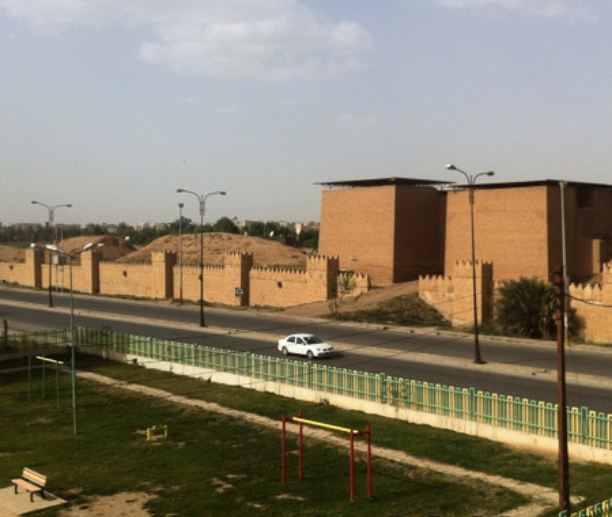
Photo: Photo by Fredarch. · CC BY-SA 3.0 · Wikimedia Commons
Nineveh is an ancient Assyrian city, capital of the Neo-Assyrian Empire. Nineveh lies on the Tigris, facing the old city of Mosul. The free Lokali audio guide runs 7 minutes.
✓ Published October 2026 · how we write these guides
Visitor facts
| Lokali audio guide | 7 min · free |
|---|---|
| Type | Archaeological Site |
| Location | Mosul, Iraq |
| Coordinates | 36.3667, 43.1500 |
| Languages | 50+, in the Lokali app |
The story
Stand still for a moment and feel the ground under your feet. It is not flat. It rises and falls in long, grassy swells, and the soil is pale and crumbly, full of small fragments of baked clay. Wind comes off the Tigris River to the west. Across the water, the minarets and rooftops of Mosul rise into the haze. These quiet mounds were once the largest city on Earth.
This is Nineveh, on the eastern bank of the Tigris, facing the old city of Mosul. People lived here for thousands of years before it became famous. But its great moment came in the late eighth and seventh centuries before the common era. Then it was the capital of the Neo-Assyrian Empire, a state that reached from the mountains of Iran to the edge of Egypt. Assyria was the northern Mesopotamian kingdom whose kings ruled by the sword and recorded everything in stone.
The king who made Nineveh great was Sennacherib. He reigned from around 705 to 681 before the common era, and he chose this old city as his capital. He rebuilt it on a huge scale. He widened streets, raised walls, and dug canals to bring water from the hills. In his own inscriptions he called his new royal residence the Palace Without Rival. Kings rarely hide their pride, and Sennacherib clearly did not.
Look around at the long ridges of earth that run across the landscape. Those are the remains of the city walls. Together they ran for roughly twelve kilometres, with around fifteen gates. Each gate carried the name of a god. Today you can still trace their line by eye, a low wall of earth running toward the horizon. It is one of the easiest ways to understand just how large this city really was.
Two great mounds stand inside the walls. The larger one is called Kuyunjik. It held palaces, temples, and the royal archives. The second mound is Nebi Yunus, which means the Prophet Jonah. For centuries, a mosque on that hill marked the place that local tradition linked to the tomb of Jonah. Remember the Book of Jonah? It tells of a prophet sent to warn this very city. Locals and pilgrims have honoured that story here for many generations.
Now for a surprise most visitors miss. In the 1840s and 1850s, British explorers dug into Kuyunjik. Austen Henry Layard uncovered Sennacherib's palace, with its long halls of carved stone panels. His assistant, Hormuzd Rassam, was himself born in Mosul. Rassam found thousands of clay tablets from the time of Ashurbanipal, one of the last great Assyrian kings. They became known as the Library of Ashurbanipal, one of the oldest organised collections of writing ever found.
The tablets were shipped to London, to the British Museum. There, in 1872, a young scholar named George Smith was reading one of them. He realised it told the story of a great flood, a boat, and birds sent out to find dry land. It was part of the Epic of Gilgamesh, an ancient Mesopotamian poem. The story was strikingly close to the biblical flood. It is said that Smith became so excited he began to undress in the reading room, though that detail may have grown in the retelling.
The carved panels from these palaces now sit in museums around the world. One famous set shows the Assyrian siege of Lachish, a city in the ancient kingdom of Judah. You can see soldiers, battering rams, and families carried into exile. These were not decorations in the modern sense. They were messages to visitors at court. They said, very clearly, what happened to anyone who resisted the king of Assyria.
Yet power did not last. In 612 before the common era, an alliance of Babylonians and Medes attacked the city. The Medes were a people from the Iranian plateau. Nineveh fell, and the Assyrian Empire collapsed soon after. Ancient texts describe a city in flames. In a strange twist, that fire helped the library survive. Clay tablets bake hard in heat, so the destruction of Nineveh preserved its words for us.
In the twentieth century, Iraqi archaeologists rebuilt parts of several gates to show their original shape. The Nergal Gate once had a pair of great stone guardian figures called lamassu. These are winged bulls with human heads, set at doorways to protect the city. Then came recent tragedy. After 2014, when the group known as ISIS held Mosul, militants damaged the Nergal Gate guardians. They also bulldozed reconstructed gates, including the Mashki Gate, and destroyed the mosque on Nebi Yunus.
Here is the second surprise. When Iraqi forces retook the area in 2017, investigators found tunnels that the militants had dug under Nebi Yunus. The tunnels cut into the remains of an Assyrian palace. Archaeologists saw carved stone and inscriptions that had been hidden under the hill for over two thousand years. The damage was real and painful. But it also showed how much of ancient Nineveh still lies unexcavated, beneath the grass you see today.
Since then, Iraqi teams have worked with international partners to record, protect, and rebuild. You may see fencing, survey markers, or fresh brickwork near the gates. This is careful, slow work. Each layer of earth holds broken pottery, mudbrick, and sometimes inscribed fragments. The people of Mosul often speak of Nineveh as part of their own identity. For many families across the river, these mounds are not distant ruins. They are home ground.
As you walk, notice the colours. The earth is beige and grey, and in spring the mounds turn green with new grass. Mudbrick, the main building material here, slowly returns to soil when it is left in the rain. That is why Nineveh does not look like a stone ruin in Greece or Rome. Its walls were once tall and painted. Now they are gentle hills, shaped by wind and water over more than two thousand years.
Before you leave, turn back toward the river. Picture the city at its height... palace roofs, temple towers, gardens watered by Sennacherib's canals, and boats on the Tigris. Then look at what is in front of you now — grass, wind, the low line of the old walls, and Mosul rising on the far bank. The empire is gone. But the stories written here in clay are still being read today, all around the world.
Key facts
What to look for
Practical tips
Common questions
Is there a free audio guide to Nineveh?
Yes — the Lokali app narrates Nineveh free of charge in 50+ languages. The guide runs about 7 minutes, covers the history, what to look for on site and practical tips, and works offline once downloaded.
Where is Nineveh?
Nineveh is near Mosul, Iraq, at 36.3667, 43.1500. Tap the map link on this page for directions from where you are.
What is Nineveh known for?
Nineveh lies on the Tigris, facing the old city of Mosul. Sennacherib made Nineveh the Assyrian capital around 700 BCE.
What should you look for at Nineveh?
Long earthen ridges marking the line of the ancient walls. Reconstructed brickwork at the Nergal and Mashki gate sites. Small fragments of baked clay scattered in the soil.
What should you know before visiting Nineveh?
Check current access and security conditions before visiting the site. Hire a local guide who knows the excavation areas.
When is the best time to visit Nineveh?
Visit in spring when the mounds turn green.
On the map
Opens directions to Nineveh from your location.
More to see near Nineveh

Hear Nineveh in your language
The full story, narrated, in 50+ languages. Download it before you go and it plays offline, at your own pace, with no ticket and no tour group.