
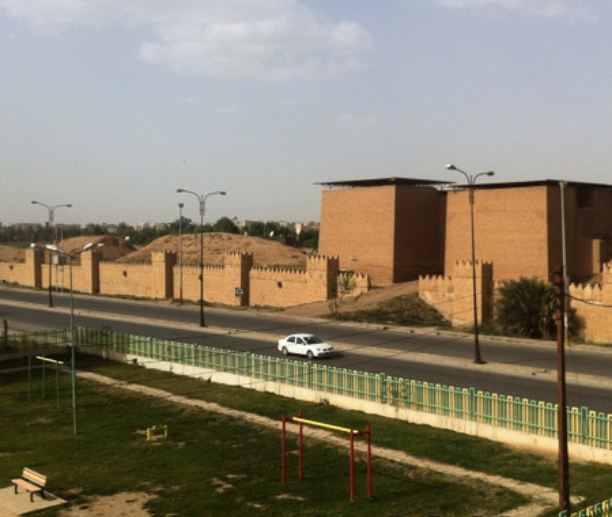
Photo: Staff Sgt. JoAnn Makinano · Public domain · Wikimedia Commons
Nimrud is an ancient Assyrian city. It is near Nineveh Governorate, Iraq. Ancient Assyrian name was Kalhu, called Calah in the Bible. The free Lokali audio guide runs 7 minutes.
✓ Published October 2026 · how we write these guides
Visitor facts
| Lokali audio guide | 7 min · free |
|---|---|
| Type | Archaeological Site |
| Location | Nineveh Governorate, Iraq |
| Coordinates | 36.0981, 43.3289 |
| Languages | 50+, in the Lokali app |
The story
The ground here crunches underfoot. Broken mudbrick, fragments of pale gypsum, dust the colour of milky tea. A dry wind comes off the plain, and somewhere to the west the Tigris River moves slowly south. At first glance, this looks like a low hill in the farmland south of Mosul. But you are standing on the remains of one of the great royal cities of the ancient world. Almost three thousand years ago, this mound was the beating heart of an empire.
The Assyrians called this city Kalhu. The Bible knows it as Calah. The name you hear today, Nimrud, came much later. Local tradition linked the ruins to Nimrod, the mighty hunter from the Book of Genesis. There is no evidence that any real Nimrod lived here, but the name stuck. It is a reminder that people have always tried to explain these mounds. Long before archaeologists arrived, farmers ploughed around carved stones and told stories about giants.
The city became a capital in the ninth century BCE under King Ashurnasirpal the Second. He chose a site that already existed and rebuilt it on a vast scale. Workers raised a huge citadel platform, built new walls, and dug a canal from the Upper Zab River to water orchards and gardens. Assyria was then the strongest military power in the Near East. Its kings wanted a capital that showed that power to every visitor, every envoy, every captive.
Here is a detail most visitors miss. When the new palace was finished, Ashurnasirpal held a celebration and recorded it on a carved stone stele. The inscription claims that tens of thousands of guests were fed for ten days. It lists the food in detail — oxen, sheep, deer, birds, bread, beer, and wine. Kings exaggerated, of course. Even so, the stele gives us a rare picture of an ancient royal feast, written down by the host himself.
The heart of the citadel was the Northwest Palace. Its walls were lined with tall slabs of gypsum, carved in low relief. They show the king hunting lions, leading armies, and standing beside winged protective spirits. At the main doorways stood colossal guardian figures called lamassu. Each one had the body of a bull or lion, great feathered wings, and a bearded human head. Look closely at old photographs and you will notice they often have five legs. From the front they stand still. From the side they walk.
The modern story of Nimrud begins in the 1840s. A young British traveller named Austen Henry Layard dug into the mound and found the carved walls almost at once. He shipped reliefs and lamassu down the Tigris on rafts, and many reached the British Museum in London. One of his finds was the Black Obelisk of Shalmaneser the Third. It shows foreign rulers bringing tribute, and one panel names Jehu, a king of Israel. It is among the earliest known images of a figure from the Bible.
A century later, in the 1950s, the British archaeologist Max Mallowan led new excavations here. His wife travelled with him. She was Agatha Christie, the crime novelist. She photographed finds, cleaned objects, and wrote in a mudbrick room at the dig house. Mallowan's team uncovered thousands of carved ivories, many pulled from wells and storerooms. These ivories once decorated furniture for the Assyrian court. Some were made in Assyria, others came from workshops in Syria and Phoenicia, as tribute or plunder.
The second surprise came much later, and it came from Iraqi archaeologists. In the late 1980s, a team working for Iraq's antiquities service found tombs beneath the floors of the Northwest Palace. They held the remains of Assyrian queens and royal women. With them lay a great quantity of gold — crowns, earrings, bracelets, and finely worked vessels. The tombs had escaped looters for nearly three thousand years. The discovery is often counted among the most important archaeological finds of the twentieth century.
Nimrud did not stay the capital forever. Later kings moved the seat of power, first to a new city at Khorsabad, then to Nineveh, across the river from modern Mosul. Kalhu remained an important royal city. Kings kept building here, including a great arsenal on the edge of town now called Fort Shalmaneser. But in 612 BCE, the Assyrian Empire collapsed. Armies of Babylonians and Medes sacked its cities. Kalhu burned, and the mudbrick slowly melted back into the plain.
The hardest chapter came in our own time. In 2015, the group known as ISIS occupied this region. Its fighters filmed themselves smashing reliefs and blowing up parts of the palace. They also flattened much of the ziggurat, a stepped temple tower that had risen above the citadel for millennia. Iraqi forces retook the site in late 2016. What they found was rubble, broken stone, and deep scars in the mound.
Since then, Iraqi archaeologists and international partners have worked to record the damage, gather fragments, and protect what survived. It is slow, careful work. Pieces of carved gypsum are sorted and studied, sometimes one fragment at a time. As you look around, you may see signs of this effort. Some areas are fenced, covered, or marked. The site is not a finished museum. It is a place still recovering, and the people working here are part of its long story.
Take a moment to think about distance. The carvings from these walls are now spread across the world — in London, New York, Berlin, Baghdad, and many other cities. A visitor in a museum gallery may stand before a winged spirit from this very palace without knowing this field exists. You are seeing the other half of that story. Here is the place those stones came from, with the same sky and the same river nearby.
Now listen again to the wind across the mound. Look at the shape of the land. The raised ground under your feet is the old citadel platform, built by hand from millions of mudbricks. The flat fields beyond were once streets, gardens, and houses. As you walk away, notice the small things — a fragment of pale stone, a line of brick in a cut bank. Each one belonged to a city that ruled an empire, then vanished, and is still being remembered.
Key facts
What to look for
Practical tips
Common questions
Is there a free audio guide to Nimrud?
Yes — the Lokali app narrates Nimrud free of charge in 50+ languages. The guide runs about 7 minutes, covers the history, what to look for on site and practical tips, and works offline once downloaded.
Where is Nimrud?
Nimrud is near Nineveh Governorate, Iraq, at 36.0981, 43.3289. Tap the map link on this page for directions from where you are.
What is Nimrud known for?
Ancient Assyrian name was Kalhu, called Calah in the Bible. Ashurnasirpal the Second made it capital in ninth century BCE.
What should you look for at Nimrud?
Fragments of pale carved gypsum scattered across the mound. Layers of mudbrick visible in cut banks and trenches. The low remains where the ziggurat once stood.
What should you know before visiting Nimrud?
Check current access and permission rules before travelling here. Visit with a local guide familiar with recent conditions.
On the map
Opens directions to Nimrud from your location.
More to see near Nimrud
Hear Nimrud in your language
The full story, narrated, in 50+ languages. Download it before you go and it plays offline, at your own pace, with no ticket and no tour group.