
Tomb of Shah Rukn-e-Alam
30.1989° N · 71.4714° E · Monument
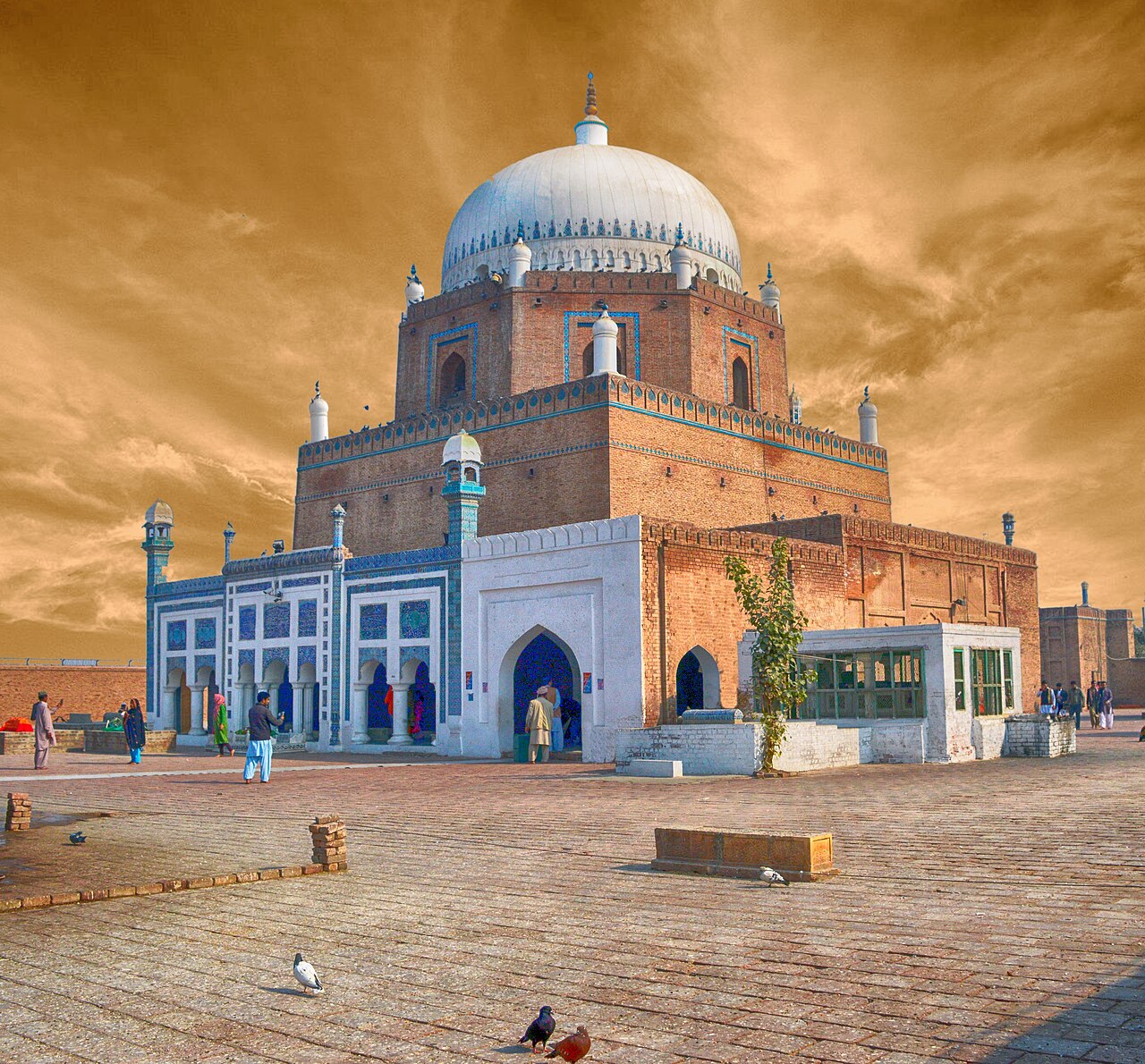
Photo: Yaarahmadd · CC BY-SA 4.0 · Wikimedia Commons
Tomb of Shah Rukn-e-Alam is a mausoleum of the Sufi saint Sheikh Rukn-ud-Din Abul Fateh in Multan, Pakistan. Built in the early fourteenth century during the Tughluq era. The free Lokali audio guide runs 8 minutes.
✓ Published October 2026 · how we write these guides
Visitor facts
| Lokali audio guide | 8 min · free |
|---|---|
| Type | Monument |
| Location | Multan, Pakistan |
| Coordinates | 30.1989, 71.4714 |
| Languages | 50+, in the Lokali app |
The story
Feel the warmth coming off the brick. Even after sunset, the walls of this tomb hold the heat of a Multan day. Put your palm flat against the surface and you will feel it. The bricks are red-brown and finely laid, and between them run dark bands of old timber. Above you, a great white dome rises against the sky. It is visible from far across the city. Around you there is the murmur of prayer, the shuffle of bare feet on stone, and perhaps the call of pigeons settling on the ledges.
This is the Tomb of Shah Rukn-e-Alam, and it stands on the high ground of Multan's old fort. That height matters. For centuries, travellers on the roads into the city saw this dome long before they saw anything else. It became a kind of signature on the skyline. Multan is one of the oldest continuously inhabited cities in South Asia, and this building has watched over it for roughly seven hundred years. It is still one of the first images many Pakistanis connect with the city.
So who was Shah Rukn-e-Alam? His name means, roughly, Pillar of the World. He was a Sufi saint of the Suhrawardi order. Sufism is the mystical tradition within Islam, focused on the inner path to God through devotion, discipline, and teaching. Rukn-e-Alam was the grandson of Bahauddin Zakariya, another great Sufi master of Multan. Together, this family made Multan a major centre of Sufi learning in the medieval period. Students and seekers came from far away to sit with them.
Here is the first surprise. This tomb was not built for the saint at all. It was built in the early fourteenth century by Ghiyath al-Din Tughluq, a powerful governor who later became Sultan of Delhi. The usual account is that he intended it as his own resting place. But he was eventually buried near Delhi instead. His son, Muhammad bin Tughluq, then gave the building to the descendants of Rukn-e-Alam. The saint was laid to rest here after his death in the 1330s.
Think about what that means. A monument designed to honour a king now honours a man of prayer. The visitors who come today are not here for a sultan. Most of them could not tell you the name of the man who paid for these walls. They come for the saint. In a quiet way, the building tells a story about what people choose to remember. Power built the tomb... but devotion is what keeps it alive.
Now step back and look at the shape. The building is an octagon, eight sides, and it rises in three stages. The lowest stage is the largest, with thick walls that lean slightly inward as they rise. At each corner stands a sturdy, tapering tower, like a buttress. Above that sits a smaller octagon. And on top of everything rests the dome. The effect is solid and heavy at the base, then lighter as your eye climbs upward.
Those sloping walls and corner towers are typical of the Tughluq style. The Tughluqs were a dynasty that ruled from Delhi in the fourteenth century, and their buildings often look like fortresses. Many historians see this tomb as one of the finest early examples of that style. Some details here, such as the battered walls and the strong corner turrets, appear again in later Tughluq buildings in northern India. In a sense, this hilltop in Multan helped shape a way of building.
Look closely at the brickwork, because this is the second surprise. Running through the walls are horizontal bands of wood. This timber was built into the masonry to bind and strengthen it. Multan sits in a region where earthquakes are possible, and wood can flex where brick alone would crack. It is an old, practical technique. Over centuries, the combination of brick and timber has helped this heavy structure stay standing.
Now let your eyes find the colour. Across the brick surfaces you will see panels of glazed tiles, mostly in deep blue, turquoise, and white. Some are set in geometric patterns. Others form bands of calligraphy and floral designs. Multan has long been known for this kind of blue-glazed tilework, and craftsmen in the city still practise it today. When sunlight hits the tiles, the blues shift from almost black to bright sky colour within a few steps.
The tomb has seen damage and repair. Over the centuries, weather, war, and simple age wore away parts of the decoration. In the later twentieth century, a major restoration was carried out by the Auqaf Department, the government body that manages religious properties in Pakistan. Local craftsmen replaced many lost tiles and bricks. So as you look around, some of what you see is original, and some is careful renewal. Both are part of the building's life.
When you step inside, the temperature drops and the light softens. The interior is a single high space under the dome. Sound behaves differently here. Voices rise and hang in the air. At the centre lies the grave of the saint, often covered with embroidered cloth and scattered with rose petals. Around it, you may see other graves of family members and descendants. Look also for the carved wooden mihrab, the prayer niche that shows the direction of Mecca. It is valued as a rare piece of early woodwork.
This is a living shrine, not a museum. People come to pray, to ask for blessings, to tie threads, or simply to sit in silence. You may see families sharing food, an elderly man reciting softly, or a child being lifted to touch the grave's railing. Once a year, the saint's urs, the anniversary of his death, brings large crowds of pilgrims, with music, prayer, and celebration. Visitors are welcome, but modest dress and quiet behaviour are expected, and shoes come off before you enter.
If you have time, look out toward the nearby tomb of Bahauddin Zakariya, the saint's grandfather. The two shrines share the same high ground. Between them, they explain why Multan is often called the City of Saints. Many smaller shrines are scattered across the old city below. From this spot, you can begin to sense how deeply this tradition runs through daily life here.
Before you go, turn around one more time. Notice the warm brick, the dark lines of timber, the flash of blue tile, and the white dome above it all. Listen to the soft voices and the pigeons. A king planned this building for himself, and history gave it to a saint. As you walk down the slope and back into the city, glance over your shoulder. The dome will stay in view for a long time... just as it has for every traveller before you.
Key facts
What to look for
Practical tips
Common questions
Is there a free audio guide to Tomb of Shah Rukn-e-Alam?
Yes — the Lokali app narrates Tomb of Shah Rukn-e-Alam free of charge in 50+ languages. The guide runs about 8 minutes, covers the history, what to look for on site and practical tips, and works offline once downloaded.
Where is Tomb of Shah Rukn-e-Alam?
Tomb of Shah Rukn-e-Alam is in Multan, Pakistan, at 30.1989, 71.4714. Tap the map link on this page for directions from where you are.
What is Tomb of Shah Rukn-e-Alam known for?
Built in the early fourteenth century during the Tughluq era. Commissioned by Ghiyath al-Din Tughluq, later Sultan of Delhi.
What should you look for at Tomb of Shah Rukn-e-Alam?
Horizontal timber bands running through the red brick walls. Sloping walls leaning inward as they rise from the base. Tapering corner towers at each of the eight corners.
What should you know before visiting Tomb of Shah Rukn-e-Alam?
Remove your shoes before entering the inner tomb chamber. Dress modestly, covering shoulders and legs, out of respect.
When is the best time to visit Tomb of Shah Rukn-e-Alam?
Visit in late afternoon to see the tiles in warm light.
On the map
Opens directions to Tomb of Shah Rukn-e-Alam from your location.
More to see in Multan

Hear Tomb of Shah Rukn-e-Alam in your language
The full story, narrated, in 50+ languages. Download it before you go and it plays offline, at your own pace, with no ticket and no tour group.