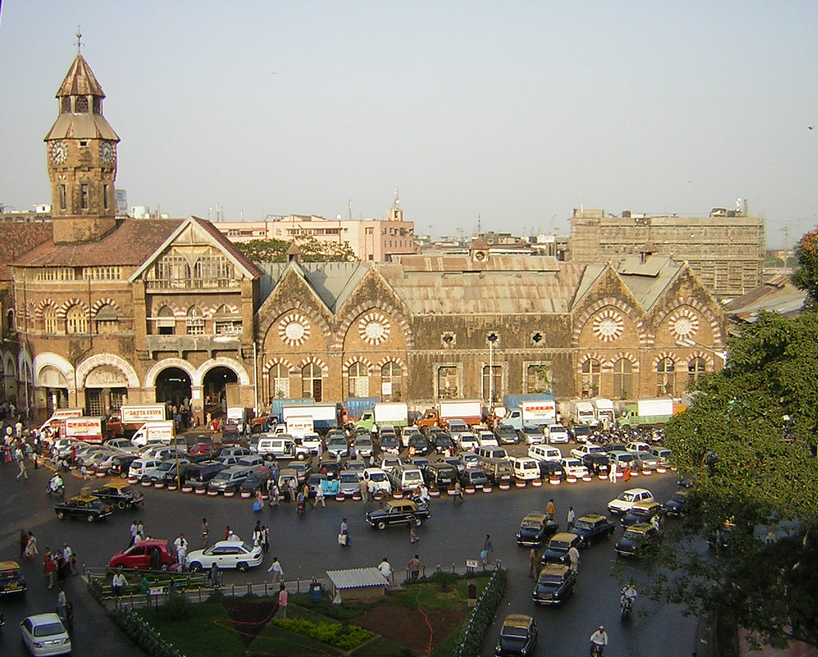
Crawford Market is a food market in Mumbai, India. Historic Victorian market building opened in 1869, sprawling across two storeys with hundreds of vendors selling fresh produce, spices, dried fruits, and flowers. Most visitors spend 1–1.5 hours here. The free Lokali audio guide runs 5 minutes.
✓ Verified August 2026 · how we write these guides
Visitor facts
| Time needed | 1–1.5 hours |
|---|---|
| Lokali audio guide | 5 min · free |
| Type | Food Market |
| Best for | Local life |
| Location | Mumbai, India |
| Coordinates | 18.9656, 72.8289 |
| Languages | 45, in the Lokali app |
The story
The smell reaches you before anything else. Ripe mangoes. Fresh coriander. Sharp ginger and cut flowers. Sound comes next, the calls of sellers and the rattle of handcarts on stone. You step out of the open street and into one of the oldest covered markets in the city. The change is sudden, from glare and traffic to shade and noise.
This is Crawford Market. Today its official name is Mahatma Jyotiba Phule Mandai. It sits in the southern part of Mumbai, near the old fort district. For more than a hundred and fifty years, people have come here to buy food. Fruit, vegetables, spices, and much more change hands under its high roof every day. Traders here supply shops and kitchens across the whole city.
The building opened in 1869. It was named after Arthur Crawford, the first municipal commissioner of the city. After independence, Mumbai renamed it for Jyotirao Phule, a teacher and reformer who worked for the poor and for the education of girls. The old name stayed in common use, but the new name honors a local hero.
An English architect named William Emerson designed the market. He chose European styles, drawing on Norman and Flemish forms. The walls are built from rough local stone in shades of buff and brown. The result is a large, cool hall with tall arches that let in light and air, even on the hottest afternoons. The high roof keeps the worst of the heat away.
Look above the main entrance. There you will find carved stone panels. They show Mumbain farmers and workers in the fields. The man who designed them was Lockwood Kipling, an art teacher in Bombay. His son Rudyard, the writer, was born in this city. The father's quiet work still watches over the door today. Few shoppers below ever stop to look up at it.
Inside stands a stone fountain, also shaped by Lockwood Kipling's hand. Around it, the market opens into sections. One area sells fruit, stacked in bright pyramids. Another sells vegetables, washed and arranged with care. Further on are the spices, their colors deep red and gold. The air itself changes as you walk from one part to the next. Sweet fruit gives way to sharp spice within a few steps.
The market holds a quiet record. In 1882, it became one of the first buildings in Mumbai to be lit by electric light. Imagine the surprise of shoppers who had only known oil lamps and daylight. The market was modern for its time, and it drew curious crowds for that reason alone, long before the goods on sale. People came simply to see the new electric lamps glow.
Above the hall rises a clock tower. It helped shoppers and traders keep the time through the long working day. The market opened early and stayed busy until dark. Porters carried heavy baskets on their heads. Carts rolled in from the docks and the railway nearby. Goods arrived from across the region and beyond. The market was a meeting point for the whole coast.
Walking here takes patience. The lanes are narrow and full. Sellers will call to you and hold up their best fruit for you to see. Bargaining is normal and expected, so do not be shy. A slow walk rewards you. You will find things you did not expect, and smell spices you cannot yet name. Take your time and let the crowd carry you.
The market also has a harder side. Some sections in the past sold live animals and birds, kept in small cages. Many visitors find this part difficult to see. You are free to walk straight past it. The food halls are the heart of the place, and they are where most people choose to spend their time.
Step back and look at the whole building. It was made to serve a growing city, to bring food to its people in one organized place. It has done that job for many generations. The same stone arches that sheltered shoppers in the nineteenth century shelter them still, through heat and rain and the long rush of the years.
Stand for a moment in the cool shade of the hall. Around you, the trade goes on as it always has. Hands weigh fruit. Coins pass from palm to palm. Voices rise and fall in a dozen languages. This is an ordinary place doing an ordinary thing, feeding a city, day after day. In that steady rhythm, there is something worth pausing to feel.
Key facts
What to look for
Practical tips
Common questions
How long do you need at Crawford Market?
Plan 1–1.5 hours. That is the time most visitors spend at Crawford Market. The free Lokali audio guide adds about 5 minutes of narration you can listen to as you walk, so it fits inside your visit rather than adding to it.
Is there a free audio guide to Crawford Market?
Yes — the Lokali app narrates Crawford Market free of charge in 50+ languages. It covers the history, what to look for on site and practical tips, and it works offline once downloaded.
Where is Crawford Market?
Crawford Market is in Mumbai, India, at 18.9656, 72.8289. Tap the map link on this page for directions from where you are.
What should you know before visiting Crawford Market?
Come early morning for the freshest produce and calm.
What is Crawford Market known for?
The market building first opened in 1869.
What is the best time to visit Crawford Market?
The entrance portico is ornate stone; inside, the air is thick with spice dust and the noise of haggling.
On the map
Opens directions to Crawford Market from your location.
Reference
More to see in Mumbai


Hear Crawford Market in your language
The full story, narrated, in 50+ languages. Download it before you go and it plays offline, at your own pace, with no ticket and no tour group.