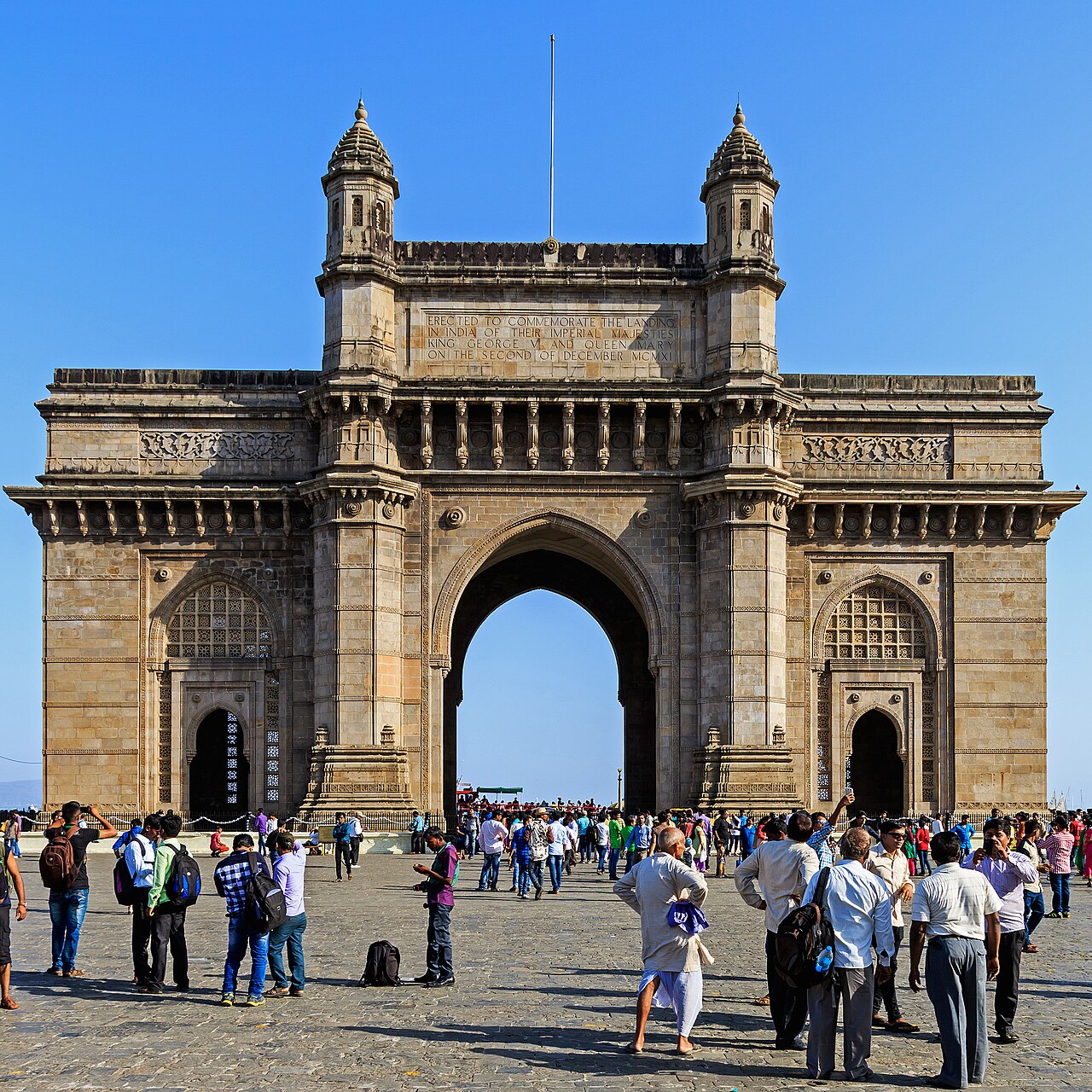
Gateway of Mumbai is a monument in Mumbai, India. Iconic arch completed in 1924 at the waterfront, built to commemorate King George V's visit. Most visitors spend 30–45 min here. The free Lokali audio guide runs 5 minutes.
✓ Verified August 2026 · how we write these guides
Visitor facts
| Time needed | 30–45 min |
|---|---|
| Lokali audio guide | 5 min · free |
| Type | Monument |
| Best for | Editors' pick |
| Location | Mumbai, India |
| Coordinates | 18.9220, 72.8347 |
| Languages | 45, in the Lokali app |
The story
The sea wind reaches you first. It carries salt, and the smell of diesel from the ferries, and the cries of vendors selling balloons. Then you see it. A great arch of yellow stone rises against the water. Behind it spreads the gray Arabian Sea. You are standing at the edge of Mumbai, where the city meets the harbor.
This is the Gateway of Mumbai. It stands at Apollo Bunder, on the southern tip of the city, in the area called Colaba. The arch faces the water. For travelers who once arrived by ship, this was the first thing they saw of Bombay. It was built to be exactly that. A welcome. A doorway between the sea and the land.
The monument marks a royal visit. In December 1911, King George the Fifth and Queen Mary of Britain landed near this spot. They came for a grand ceremony in Delhi. The city wanted to honor their arrival with a lasting structure. At the time of the visit, only a simple model stood here. The real Gateway came years later.
Construction was slow. The foundation was laid in 1913. The land had to be reclaimed from the sea first. The work finished in 1924. By then the king's visit was long past. The Viceroy opened the monument in December of that year. It had taken more than ten years to complete. Even so, the city kept its promise to mark the royal landing.
The architect was a Scotsman named George Wittet. He also designed a great museum nearby. Wittet chose a style that blended European and Mumbain forms. Look at the shape of the arch. Look at the carved stone screens and the small domes around it. These details borrow from the architecture of Gujarat, a region to the north, in the sixteenth century.
The stone is yellow basalt, cut from local quarries. The central dome rises about twenty-six meters above the ground. That is roughly the height of an eight-story building. Inside the arch are halls that once held large gatherings. The whole structure was meant to impress the people who arrived by sea, and for many years it did. From a ship's deck, the arch was a sign that the long voyage was nearly over.
The Gateway also saw the end of an era. For decades it served as a ceremonial entrance for British officials. Then came independence. In February 1948, the last British troops left Mumbai through this arch. They marched to their ships and sailed away. The doorway that had welcomed a king became the exit for an empire.
Today the meaning has changed. The Gateway belongs to the city now. Families come here in the evening. Couples sit along the wall. Children chase pigeons across the wide stone plaza. Photographers offer quick portraits for a small fee. The monument is no longer about kings. It is a public square open to the sea. Vendors sell tea and roasted nuts, and the smell drifts across the warm stones.
Turn around and you will see another grand building. The Taj Mahal Palace Hotel stands just across the road. Its red dome has watched over this shore since 1903. The hotel and the Gateway are often photographed together. They frame the entrance to old Bombay. Many people come at dawn, when the light is soft and the crowds are still thin.
Near the arch stand two statues. One shows Chhatrapati Shivaji, a warrior king honored across this region, seated on a horse. The other shows Swami Vivekananda, a teacher and monk. Both were added long after the Gateway itself. They give the plaza a sense of place and pride, and people often pause to read their names. Both men are remembered far beyond this city.
From the water's edge, boats leave through the day. Many carry visitors to Elephanta Island, about an hour away by sea, where ancient caves are cut into the rock. The Gateway is the starting point for that trip. Stand near the steps and you will hear the engines, the ticket sellers, and the slap of waves against the stone.
Stay a while as the light softens. The sea turns silver. The arch holds its shape against the fading sky. People have passed through this place for a hundred years, arriving and leaving, greeting and parting. Stand here quietly, and you join that long line of travelers, here for just a moment beside the open water. The arch will remain when you are gone, waiting for the next ship and the next evening by the sea.
Key facts
What to look for
Practical tips
Common questions
How long do you need at Gateway of Mumbai?
Plan 30–45 min. That is the time most visitors spend at Gateway of Mumbai. The free Lokali audio guide adds about 5 minutes of narration you can listen to as you walk, so it fits inside your visit rather than adding to it.
Is there a free audio guide to Gateway of Mumbai?
Yes — the Lokali app narrates Gateway of Mumbai free of charge in 50+ languages. It covers the history, what to look for on site and practical tips, and it works offline once downloaded.
Where is Gateway of Mumbai?
Gateway of Mumbai is in Mumbai, India, at 18.9220, 72.8347. Tap the map link on this page for directions from where you are.
What should you know before visiting Gateway of Mumbai?
Visit at sunset for cooler air and softer light.
What is Gateway of Mumbai known for?
Built to mark King George the Fifth's 1911 visit.
What is the best time to visit Gateway of Mumbai?
Visit at sunset when the stone glows gold and the waterfront fills with families and street vendors.
On the map
Opens directions to Gateway of Mumbai from your location.
More to see in Mumbai


Hear Gateway of Mumbai in your language
The full story, narrated, in 50+ languages. Download it before you go and it plays offline, at your own pace, with no ticket and no tour group.