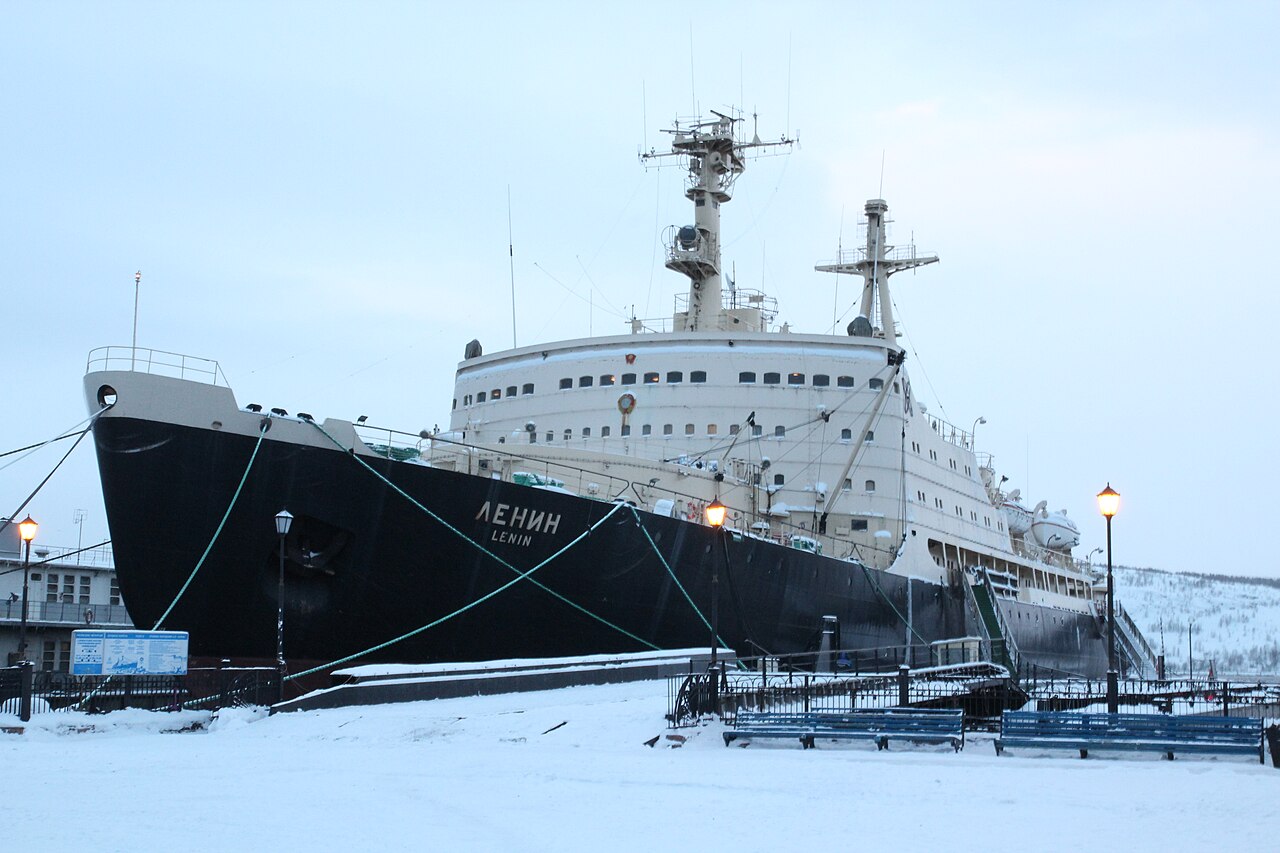
Lenin Icebreaker is a museum ship in Murmansk, Russia. World's first nuclear-powered icebreaker, decommissioned in 1989 and now a floating museum. Most visitors spend 1–1.5 hours here. The free Lokali audio guide runs 6 minutes.
✓ Verified August 2026 · how we write these guides
Visitor facts
| Time needed | 1–1.5 hours |
|---|---|
| Lokali audio guide | 6 min · free |
| Type | Museum Ship |
| Best for | History |
| Location | Murmansk, Russia |
| Coordinates | 68.9678, 33.1122 |
| Languages | 45, in the Lokali app |
The story
Stand on the quay in central Murmansk and look up. A long black-and-white hull rises far above your head, longer than a city block. Its sides are streaked with rust and salt. This is the Lenin, the first surface ship in the world to run on nuclear power. It no longer sails. It rests here at the edge of the Kola Bay, and you can walk inside it.
The Lenin was launched in 1957. Two years later, in 1959, it entered service in the Arctic. Its work was hard and constant. Thick sea ice closes the northern shipping routes for much of the year. The Lenin broke that ice. It pushed its heavy bow up onto the ice and let its weight crack the surface. It opened a path so that cargo ships could follow it to the ports of the far north.
Before this ship, icebreakers burned coal or oil. They had to stop often to refuel, and fuel was hard to carry so far north. A nuclear engine changed that. The Lenin could work for long stretches without returning to port. This gave it a reach that older ships did not have. Over its working life it traveled more than 654,000 nautical miles. That is more than three times the distance from the Earth to the Moon.
Walk up the gangway and step inside. The ship is large, almost like a small town under steel. It holds more than one thousand separate compartments. Narrow corridors connect them, and you climb steep stairways between the decks. Heavy steel doors seal each section. As you move through the vessel, you begin to feel how many people lived and worked here at the same time.
The crew did not only steer the ship. They lived aboard for weeks on end. There was a dining room where they ate together. There was a medical unit for the sick and the injured. There was a club room where they could rest between shifts. Guides lead you through these spaces. You see the bunks, the tables, and the small details of daily life far out on the ice.
Climb toward the captain's bridge. From here the officers watched the ice ahead and gave their orders. Old dials, levers, and brass instruments still fill the room. The wide windows look out over the bay. Picture the view in deep winter, when the sun never rises for weeks and the ice stretches pale and broken in every direction.
One room stands apart from the rest. The wardroom has warm wood paneling and a quieter feeling than the working decks. Here the ship received important visitors over the years. Political leaders, scientists, and famous guests came aboard to see the vessel that had carried the country into the nuclear age.
At the heart of the ship sat its reactors. They produced the heat that turned water into steam, and the steam drove the engines. For safety, this part of the vessel is carefully sealed and managed, and your guide will explain how the system worked without exposing the crew to harm. The power plant is the reason the Lenin earned its place in the record books.
The ship served for about thirty years. In 1989 it was taken out of active duty. For a time its future was unclear. A long working life had ended, but the hull was still sound and the story it carried was important. In the end, people decided to keep it rather than scrap it.
The conversion into a museum was completed in 2005. In 2009 the Lenin was moored here in the center of Murmansk, close to the marine station. Since then it has become one of the most visited places in the whole region. Schoolchildren on class trips, old sailors, and travelers from far away all climb its gangway through the year.
When you reach the upper deck, find the flat open space near the stern. This was the landing area for a helicopter. The crew used aircraft to scout the ice from above and to find the easiest path forward through the broken floes. Standing there in the wind, you can picture the small machine lifting off and turning out over the cold gray sea.
Take your time as you walk back down through the decks. Run your hand along the painted steel. Notice how solid everything feels, how every fitting was built to last in a hard place. A ship like this was not made for comfort. It was made to push forward, season after season, where few other vessels could go.
The Lenin will never sail again. Its engines are silent now. But it remains, fixed to the shore, open to anyone who wants to step aboard. Take a moment at the rail before you leave. The same cold water that once carried this ship through the ice still moves quietly below you.
Key facts
What to look for
Practical tips
Common questions
How long do you need at Lenin Icebreaker?
Plan 1–1.5 hours. That is the time most visitors spend at Lenin Icebreaker. The free Lokali audio guide adds about 6 minutes of narration you can listen to as you walk, so it fits inside your visit rather than adding to it.
Is there a free audio guide to Lenin Icebreaker?
Yes — the Lokali app narrates Lenin Icebreaker free of charge in 50+ languages. It covers the history, what to look for on site and practical tips, and it works offline once downloaded.
Where is Lenin Icebreaker?
Lenin Icebreaker is in Murmansk, Russia, at 68.9678, 33.1122. Tap the map link on this page for directions from where you are.
What should you know before visiting Lenin Icebreaker?
Buy tickets at the gangway; group tours run on schedules.
What is Lenin Icebreaker known for?
World's first nuclear-powered icebreaker and surface ship.
What is the best time to visit Lenin Icebreaker?
The engine room's scale is overwhelming—massive turbines and pipes fill the space.
On the map
Opens directions to Lenin Icebreaker from your location.
More to see in Murmansk


Hear Lenin Icebreaker in your language
The full story, narrated, in 50+ languages. Download it before you go and it plays offline, at your own pace, with no ticket and no tour group.