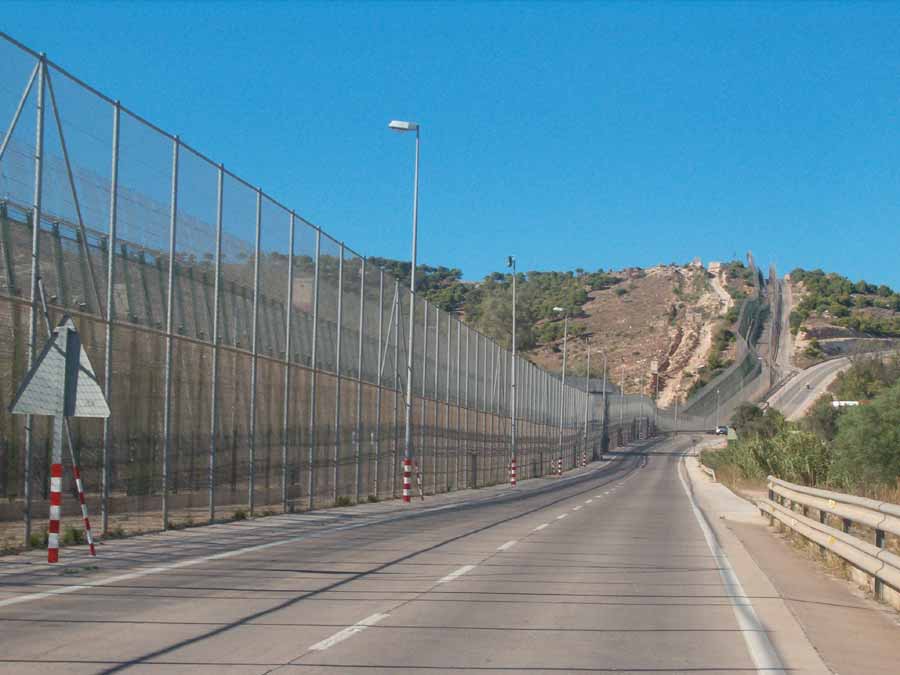
Melilla Border Fence
35.2994° N · 2.9745° W · Fortification
Photo: Ongayo · CC BY-SA 4.0 · Wikimedia Commons
Melilla Border Fence is part of the Morocco–Spain border at Melilla. Spain has held Melilla since 1497. The free Lokali audio guide runs 7 minutes.
✓ Published October 2026 · how we write these guides
Visitor facts
| Lokali audio guide | 7 min · free |
|---|---|
| Type | Fortification |
| Location | Nador, Spain |
| Coordinates | 35.2994, -2.9745 |
| Languages | 50+, in the Lokali app |
The story
The wind here comes off the Mediterranean carrying salt and fine red dust. It moves across the dry hills and rattles against long lines of grey metal mesh. Somewhere behind you, car horns stack up at the crossing. A vendor calls out. A police radio crackles. Before you is a line on the map made solid. It is a barrier of steel and wire that separates Morocco from a small piece of Spain, here on the African coast.
That piece of Spain is Melilla. It sits just beside Nador, close enough that the two cities share one stretch of coastline and one sky. Melilla is one of two Spanish cities on the North African mainland. The other is Ceuta, further west near the Strait of Gibraltar. The fence curves around Melilla's land border in a long arc of roughly twelve kilometres, from the sea on one side to the sea on the other.
To understand the fence, start with the city behind it. Spanish forces took Melilla at the end of the fifteenth century, in 1497. That was only five years after the last Muslim kingdom in Spain fell. For centuries the city was a fortified outpost, with walls facing the land. Morocco has never accepted Spanish rule here. It still regards Melilla as Moroccan territory. So this barrier marks a border that one of its two neighbours does not recognise.
The modern fence is surprisingly young. Spain began building it in the 1990s, with financial support from the European Union. In practice, this short line in North Africa became one of the external borders of Europe. Over the following years the barrier grew taller and more complex. After repeated mass attempts to climb it, Spanish authorities raised it and added more layers. Today it is a system of parallel fences rather than a single wall.
Look closely at its construction. The mesh has very small openings, designed so that fingers and shoes cannot find a grip. Cameras and sensors run along its length, and patrol roads follow the line. Morocco has added its own barriers, ditches and watch posts on this side. In recent years Spain removed the razor wire from the top of its fence and made the fence higher instead. It was a quiet change, but a significant one.
Now lift your eyes to the hills. The large mountain above Nador is Mount Gurugu. For years, people from across West and Central Africa camped in its forests. They waited, sometimes for months, for a chance to reach the fence. From the slopes they could see the lights of Melilla below. To them, those lights meant Europe. Moroccan security forces regularly cleared the camps, and people often returned.
The crossings that followed were dramatic and dangerous. Groups of hundreds would run toward the fence together, often before dawn. Many were stopped. Some climbed and sat on top for hours. Others fell and were badly hurt on the metal. In 2005, several migrants died during attempts on the fences of Melilla and Ceuta. Those deaths drew international attention and led directly to the higher, layered barrier you see now.
The heaviest moment came in June 2022. A large group tried to force the crossing area at a point near the edge of Melilla. In the crush, at least twenty-three people died, according to Moroccan authorities. Human rights groups said the true number was higher, and that many others were missing. Investigations and arguments over responsibility continued for a long time. Many visitors know this place mainly through that day, and it is right to stand here with that in mind.
But the fence is not only a story of migration. It is also a story of daily life. For decades, thousands of people crossed here each day for work, shopping and trade. Women known in Spanish as porteadoras carried huge bundles of goods on their backs from Melilla into Morocco. Their trade ended around 2019. Then the pandemic closed the border completely in 2020. When the crossing reopened in 2022, the local economy on both sides had already changed.
The Nador side has its own character. The main crossing sits at Beni Ansar, a town of busy roads, small cafés and money changers. To the south lies the Marchica, a wide salt lagoon separated from the sea by a thin strip of sand. Nador has grown fast in recent decades. Many families here have relatives across the line, and many more have relatives in Europe. The border is part of ordinary conversation.
Here is a detail many visitors miss. On the Melilla side, a golf course runs close to the fence. In 2014, a photograph showed golfers playing on bright green grass. Behind them, a group of migrants sat on top of the fence. The image travelled around the world. For many people it summed up the gap between two worlds in a single frame. The golf course is still there, inside Melilla.
A practical word, gently. This is an active security zone, not a museum. Police and soldiers on both sides watch the area closely. Photographing officers, patrols or the fence itself can bring questions, or worse. Stay on public roads and in public spaces, and keep a respectful distance. If you plan to cross into Melilla, carry the right passport and visa for Spain and the Schengen area. Expect long queues, especially on weekends and holidays.
As you stand here, notice how normal everything around the fence looks. Taxis wait. Children walk home from school. Tea is poured in glasses at a café table. A few hundred metres away, the line of mesh runs on across the hills toward the sea. Two countries, two continents in the minds of many, and a single strip of land between them.
When you turn to leave, listen for a moment to the wind against the metal. It is a small, dry sound, easy to ignore. Thousands of people have heard it from much closer than you. Some crossed. Many did not. Take that thought with you as you walk back into the streets of Nador.
Key facts
What to look for
Practical tips
Common questions
Is there a free audio guide to Melilla Border Fence?
Yes — the Lokali app narrates Melilla Border Fence free of charge in 50+ languages. The guide runs about 7 minutes, covers the history, what to look for on site and practical tips, and works offline once downloaded.
Where is Melilla Border Fence?
Melilla Border Fence is near Nador, Spain, at 35.2994, -2.9745. Tap the map link on this page for directions from where you are.
What is Melilla Border Fence known for?
Spain has held Melilla since 1497. Fence runs roughly twelve kilometres around Melilla.
What should you look for at Melilla Border Fence?
Fine anti-climb mesh with very small openings. Parallel fence layers separated by patrol roads. Mount Gurugu rising above Nador to the west.
What should you know before visiting Melilla Border Fence?
Avoid photographing police, soldiers or security installations. Carry a valid Schengen visa before crossing into Melilla.
On the map
Opens directions to Melilla Border Fence from your location.
More to see near Melilla Border Fence

Hear Melilla Border Fence in your language
The full story, narrated, in 50+ languages. Download it before you go and it plays offline, at your own pace, with no ticket and no tour group.