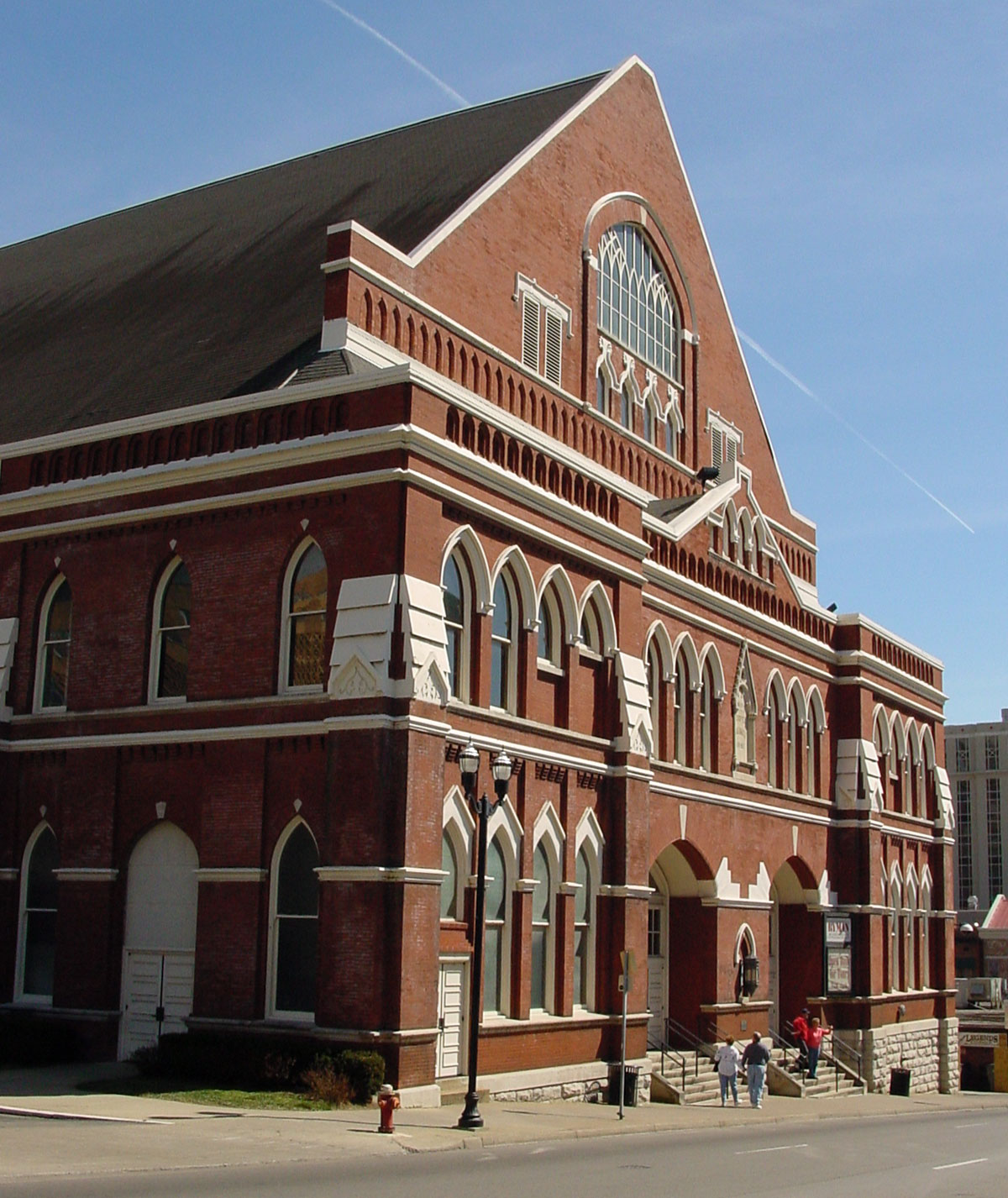
Photo: Wikimedia Commons contributor · CC0 · Wikimedia Commons
Ryman Auditorium is a concert hall and theatre in Nashville, Tennessee, United States. Opened in 1892 as the Union Gospel Tabernacle. The free Lokali audio guide runs 6 minutes.
✓ Published October 2026 · how we write these guides
Visitor facts
| Lokali audio guide | 6 min · free |
|---|---|
| Type | Theatre |
| Location | Nashville, United States |
| Coordinates | 36.2068, -86.6921 |
| Official website | ryman.com |
| Languages | 50+, in the Lokali app |
The story
Run your hand along the back of a wooden pew. The wood is smooth and slightly worn, polished by generations of people who sat right here. Above you, coloured light falls through tall arched windows onto rows of curved benches. The room is quiet now. But when it fills, the sound in here is close and warm, and many musicians say there is no better room to play in.
This is the Ryman Auditorium. People in Nashville often call it the Mother Church of Country Music. That nickname sounds like a joke at first. Then you look around. The pews, the stained glass, the tall red-brick walls — this building really was made as a house of worship. It was built in the late nineteenth century, and it is still one of the most important stages in American music.
The story begins with a riverboat captain named Thomas Ryman. He ran steamboats on the Cumberland River, and by most accounts he was a rough, hard-living man. In the 1880s he went to a revival meeting led by a travelling preacher, Sam Jones. The story goes that Ryman came to heckle the preacher. Instead, he left a changed man and decided to build a permanent hall where everyone could hear sermons like that.
The building opened in 1892 as the Union Gospel Tabernacle. Its builders wanted a large space for big crowds, and they had no microphones or speakers. So the shape of the room had to carry the human voice. That practical need is a big part of why the acoustics still work so well today. Notice how the seats curve around the stage, so that every listener sits fairly close to the performer.
When Thomas Ryman died in 1904, Sam Jones spoke at his funeral. He proposed renaming the tabernacle in honour of the captain, and the name Ryman Auditorium has stayed ever since. Look up at the balcony that wraps around the hall. It was added in the late 1890s for a large reunion gathering. It made the building far more useful for big events.
Here is something many visitors miss. For decades, the Ryman was not mainly a country music venue at all. In the early twentieth century, it hosted lectures, political speeches, opera, theatre, and touring stars of every kind. Much of this was thanks to a manager named Lula Naff. She was a woman running a major hall at a time when that was rare, and she booked big names to Nashville again and again.
Then came the radio. The Grand Ole Opry, a live country music radio show, moved into the Ryman in 1943. It stayed for about thirty years. Every weekend, the show was broadcast far beyond Tennessee, and this stage became the place every country singer dreamed of standing. Hank Williams, Patsy Cline, and many other legends performed here. For listeners across America, this room was the sound of Saturday night.
The Opry years were not comfortable ones. For a long time the building had no air conditioning. On hot summer nights, the audience waved paper fans to keep cool, while performers sweated under the stage lights. Backstage space was tiny. Yet the shows went on, crowded and loud, with fans packed into these same pews. When you sit down, imagine the heat, the fans moving, and the radio microphones on the stage.
This stage is also tied to the birth of bluegrass. Bill Monroe and his band played here during the Opry years, and in the mid-1940s his group included banjo player Earl Scruggs and guitarist Lester Flatt. Many music historians point to their performances at the Ryman as the moment the bluegrass sound came together. Fast banjo picking, high harmonies, and acoustic strings — that style travelled out from this room to the world.
In 1974, the Opry moved to a new, larger home outside downtown. The Ryman was left mostly empty. For years the building aged quietly, and there was serious talk about tearing it down. But a piece of it went along with the show. A circle of wood was cut from this stage and set into the stage of the new Opry House, so performers there still stand on Ryman boards.
The building survived. A major restoration was completed in the 1990s, and the Ryman reopened as a concert hall. Today it hosts every kind of music, from country and gospel to rock, folk, and comedy. In 2001, it was named a National Historic Landmark. Walk to the back of the hall and look toward the stage. That view has barely changed, even though modern sound and lighting now hide in plain sight.
Step outside, and you are only a short walk from Lower Broadway, with its neon signs and live music pouring out of open bar doors. During the Opry years, performers would slip out between sets and cross the alley behind the Ryman to the honky-tonks nearby. Locals still tell stories of singers getting a quick drink and running back just in time to go on stage.
Before you leave, take one more look at the room. See the light through the coloured glass, the curve of the wooden pews, and the simple stage at the centre of it all. Listen to how your own footsteps sound on the floor. As you walk back into the noise of downtown Nashville, you may still hear that quiet hall in your mind for a while.
Key facts
What to look for
Practical tips
Common questions
Is there a free audio guide to Ryman Auditorium?
Yes — the Lokali app narrates Ryman Auditorium free of charge in 50+ languages. The guide runs about 6 minutes, covers the history, what to look for on site and practical tips, and works offline once downloaded.
Where is Ryman Auditorium?
Ryman Auditorium is in Nashville, United States, at 36.2068, -86.6921. Tap the map link on this page for directions from where you are.
What is Ryman Auditorium known for?
Opened in 1892 as the Union Gospel Tabernacle. Built by riverboat captain Thomas Ryman after a revival.
What should you look for at Ryman Auditorium?
Curved wooden church pews facing the stage. Coloured light through the tall stained-glass windows. The balcony wrapping around three sides of the hall.
What should you know before visiting Ryman Auditorium?
Take the daytime self-guided tour to see the empty hall. Book concert seats early; popular shows sell out fast.
When is the best time to visit Ryman Auditorium?
Book concert seats early; popular shows sell out fast.
On the map
Opens directions to Ryman Auditorium from your location.
More to see in Nashville


Hear Ryman Auditorium in your language
The full story, narrated, in 50+ languages. Download it before you go and it plays offline, at your own pace, with no ticket and no tour group.