
Photo: Rhododendrites · CC BY-SA 4.0 · Wikimedia Commons
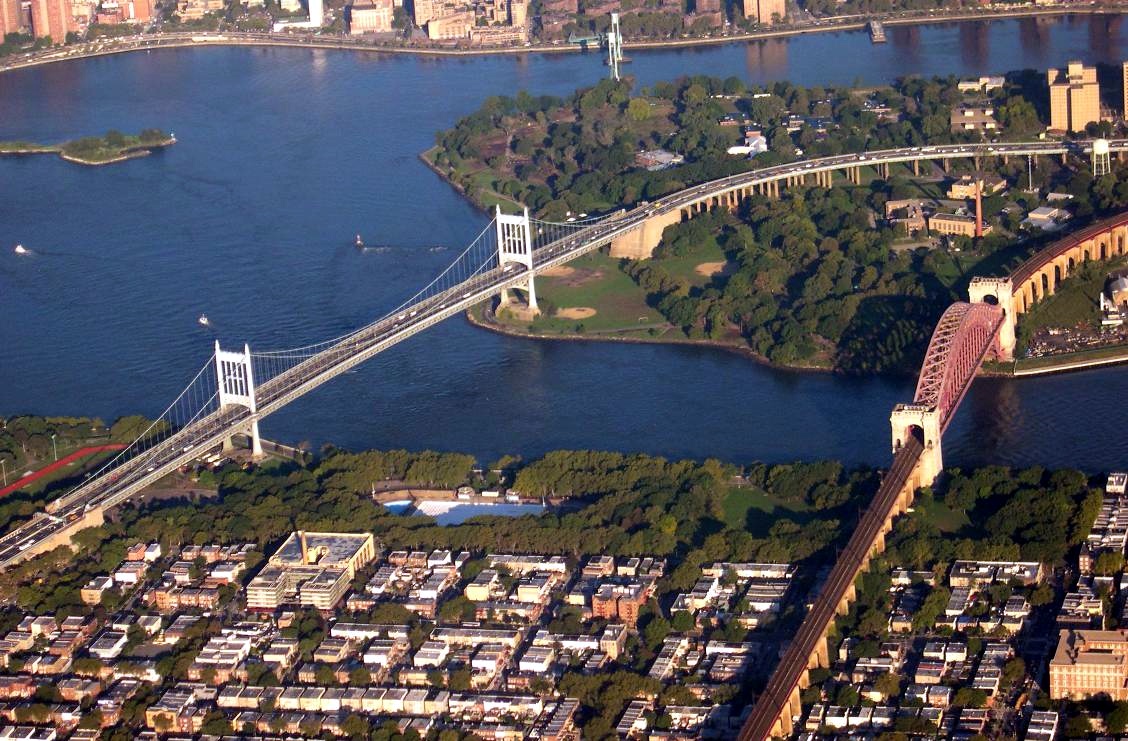
Hell Gate Bridge is a through arch bridge connecting the Bronx and Queens in New York City. Opened in 1917 for the New York Connecting Railroad. The free Lokali audio guide runs 6 minutes.
✓ Published October 2026 · how we write these guides
Visitor facts
| Lokali audio guide | 6 min · free |
|---|---|
| Type | Bridge |
| Location | New York, United States |
| Coordinates | 40.7825, -73.9219 |
| Languages | 50+, in the Lokali app |
The story
Stand on the grass of Astoria Park and listen. A low rumble starts somewhere to the east, grows louder, and then rolls overhead like distant thunder. A train is crossing the great red arch above you. Below, the East River slides past in dark, uneven currents, and the air carries the smell of salt water and cut lawn.
This is the Hell Gate Bridge. It is a steel arch that carries railway tracks high over a narrow, troubled stretch of water between Queens and the islands of the East River. Most New Yorkers never ride across it, and many have never noticed it. Yet it is one of the most important engineering works in the city's history.
Start with the name. Hell Gate is the strait beneath you, not the bridge itself. The name comes from early Dutch settlers, who called this passage something close to Hellegat. Historians still debate the exact meaning. It may have meant a bright passage, or something closer to a gate to hell. Sailors of the colonial era had no doubt which meaning fit.
For centuries, this water was a graveyard for ships. Here the tidal flows of Long Island Sound meet the waters of the upper bay. The currents twist and fight around rocks and reefs. Hundreds of vessels ran aground or sank here. In the late nineteenth century, army engineers drilled tunnels under the worst reefs and blasted them apart. One of those blasts was among the largest planned explosions of its era, and people felt it across the city.
Now, a story that sits between history and legend. During the American Revolution, a British warship called the Hussar sank somewhere in these waters. Locals have long said she carried a fortune in gold to pay British troops. Treasure hunters have searched for generations. No one has ever proved the gold was aboard, so treat this one as a tale... but it is a good tale to keep in mind as you watch the water.
The bridge itself opened in 1917. It was built for the New York Connecting Railroad, a joint project of the Pennsylvania Railroad and the New Haven Railroad. The goal was simple and ambitious. For the first time, trains from New England could run straight through to Pennsylvania Station in Manhattan and continue south, without passengers changing to ferries.
The man behind the design was Gustav Lindenthal, an Austrian-born engineer who had already shaped much of the city's infrastructure. He also worked on the Queensboro Bridge, further down the East River. Here is a detail most visitors miss. One of his assistants on this project was a young Swiss engineer named Othmar Ammann. Ammann later designed the George Washington Bridge and the Verrazzano-Narrows Bridge. In a way, this arch was his training ground.
When it opened, the Hell Gate Bridge had the longest steel arch span in the world. It held that title until the Bayonne Bridge opened in 1931. Look at the shape carefully. The main arch is the lower curve. The upper line is a stiffening truss, and near each end it sweeps upward to meet the stone towers. That reverse curve gives the bridge its strong, almost muscular profile.
Now look at those towers. They are massive, faced in stone, and they look as if they hold the whole structure up. Here is the second surprise. Engineers generally agree that the steel arch does most of the work. The towers mainly give the eye a sense of weight and rest at each end. Lindenthal believed a bridge should look as solid as it truly was, and the towers deliver that feeling.
This bridge travelled further than you might expect, at least as an idea. When engineers designed the Sydney Harbour Bridge in Australia, they drew heavily on this arch. Put photographs side by side and the family resemblance is clear: the same steel arch, the same stone towers at each end. A railway bridge in Queens helped shape a symbol on the other side of the world.
Today the bridge still does exactly the job it was built for. Amtrak passenger trains on the Northeast Corridor cross it, linking Boston, New York, and Washington. Freight trains use it too. The deep red colour you see dates from a major repainting near the end of the twentieth century. Many people now call that shade Hell Gate red, and it glows warmly at sunset.
The bridge is also famous for its strength. It is often described as one of the sturdiest bridges in the country. A popular television series once suggested that, if humans disappeared, this bridge might outlast almost every other in New York by many centuries. That was speculation, not a measured study, but engineers do agree the structure was built with generous margins.
As you stand here, notice the company the arch keeps. Just beside it runs the Robert F. Kennedy Bridge, once called the Triborough, carrying cars instead of trains. Behind you, Astoria Park stretches along the shore with its old trees, running paths, and large public pool. On the far side lie Randalls and Wards Islands, green and quiet.
Before you leave, wait for one more train. Watch the steel arch take the load without a visible tremble. Listen as the sound rises and fades. Then look down at the water, still twisting through its narrow gate. The river has not changed its temper. The bridge simply learned to stand above it.
Key facts
What to look for
Practical tips
Common questions
Is there a free audio guide to Hell Gate Bridge?
Yes — the Lokali app narrates Hell Gate Bridge free of charge in 50+ languages. The guide runs about 6 minutes, covers the history, what to look for on site and practical tips, and works offline once downloaded.
Where is Hell Gate Bridge?
Hell Gate Bridge is in New York, United States, at 40.7825, -73.9219. Tap the map link on this page for directions from where you are.
What is Hell Gate Bridge known for?
Opened in 1917 for the New York Connecting Railroad. Designed by engineer Gustav Lindenthal.
What should you look for at Hell Gate Bridge?
The upper truss curving upward to meet each tower. Stone-faced towers anchoring both ends of the arch. Swirling, uneven currents in the strait below.
What should you know before visiting Hell Gate Bridge?
Watch from Astoria Park along the Queens shoreline. Come near sunset when the red steel glows warmest.
When is the best time to visit Hell Gate Bridge?
Come near sunset when the red steel glows warmest.
On the map
Opens directions to Hell Gate Bridge from your location.
More to see in New York


Hear Hell Gate Bridge in your language
The full story, narrated, in 50+ languages. Download it before you go and it plays offline, at your own pace, with no ticket and no tour group.