
St. Paul's Chapel is a 1766 Georgian church that served as a refuge for rescue workers during and after the attacks. It is in New York, United States. Most visitors spend 30–45 min here. The free Lokali audio guide runs 5 minutes.
✓ Verified August 2026 · how we write these guides
Visitor facts
| Time needed | 30–45 min |
|---|---|
| Lokali audio guide | 5 min · free |
| Type | Chapel |
| Best for | History |
| Location | New York, United States |
| Coordinates | 40.7113, -74.0061 |
| Languages | 45, in the Lokali app |
The story
Step off the noise of Broadway and into sudden quiet. The traffic fades behind stone walls. Old trees lean over weathered gravestones, and the air feels cooler here, shaded and still. You are standing in the yard of St. Paul's Chapel, the oldest church building still standing in Manhattan.
Builders finished this chapel in 1766. At that time, the British king still ruled these colonies, and the city was small, clustered near the harbor to the south. The chapel stood at the edge of town, looking out over open fields. The stone is rough and gray, cut from local rock, and the style is plain and balanced, in the Georgian manner of its day. Notice, too, that the chapel's grandest face does not look toward Broadway. Its tall columns and main porch face the other way, toward the west, where the water once lay closer to the town.
Ten years after it was built, much of New York burned. A great fire swept through the city in 1776, during the war for independence, and destroyed about a quarter of its buildings. St. Paul's survived. It would not be the last time this small chapel outlasted disaster around it.
In 1789, a new nation chose New York as its first capital. On the thirtieth of April that year, George Washington took the oath as the first president a short walk from here. After the ceremony, he came to this chapel to pray. For the next two years, while the city served as the capital, Washington worshiped here regularly.
His pew still stands inside, set apart and marked. Above it hangs an early painting of the seal of the United States, made when the design was new. Step indoors and the light changes. Pale columns rise to a curved ceiling painted in soft colors. Cut-glass chandeliers hang from above. The room is bright, calm, and simple. Look up to find the carved wooden pulpit, raised on its slender stand. For a building so old, the space feels surprisingly light, made for gathering rather than for shadow.
For more than two centuries, the chapel kept its quiet routine of services and prayers. The city grew up and around it, rising higher each decade. Tall towers replaced the open fields. By the end of the twentieth century, two enormous towers of the World Trade Center stood just across the street, less than a hundred yards from the chapel door.
On the morning of September 11, 2001, those towers fell. The destruction reached across the whole neighborhood. Windows broke, and a thick gray dust covered everything for blocks in every direction. Yet St. Paul's Chapel, so close to the towers, came through without major harm. Not even a single window was lost.
Many believe a tree saved it. A large sycamore had grown for years at the edge of the churchyard, on the side facing the towers. When the buildings fell, the tree took the force of the flying debris and was destroyed. The chapel behind it stood. People began to call it the little chapel that stood.
In the weeks and months that followed, the chapel became a place of rest. Recovery workers labored day and night at the ruined site nearby, searching the rubble. They came here to sleep on the pews, to eat warm food, and to be cared for. Thousands passed through. Letters, photographs, and badges from around the world were left along the fence and the walls. The relief effort here went on for months, day after day, until the work at the ruined site was finally done.
Walk slowly through the rooms today and you can still see signs of that time, kept as a memorial. Cots, banners, and gifts from those difficult months are placed here with care. The chapel holds two stories at once now. One reaches back to the founding of the country. The other is close, and recent, and still tender.
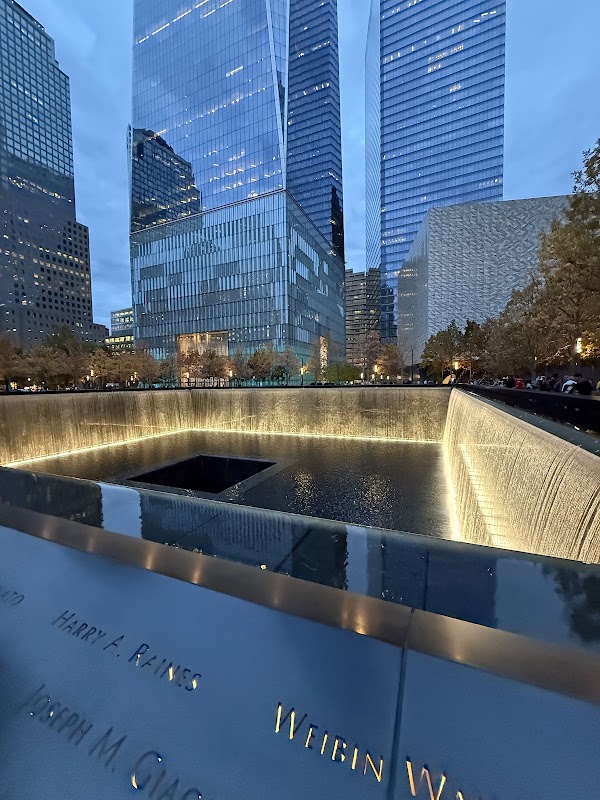
Outside again, walk among the old graves in the yard. Some of the stones are so worn that the names have nearly faded away. Roots push up the earth between them. Birds move in the branches overhead. Beyond the iron fence, modern towers climb into the sky, and the rebuilt World Trade Center site stands close by.
St. Paul's Chapel is a survivor. It outlived a colonial fire, watched a nation begin, and stood through the worst day its neighborhood ever knew. It asks nothing of you but a few quiet minutes. Sit on a bench in the shade, between the old stones and the new towers, and let the city wait outside the wall a little longer.
Key facts
What to look for
Practical tips
Common questions
How long do you need at St. Paul's Chapel?
Plan 30–45 min. That is the time most visitors spend at St. Paul's Chapel. The free Lokali audio guide adds about 5 minutes of narration you can listen to as you walk, so it fits inside your visit rather than adding to it.
Is there a free audio guide to St. Paul's Chapel?
Yes — the Lokali app narrates St. Paul's Chapel free of charge in 50+ languages. It covers the history, what to look for on site and practical tips, and it works offline once downloaded.
Where is St. Paul's Chapel?
St. Paul's Chapel is in New York, United States, at 40.7113, -74.0061. Tap the map link on this page for directions from where you are.
What should you know before visiting St. Paul's Chapel?
Step inside to see George Washington's marked pew.
What is St. Paul's Chapel known for?
St. Paul's Chapel was completed in 1766.
What is the best time to visit St. Paul's Chapel?
The chapel's walls are covered with tributes left by visitors—handwritten notes, photographs, and mementos.
On the map
Opens directions to St. Paul's Chapel from your location.
More to see in New York


Hear St. Paul's Chapel in your language
The full story, narrated, in 50+ languages. Download it before you go and it plays offline, at your own pace, with no ticket and no tour group.