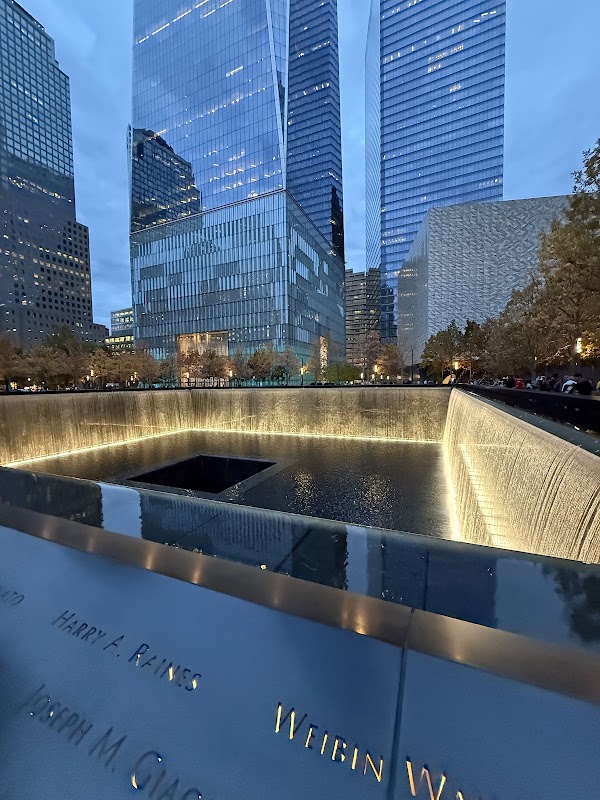
9/11 Memorial & Museum is a landmark in New York, United States. Water falls, and the sound fills the square. The free Lokali audio guide runs 6 minutes.
✓ Verified August 2026 · how we write these guides
Visitor facts
| Lokali audio guide | 6 min · free |
|---|---|
| Location | New York, United States |
| Coordinates | 40.7126, -74.0129 |
| Languages | 45, in the Lokali app |
The story
Water falls, and the sound fills the square. It pours down four gray stone walls into a wide pool below. Then it slides into a smaller square void at the very center, an opening that seems to drop without end. You came here to a place of falling water. You also came to a place of names. Listen first, before you read them.
You are standing where the Twin Towers once rose. They were the two main towers of the World Trade Center, each more than a quarter of a mile tall. On the morning of September 11, 2001, attackers flew two passenger planes into them. Within hours both towers fell. Nearly three thousand people died here that single day. The ground you cross was the center of it.
The memorial sits inside the exact footprints of the two fallen towers. Each pool fills the square where a tower's base once met the earth. The water drops about thirty feet down every side. These are among the largest built waterfalls in North America. The whole design carries a plain and honest name. It is called Reflecting Absence. The empty centers are the heart of it.
The architect was Michael Arad, then a young and little-known designer. He shaped the plan with the landscape architect Peter Walker. Their idea was simple to say and hard to do. Mark the empty space. Do not fill it in. Let the missing towers stay missing. Let falling water and rows of trees carry the weight of so much grief, year after year.
Run your hand along the bronze edge that frames each pool. The dark metal is cut clean through with names. There are 2,983 of them in all. They name everyone killed on September 11, 2001, at all three sites that were struck. They also name the six people killed when a truck bomb tore through these same towers earlier, on February 26, 1993.
The names are not set in alphabetical order. Instead, the planners asked the families a question. Who did your loved one know? Who did they work beside, or love, or sit near? Then they placed each name next to those people. Co-workers rest together. Friends stay close to friends. This careful pairing has a name of its own. It is called meaningful adjacency.
Now look for a single pear tree that stands a little apart from the rest. Workers found it in the wreckage, burned black and snapped, with one branch still alive. A city nursery took it in and cared for it for years. Slowly it healed. Then it was brought back and replanted here. People call it the Survivor Tree. Each spring it flowers white.
Around you grow more than four hundred swamp white oaks. They were chosen to turn warm gold and brown in autumn and to throw cool shade in summer. The trees stand in tidy lines across the plaza. Yet one open clearing is left bare among them, with no tree at all. That gap lets light pour down and lets the sky reach the ground.
One low, clear glass building leans up from the plaza. It is the doorway to the museum, and most of the museum lies far below your feet. You walk down slowly, ramp by ramp, toward bedrock. That is the solid stone the towers were anchored into. The long descent into the earth is not a delay. It is part of the story itself.
Underground you come to the slurry wall. This concrete wall held back the Hudson River while the towers were built, and it did not give way even when they collapsed above it. Close by stands the Last Column. It is a steel beam covered in written messages, photographs, and badges, the final piece carried out when the cleanup ended in 2002.
The museum also keeps small, everyday things. A pair of dusty shoes worn while fleeing down the stairs. A firefighter's dented helmet. A voicemail left in the last few minutes. These quiet objects do not shout. They ask you to slow your steps and to look closely at single human lives, rather than at one vast and numbing number.
Take your time below, then climb back up into the open air. The water is still falling. It will keep falling all day and through the night, the same steady sound, over and again. There is no closing hour for the pools. They run on while the city moves around them, holding the space where two towers used to stand.
Stand at the bronze edge a while longer. Around you, people lower their voices without being told. Some trace a name with a fingertip. Some leave a flower in the cut letters. Read one name slowly. Say it once, under your breath. Then let the water carry it. That small act, repeated by strangers all day, is the quiet center of this place.
Key facts
What to look for
Practical tips
Common questions
How long is the audio guide for 9/11 Memorial & Museum?
The free Lokali audio guide for 9/11 Memorial & Museum runs about 6 minutes. Allow extra time beyond that to look around at your own pace.
Is there a free audio guide to 9/11 Memorial & Museum?
Yes — the Lokali app narrates 9/11 Memorial & Museum free of charge in 50+ languages. It covers the history, what to look for on site and practical tips, and it works offline once downloaded.
Where is 9/11 Memorial & Museum?
9/11 Memorial & Museum is in New York, United States, at 40.7126, -74.0129. Tap the map link on this page for directions from where you are.
What should you know before visiting 9/11 Memorial & Museum?
Visit early morning for quieter pools and shorter lines.
What is 9/11 Memorial & Museum known for?
Nearly three thousand people died here on September 11, 2001.
On the map
Opens directions to 9/11 Memorial & Museum from your location.
More to see in New York


Hear 9/11 Memorial & Museum in your language
The full story, narrated, in 50+ languages. Download it before you go and it plays offline, at your own pace, with no ticket and no tour group.