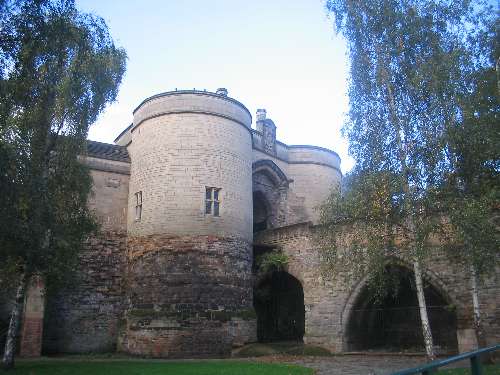
Nottingham Castle
52.9492° N · 1.1547° W · Castle
Photo: Cosmicutencil · CC0 · Wikimedia Commons
Nottingham Castle is a castle in Nottingham, Nottinghamshire, England, UK. William the Conqueror founded the first castle here in 1068. The free Lokali audio guide runs 7 minutes.
✓ Published October 2026 · how we write these guides
Visitor facts
| Lokali audio guide | 7 min · free |
|---|---|
| Type | Castle |
| Location | Nottingham, United Kingdom |
| Coordinates | 52.9492, -1.1547 |
| Official website | nottinghamcastle.org.uk |
| Languages | 50+, in the Lokali app |
The story
Feel the ground under your feet for a moment. It is soft, warm-coloured sandstone, the same pale rock that rises in a cliff beneath the castle walls. Run a hand along an exposed face and grains of sand come away on your fingertips. This rock is the reason a castle stands here at all. It lifts sharply above the old town and the river valley, and from the top, a lookout could see anyone coming for miles.
Welcome to Nottingham Castle. Before we go further, here is the first surprise. The grand building in front of you is not a medieval castle. It is a seventeenth-century ducal mansion, later burned out and rebuilt as a museum. The real medieval fortress is mostly gone. What survives are fragments, foundations, a gatehouse, and the rock itself. The story of this hill is one of building, destruction, and building again.
The story begins in 1068, two years after the Norman Conquest. William the Conqueror ordered a castle on this rock. It was a simple design at first — an earth mound and a timber fort, with an enclosed yard around it. Over the following centuries, kings replaced the timber with stone. The fortress grew into one of the most important royal strongholds in the middle of England. Monarchs stayed here, held councils here, and used it as a base for their armies.
In 1194, King Richard the First, often called the Lionheart, came back from crusade and imprisonment abroad. He found this castle in the hands of men loyal to his brother, Prince John. Richard laid siege to it, and the defenders soon surrendered. If that pairing sounds familiar, it should. Richard and John are the king and the villain-prince of the Robin Hood stories. Those tales grew up around this region, and the Sheriff of Nottingham became their most famous enemy.
Now for one of the most dramatic nights in English royal history. In 1330, the young King Edward the Third wanted to take power from Roger Mortimer. Mortimer ruled England alongside Edward's mother, Queen Isabella. According to the accounts of the time, Edward and a small group of loyal men entered the castle through a secret passage in the rock. They seized Mortimer in his chambers. Mortimer was later executed, and Edward began to rule in his own right.
That passage is known today as Mortimer's Hole. It is one of many caves cut into the sandstone under the castle. Nottingham is a city built on hollow ground. Hundreds of caves run beneath its streets, carved by hand over many centuries. People used them as cellars, workshops, stores, and even homes. Guided cave tours here often need a separate booking, so check before your visit if you want to go underground.
The next turning point came in 1642. King Charles the First raised his royal standard in Nottingham, a formal call to arms. That act marked the start of the English Civil War, a conflict between the King and Parliament. The site is remembered in a street name nearby, Standard Hill. But Nottingham did not side with the King. Parliament's forces held the castle through the war, and it never fell to the royalists.
When the fighting ended, Parliament did not want strong castles left standing for future rebels. So in 1651, the old fortress was deliberately pulled down. This was a common fate for castles at the time, known as slighting. Stone from the walls was carried off and reused. Within a few years, the royal stronghold of five centuries was little more than ruins and rubble on the rock.
In the 1670s, the Duke of Newcastle chose the cleared hilltop for something new. He began a grand mansion in an elegant classical style, with long rows of windows and carved stone details. The Duke died before it was finished, and his son completed the work. Look up at the facade now. It is a house built to show wealth and taste, not to withstand a siege. It sits on medieval foundations, but it belongs to a completely different world.
Then came fire. In 1831, a bill to reform Parliament and widen the vote was blocked. Anger spread across the country. The Duke of Newcastle of that time was a strong opponent of reform. Crowds in Nottingham marched up to his mansion and set it alight. The building burned to an empty shell. For decades afterwards, the blackened ruin stood over the city, a visible reminder of that night of protest.
Here is the second surprise. That ruin became a landmark of public culture. In 1878, the restored building opened as a museum and art gallery. It was the first municipal art museum in Britain outside London — a museum owned and run by a town for its own people. The burned palace of an unpopular duke became a place where anyone could walk in and look at paintings. Many visitors find that a fitting end to the story.
The castle has changed again in recent years. It went through a major redevelopment and a period of closure, and new galleries now tell the stories of Robin Hood and of rebellion in Nottingham. As you walk the grounds, notice the gatehouse, with its older stonework set into the walls. Then step outside the walls to find the bronze statue of Robin Hood, drawing his bow. It has become one of the most photographed spots in the city.
Before you leave, walk to the edge of the terrace and look out. Below you are rooftops, church towers, and the green line of distant hills. At the foot of the rock sits an old inn that claims to be among the oldest in England, though that claim is debated. Listen to the city around you. Under its streets, the caves are still there, quiet and cool. And under your feet, the same soft sandstone that drew William the Conqueror here still holds everything up.
Key facts
What to look for
Practical tips
Common questions
Is there a free audio guide to Nottingham Castle?
Yes — the Lokali app narrates Nottingham Castle free of charge in 50+ languages. The guide runs about 7 minutes, covers the history, what to look for on site and practical tips, and works offline once downloaded.
Where is Nottingham Castle?
Nottingham Castle is in Nottingham, United Kingdom, at 52.9492, -1.1547. Tap the map link on this page for directions from where you are.
What is Nottingham Castle known for?
William the Conqueror founded the first castle here in 1068. Richard the Lionheart besieged the castle in 1194.
What should you look for at Nottingham Castle?
Pale sandstone of Castle Rock exposed below the walls. Older medieval stonework surviving in the gatehouse. Classical rows of windows on the ducal mansion facade.
What should you know before visiting Nottingham Castle?
Book cave tours ahead, as they may need a separate ticket. Wear sturdy shoes for steep paths and uneven cave floors.
On the map
Opens directions to Nottingham Castle from your location.
More to see near Nottingham Castle


Hear Nottingham Castle in your language
The full story, narrated, in 50+ languages. Download it before you go and it plays offline, at your own pace, with no ticket and no tour group.