
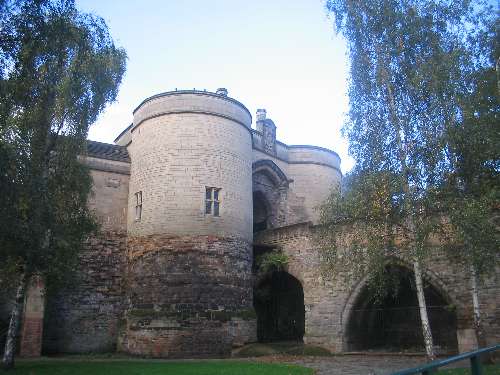
Photo: Nancy · CC BY-SA 4.0 · Wikimedia Commons
Belvoir Castle is a historic house museum and home of the Dukes of Rutland in Leicestershire, England, UK. Belvoir is pronounced 'Beaver' by locals. The free Lokali audio guide runs 6 minutes.
✓ Published October 2026 · how we write these guides
Visitor facts
| Lokali audio guide | 6 min · free |
|---|---|
| Type | Museum |
| Location | Grantham, United Kingdom |
| Coordinates | 52.8945, -0.7826 |
| Official website | belvoircastle.com |
| Languages | 50+, in the Lokali app |
The story
Listen first to the wind. Up here, on this wooded ridge, the air moves freely across open country. Below you, the land falls away in long green folds. Hedgerows, fields and small villages spread towards a soft horizon. The castle walls are a warm, golden stone. Late in the day they glow almost honey-coloured. Before we talk about dukes or fires or film crews, take a moment to look outward. This view is the whole reason the castle exists.
First, a small surprise. The name is written Belvoir, but nobody here says it that way. Locals pronounce it 'Beaver'. The spelling comes from Norman French and means 'beautiful view'. Over the centuries, English tongues smoothed the word down into something simpler. So if you hear people talking about Beaver Castle, they mean exactly where you are standing. The valley below shares the name. It is the Vale of Belvoir, also said as 'Beaver'.
The story begins with the Norman Conquest of England in the eleventh century. A Norman lord named Robert de Todeni received land here. He is remembered as a standard-bearer to William the Conqueror, the man who carried the flag into battle. He chose this ridge for a fortress. The reason was practical. From this height, a garrison could watch the whole vale. Nobody could approach unseen. Height meant safety, and safety meant power.
That first castle is long gone. Over the following centuries, the buildings on this hill were built, damaged and rebuilt more than once. Medieval wars took their toll. Later, during the English Civil War of the seventeenth century, the castle was held as a stronghold. When the fighting ended, the old fortifications were pulled down so they could never be used again. A new house rose afterwards. Each generation left its own layer on this hilltop.
Through most of that long story, one family stayed at the centre. They are the Manners family, the Dukes of Rutland. Their link to Belvoir goes back to Tudor times, the age of Henry the Eighth and Elizabeth the First. The family still lives here today. That makes this place more than a museum. It is a working home. Behind some of these doors, ordinary family life carries on, with all its kitchens, dogs and daily routines.
Now look closely at the building itself. The towers, battlements and turrets seem medieval. But here is the second surprise — most of what you see is not old in that sense. The present castle is largely a creation of the early nineteenth century. It is in a style called Gothic Revival. This was a fashion for buildings that imitated the castles and churches of the Middle Ages. In other words, it is a romantic dream of a castle, built with nineteenth-century skill.
The architect most connected with this rebuilding was James Wyatt, one of the leading designers of his day. Work was well underway when disaster struck. In 1816, a great fire swept through part of the castle. Rooms were lost. Many fine paintings were destroyed, including works by Sir Joshua Reynolds, a celebrated English portrait painter. For a family that loved art, it was a heavy blow. Yet the rebuilding went on.
Much of the energy behind that effort came from Elizabeth, the Fifth Duchess of Rutland. She took a close personal interest in the design. Her influence shows most clearly in one room named after her, the Elizabeth Saloon. It is decorated in a rich French style, full of gilding, silk and painted ceilings. After the grey stone outside, the brightness inside can feel like stepping into a jewel box. If you visit the state rooms, watch for it.
Inside, the castle holds a large collection of paintings, tapestries, furniture and porcelain gathered over many generations. The rooms change in mood as you move through them. Some are grand and ceremonial. Others are panelled and quieter. In the great spaces, notice how sound travels. Footsteps echo on stone. Voices soften on carpet. These rooms were made to impress guests, but also to be lived in through long English winters.
You may feel you have seen these interiors before. That would not be strange. Belvoir has often appeared on screen. Film and television makers come here when they need a grand English castle. It appeared in films such as The Young Victoria and The Da Vinci Code. In the television series The Crown, it stood in for Windsor Castle. So a building that imitates the Middle Ages now also plays other castles. It is a performer in stone.
Outside, the gardens tell their own story. In the eighteenth century, the famous landscape designer Lancelot 'Capability' Brown drew up plans for the grounds. He earned his nickname by telling clients their land had 'capability' for improvement. His plans for Belvoir were never carried out in his lifetime. They waited in the archive for a very long time. In recent years, the estate has worked to bring that vision to life at last.
The gardens also include quieter, more intimate spaces. The slopes below the castle hold woodland walks, terraces and planted gardens. In spring and early summer, flowers and blossom soften the steep ground. In autumn, the trees turn copper and gold against the pale stone. Paths wind downhill and back up again. The climb can be steady, so take it slowly. Every turn gives you a new angle on the towers above.
Before you leave, come back to where we began. Stand still and look out across the Vale once more. A Norman soldier once stood near here, watching for danger. A nineteenth-century duchess looked at this view and imagined a castle from a storybook. Today, you see the same rolling fields, the same wide sky. The buildings changed many times. The view did not. Listen again to the wind as you walk away, and let the beautiful view stay with you.
Key facts
What to look for
Practical tips
Common questions
Is there a free audio guide to Belvoir Castle?
Yes — the Lokali app narrates Belvoir Castle free of charge in 50+ languages. The guide runs about 6 minutes, covers the history, what to look for on site and practical tips, and works offline once downloaded.
Where is Belvoir Castle?
Belvoir Castle is near Grantham, United Kingdom, at 52.8945, -0.7826. Tap the map link on this page for directions from where you are.
What is Belvoir Castle known for?
Belvoir is pronounced 'Beaver' by locals. Name means 'beautiful view' in Norman French.
What should you look for at Belvoir Castle?
Gilded French-style decoration in the Elizabeth Saloon. Battlements and turrets imitating medieval castle design. Honey-coloured stone walls catching the evening light.
What should you know before visiting Belvoir Castle?
Check visiting days in advance; the family lives here. Wear sturdy shoes for the steep garden paths.
When is the best time to visit Belvoir Castle?
Come late afternoon to see the stone glow gold.
On the map
Opens directions to Belvoir Castle from your location.
More to see near Belvoir Castle


Hear Belvoir Castle in your language
The full story, narrated, in 50+ languages. Download it before you go and it plays offline, at your own pace, with no ticket and no tour group.