
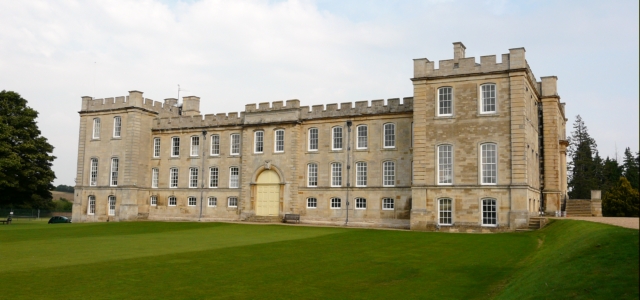
Photo: Anthony Masi from UK · CC BY 2.0 · Wikimedia Commons
Burghley House is a grand sixteenth-century country house near Stamford, Lincolnshire, England, UK. Built for William Cecil, chief adviser to Elizabeth the First. The free Lokali audio guide runs 6 minutes.
✓ Published October 2026 · how we write these guides
Visitor facts
| Lokali audio guide | 6 min · free |
|---|---|
| Type | Museum |
| Location | Stamford, United Kingdom |
| Coordinates | 52.6425, -0.4531 |
| Official website | burghley.co.uk |
| Languages | 50+, in the Lokali app |
The story
Listen first. Gravel crunches under your shoes, and somewhere across the open grass a crow calls. Then the house comes into view. It is a long, pale wall of honey-coloured limestone with a roofline that looks almost unreal. Turrets, domes, chimneys and a tall pointed spire stand against the sky like a small city. You are a short walk from the market town of Stamford, but out here it feels like another century.
This is Burghley House, one of the great houses of Elizabethan England. It was built for William Cecil, the man who served Queen Elizabeth the First as her most trusted adviser for about forty years. Cecil was made Lord Burghley, and the house carries his title. Building ran through much of the second half of the sixteenth century. His family still owns and lives in the house today, so this is a home as well as a monument.
To understand the house, you need to understand its builder. William Cecil came from a family of modest gentry here in Lincolnshire. He rose through talent, caution and hard work, and he survived the dangerous politics of several Tudor reigns. Under Elizabeth he handled state finances, foreign affairs and security. A house like this was a statement. It told visitors, and the Queen herself, that this servant of the crown had arrived.
Historians call buildings like this "prodigy houses". The term describes the huge, showy country houses that Elizabethan courtiers built, partly in the hope of hosting the monarch on her summer travels. These houses were meant to impress at first sight. Look at how much glass there is in the windows. In the sixteenth century glass was expensive, so walls of windows were a way of showing wealth. Then look up again at that crowded skyline.
Here is the first detail many visitors miss. Several of the chimneys are shaped like classical columns, grouped together with little capitals on top. From a distance they look like decoration, but they are working chimneys. This mix of English tradition and Italian Renaissance ideas runs right through the building. Renaissance, in this sense, means the revival of ancient Greek and Roman forms that spread north from Italy. Builders here borrowed those forms and used them in their own way.
Walk towards the inner courtyard if you can, and look for the tall clock tower. Above it rises an obelisk-like spire. The courtyard walls are covered with carved detail, coats of arms and stacked columns. In soft morning light the stone turns almost gold, and at dusk it goes grey and silver. The same limestone gives Stamford its warm colour, which is one reason the town and the house feel so closely related.
Inside, the mood changes completely. Much of the interior was remodelled in the late seventeenth century by a later member of the family, the fifth Earl of Exeter. He travelled across Europe, especially in Italy, and brought home paintings, furniture, porcelain and sculpture on a large scale. Many of the objects you see in the state rooms come from those journeys. The house became less of an Elizabethan fortress of status and more of a gallery.
The most dramatic rooms are the work of the Italian painter Antonio Verrio. In the Heaven Room, gods and goddesses crowd the walls and ceiling. The painted architecture seems to open the room out into the sky, and figures appear to lean out of the walls towards you. Stand in the centre and turn slowly. The effect is closer to a theatre set than to a framed picture. It is meant to overwhelm you.
Then comes the second surprise. Not far away is the staircase known as the Hell Staircase. Its ceiling shows the mouth of Hell as a gigantic open jaw, filled with figures in torment. It is a strange thing to paint above a grand stair in a family home. But the pairing of Heaven and Hell under one roof says a lot about the confidence, and the sense of drama, of the age that painted them.
For something more down to earth, find the Old Kitchen. It is a tall, vaulted space, and its walls are lined with rows of shining copper pans and moulds. Think about the scale of work here. A household of this size needed food for family, guests and a large staff every day. The heat, the noise and the smoke of this room once kept the whole house running, far from the painted gods upstairs.
Outside, the parkland was reshaped in the eighteenth century by Lancelot Brown, the landscape designer better known as Capability Brown. He favoured rolling grass, clumps of trees and long views over water, and that style still shapes what you see. A herd of fallow deer grazes in the park. The open landscape also hosts the Burghley Horse Trials each autumn, a major international equestrian event that draws large crowds.
The house has also appeared on screen. Film-makers have used it as a ready-made palace, including scenes in the 2005 film of Pride and Prejudice. In the gardens there is a more playful side too. The Garden of Surprises has water jets and mirrors that reward curiosity, and children often get wet there on warm days. Nearby, a sculpture garden places modern works among the trees, a reminder that the collection did not stop growing.
Before you leave, walk back out far enough to see the whole south or west front in one view. Notice how flat and calm the land around it is. Nothing competes with that skyline. Listen again for the gravel, the wind in the trees, perhaps the bark of a dog in the park. Four centuries of one family's ambition stand in front of you, and the deer, quite rightly, take no notice of any of it.
Key facts
What to look for
Practical tips
Common questions
Is there a free audio guide to Burghley House?
Yes — the Lokali app narrates Burghley House free of charge in 50+ languages. The guide runs about 6 minutes, covers the history, what to look for on site and practical tips, and works offline once downloaded.
Where is Burghley House?
Burghley House is in Stamford, United Kingdom, at 52.6425, -0.4531. Tap the map link on this page for directions from where you are.
What is Burghley House known for?
Built for William Cecil, chief adviser to Elizabeth the First. Classic example of an Elizabethan prodigy house.
What should you look for at Burghley House?
Chimneys shaped like grouped classical columns. The obelisk spire above the courtyard clock tower. Figures painted leaning out of the Heaven Room walls.
What should you know before visiting Burghley House?
Walk the park first to see the full skyline. Visit in morning light for golden stone tones.
When is the best time to visit Burghley House?
Check event dates if you want to avoid Horse Trials crowds.
On the map
Opens directions to Burghley House from your location.
More to see near Burghley House


Hear Burghley House in your language
The full story, narrated, in 50+ languages. Download it before you go and it plays offline, at your own pace, with no ticket and no tour group.