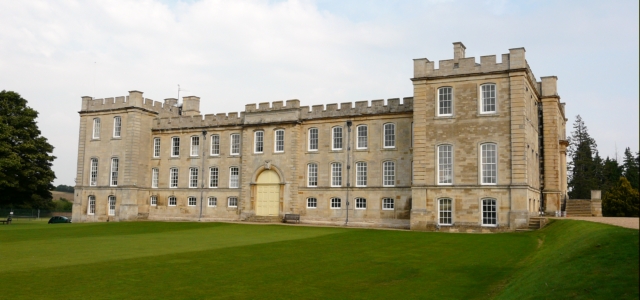
Photo: Graham Taylor · CC BY-SA 2.0 · Wikimedia Commons
Kimbolton Castle is a country house in Cambridgeshire, Engand. Catherine of Aragon died here in January 1536. The free Lokali audio guide runs 7 minutes.
✓ Published October 2026 · how we write these guides
Visitor facts
| Lokali audio guide | 7 min · free |
|---|---|
| Type | Museum |
| Location | Kimbolton, United Kingdom |
| Coordinates | 52.2956, -0.3872 |
| Official website | kimbolton.cambs.sch.uk |
| Languages | 50+, in the Lokali app |
The story
Stand at the top of the High Street for a moment and listen. The road here is unusually wide. Your footsteps fall on a broad, quiet space lined with old brick and colour-washed houses. At the far end, beyond a pair of gates, sits a long, pale building with a level roofline. It does not look like a fortress. It looks calm and ordered. Yet everyone here calls it a castle. That name carries a story, and the story begins long before the building you see today.
There has been a fortified house on this site since the Middle Ages. Over the centuries it was rebuilt and reshaped many times. Most of what you see now dates from the early eighteenth century. Older work still survives inside the walls, though. The building is not one design. It is a series of decisions by different owners, each adding to the work of the last. Keep that in mind as you look at it. You are seeing several centuries stacked together.
The most famous resident arrived against her will. In 1534, Catherine of Aragon was sent here. She was the first wife of King Henry the Eighth. Henry had set aside their marriage so that he could marry Anne Boleyn. Catherine refused to accept this. She insisted, to the end, that she was the true queen of England. She was moved away from the court and from her daughter, Mary. Kimbolton became the last stop on her long removal from power.
Her life here was small and closely watched. She kept to a few rooms with a reduced household of loyal servants. Accounts from the time describe how she would only answer to the title of queen. Servants who addressed her by any other title were refused. She spent much of her time in prayer. Her health grew worse through 1535. In January 1536, Catherine died here, within these grounds. She was buried not far away, in Peterborough Cathedral.
A house with such a history attracts stories. Locals say that Catherine has never fully left. According to one popular tale, a figure in a long gown has been seen on the stairs and in the corridors. These are legends, not records. But they show how deeply her presence marked this place. For many visitors, she is the reason they come. It is worth a quiet thought for her as you stand here.
After the Tudor period, the house changed hands. In the early seventeenth century, it was bought by Sir Henry Montagu. His family would hold it for more than three hundred years. The Montagus rose steadily in rank. They became Earls of Manchester, and later Dukes of Manchester. Kimbolton was their country seat. Most of the grand appearance you see today came from their ambition and their wealth.
Here is the first surprise. Around the early 1700s, part of the old building collapsed. The owner did not simply patch it. He called in Sir John Vanbrugh, one of the boldest architects of his age. Vanbrugh also designed Blenheim Palace and Castle Howard. He worked here with Nicholas Hawksmoor, his close collaborator. Vanbrugh wanted the new house to keep the feeling of a castle. So he gave it battlements along the roofline, even though it was really a classical mansion.
Look along the top of the walls and you will see what he meant. The battlements are a gesture, not a defence. They nod to the medieval past while the walls below are calm and symmetrical. This mix of old and new was Vanbrugh's signature. He liked buildings with drama and weight. At Kimbolton, he wrapped the earlier rooms inside a new, regular shell. The Tudor house is still in there, hidden behind the eighteenth-century stone.
Other well-known names left their mark too. On the east front stands a grand columned portico, added a little later. It is often credited to the Italian architect Alessandro Galilei. Inside, the main staircase carries painted murals by the Venetian artist Giovanni Antonio Pellegrini. He filled the walls with colour and figures in the style of Italian palaces. Then, in the later eighteenth century, Robert Adam designed the gatehouse that faces the High Street. Adam was famous for elegant, refined detail.
Now the second surprise. This is not a museum or a stately home in the usual sense. In 1950, the family sold the castle. Since then, it has been the home of Kimbolton School. Pupils walk the same corridors where Catherine of Aragon once paced. Classes take place under painted ceilings. Sports fields spread across the old parkland. The building is alive with daily routine — bells, voices, footsteps — rather than kept behind ropes.
Because it is a working school, public access is limited. The castle opens to visitors only on certain days each year. On those days you can see the state rooms and the Pellegrini murals up close. At other times, the best view is from the street and the gates. Even from outside, the building tells its story clearly. The long front, the battlements and the Adam gatehouse are all easy to read.
Take a moment to turn around and look back down the High Street. The village and the castle were planned to face each other. The wide street gave space for markets and fairs in the past. At the far end stands the parish church, its spire rising above the rooftops. Between the church and the castle, the whole village sits in a line. It is a simple, strong piece of old English town design.
So stand still for one more breath. In front of you is a Tudor prison, a Georgian mansion and a modern school, all in one. A queen spent her final months here. A family built its fortune here. Today, children learn here. As you walk away down the High Street, glance back once at the gatehouse. Notice how the battlements catch the light. Then listen — you may hear a school bell from somewhere behind those walls.
Key facts
What to look for
Practical tips
Common questions
Is there a free audio guide to Kimbolton Castle?
Yes — the Lokali app narrates Kimbolton Castle free of charge in 50+ languages. The guide runs about 7 minutes, covers the history, what to look for on site and practical tips, and works offline once downloaded.
Where is Kimbolton Castle?
Kimbolton Castle is in Kimbolton, United Kingdom, at 52.2956, -0.3872. Tap the map link on this page for directions from where you are.
What is Kimbolton Castle known for?
Catherine of Aragon died here in January 1536. Sir Henry Montagu bought the estate in the 1610s.
What should you look for at Kimbolton Castle?
Decorative battlements running along Vanbrugh's level roofline. Robert Adam's gatehouse facing the wide High Street. The columned portico on the castle's east front.
What should you know before visiting Kimbolton Castle?
Check the school's public open days before planning a visit. View the gatehouse from the far end of the High Street.
On the map
Opens directions to Kimbolton Castle from your location.
More to see near Kimbolton Castle


Hear Kimbolton Castle in your language
The full story, narrated, in 50+ languages. Download it before you go and it plays offline, at your own pace, with no ticket and no tour group.