
Dotonbori is a neighborhood in Osaka, Japan. Osaka's most energetic entertainment district, a maze of narrow streets lined with restaurants, izakayas, and shops. Most visitors spend 1–3 hours here. The free Lokali audio guide runs 5 minutes.
✓ Verified August 2026 · how we write these guides
Visitor facts
| Time needed | 1–3 hours |
|---|---|
| Lokali audio guide | 5 min · free |
| Type | Neighborhood |
| Best for | Local life |
| Location | Osaka, Japan |
| Coordinates | 34.6695, 135.5019 |
| Languages | 45, in the Lokali app |
The story
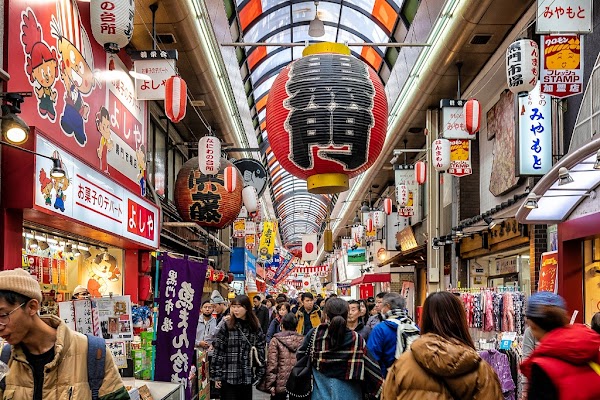
At night the canal turns into a river of light. Neon signs blaze on both banks. Their colors ripple and stretch across the dark water below. The smell of grilled food drifts through the warm air. Crowds move slowly along the narrow walkways, looking up, pointing, and eating as they walk. Let yourself be carried along with them for a while.
This is Dotonbori, the heart of Osaka's nightlife. It runs along a canal of the same name in the south of the city. The main strip is short, only a few hundred meters from end to end. But it holds more sound, light, and food than almost anywhere else in Japan. Few places try so hard to be noticed.
The canal came first, long before the lights. In the early seventeenth century, a businessman named Yasui Doton began digging it. He hoped to improve trade and move goods through the city. He did not live to see the work finished. It was completed in 1615, and the canal was named in his memory.
Soon the banks filled with theaters. Kabuki stages and puppet playhouses drew crowds for many generations. This was the entertainment quarter, the place people came to be amused. The old theaters are mostly gone now. But the spirit of performance never really left. Today the street itself has become the show you came to see.
One sign rises above all the others. It shows a runner crossing a finish line, both arms raised high. This is the Glico sign, an advertisement for a candy company. The very first version went up in 1935. People have posed beneath it, arms up like the runner, ever since. It may be the most photographed spot in the city.
Look for the giant crab as well. Its long legs and claws move slowly above a restaurant door. There is a huge pufferfish lantern, a spinning dragon, and a great mechanical octopus nearby. The signs all compete for your eyes at once. Each shop is trying hard to be the one you remember later.
Osaka has a word for the food culture here. It is kuidaore, which means roughly to eat yourself into ruin. People come to Dotonbori hungry and leave completely full. The idea behind it is simple enough. You taste a little of everything, one small dish at a time, until you can eat no more. That is the local way to enjoy this street.
Start with takoyaki. These are round balls of batter with a piece of octopus tucked inside. Cooks turn them quickly in iron molds with metal picks. They arrive hot, brushed with dark sauce, topped with flakes that wave in the rising heat. Eat them slowly and with care. The soft center stays very hot for a while.
Then try okonomiyaki, a savory pancake cooked on a flat griddle. Or kushikatsu, skewers fried in a crisp batter. There is one firm rule with kushikatsu that everyone follows. You may dip each skewer in the shared sauce only once. No double dipping is allowed. A sign on the wall will remind you of it.
The Ebisu Bridge crosses the canal in the middle of it all. People have met here for as long as anyone can remember. Say you will meet a friend on the bridge, and you will certainly not be alone. It is the busiest meeting point in the whole district. Stand still here and watch the faces pass.
For a quieter view, take a short boat ride along the canal. From the water the signs rise up on both sides of you. A guide points out the famous ones as you drift by. The colored light reflects all around the boat. It is the very same scene, seen from below, only slower and calmer.
Step off the main strip and the mood changes at once. Just south of the canal lies Hozenji Yokocho, a narrow stone-paved lane. At its heart sits a small temple with a stone figure covered in soft green moss. Visitors splash water on it as a quiet prayer. After the noise and light of the canal, the calm here comes as a relief.
Dotonbori asks nothing of you but to look and to taste. It has been a place of pleasure for four centuries, first with plays and now with food and light. Stand on the bridge for a little while. Let the colors move and bend on the water below. Then follow your nose, and let the street decide where you go next.
Key facts
What to look for
Practical tips
Common questions
How long do you need at Dotonbori?
Plan 1–3 hours. That is the time most visitors spend at Dotonbori. The free Lokali audio guide adds about 5 minutes of narration you can listen to as you walk, so it fits inside your visit rather than adding to it.
Is there a free audio guide to Dotonbori?
Yes — the Lokali app narrates Dotonbori free of charge in 50+ languages. It covers the history, what to look for on site and practical tips, and it works offline once downloaded.
Where is Dotonbori?
Dotonbori is in Osaka, Japan, at 34.6695, 135.5019. Tap the map link on this page for directions from where you are.
What should you know before visiting Dotonbori?
Try takoyaki, but let it cool before biting.
What is Dotonbori known for?
The canal was completed in 1615.
What is the best time to visit Dotonbori?
Go at dusk when neon ignites but crowds haven't peaked.
On the map
Opens directions to Dotonbori from your location.
Reference
More to see in Osaka


Hear Dotonbori in your language
The full story, narrated, in 50+ languages. Download it before you go and it plays offline, at your own pace, with no ticket and no tour group.