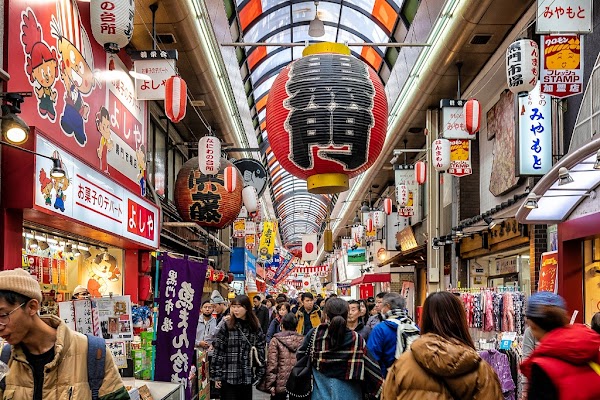
Kuromon Market is a 190-year-old covered food market with over 190 stalls selling fresh seafood, produce, prepared dishes, and street food. It is in Osaka, Japan. Most visitors spend 1–1.5 hours here. The free Lokali audio guide runs 5 minutes.
✓ Verified August 2026 · how we write these guides
Visitor facts
| Time needed | 1–1.5 hours |
|---|---|
| Lokali audio guide | 5 min · free |
| Type | Market |
| Best for | Local life |
| Location | Osaka, Japan |
| Coordinates | 34.6722, 135.5067 |
| Languages | 45, in the Lokali app |
The story
The air is thick with the smell of grilled seafood. Knives tap steadily on wooden cutting boards. Vendors call out over the heads of the crowd. A long covered arcade stretches ahead of you, lined with stalls on both sides. Ice glitters under the lights, piled high with fresh fish. This is a market that has fed Osaka for generations.
This is Kuromon Ichiba, in the Nipponbashi area of the city. The covered street runs for about 580 meters from end to end. Around one hundred fifty shops line it on either side. People here call it Osaka's Kitchen. For many years the city's cooks have come to this street to buy the ingredients they need.
The market's name means black gate. It comes from a temple that once stood nearby, whose main gate was painted black. The temple itself is long gone now. But the name it left behind has stayed. The market traces its history back roughly two centuries, to the early nineteenth century, when the city was much smaller.
For most of that time, this was a place for professionals. Restaurant owners and household cooks came early to choose the freshest fish of the day. The vendors knew their regular buyers by name. Quality mattered greatly, because a chef's reputation depended on it. That old standard still shapes the way the market works today.
Seafood is the star here, above everything else. You will see whole tuna being cut down with long, heavy blades. You will see shellfish, eel, crab, and rows of bright pink shrimp on ice. Much of it sits waiting in neat, glistening piles. Some of it is still moving slowly in tanks of cold water.
Many stalls now grill their seafood for you right on the spot. You can watch a scallop open slowly over the flame. You can try a skewer of grilled crab or a thick slice of tuna. The food travels from the ice, to the fire, to your hand in a matter of minutes. It does not get fresher than this.
Look for the pufferfish, known here as fugu. Osaka is famous for the careful way it prepares this fish. Fugu carries a strong poison if it is cut wrong, so only licensed cooks may serve it. In the winter months you will see it everywhere. It waits in tanks and lies arranged on plates throughout the market.
There is far more than seafood here, though. Stalls sell fresh fruit, cut and ready to eat in your hand. Melon, strawberries, and grapes are arranged like jewels in their cases. Pickle shops offer long rows of vegetables in wooden barrels. Other stands sell sharp knives, loose tea, and sweets. You can graze your way slowly from one end to the other.
The market wakes up early. Many shops open in the morning and begin closing in the late afternoon. The best time to come is before noon, when everything is at its freshest. That is when the cooking smells are strongest, too. Come too late in the day, and the metal shutters start to roll down around you.
Watch closely how the vendors work. They fillet a whole fish in just a few quick, sure strokes. They wrap a purchase and make change without ever pausing their talk. Many of these shops have been run by the same families for years. The easy skill you see in their hands took a very long time to learn.
A simple way to enjoy the market is to eat as you walk. Buy one small thing at a stall, eat it there, then move on to the next. Carry a little cash with you, since not every shop takes cards. Find a quiet corner to stand and eat in, rather than moving through the crowd with hot food in your hands.
The market has not always looked the way it does now. Much of it burned in the air raids of 1945, near the end of the war. The vendors returned afterward and slowly built it back, stall by stall. What you walk through today grew out of that long recovery. It has been feeding the city steadily ever since.
Kuromon Ichiba is not a museum. It is a working market that happens to welcome visitors warmly. So take your time as you go. Taste something you cannot even name. Watch a cook you will never meet again handle a fish with perfect, practiced ease. Then step back out into the city, with the smell of the grill still on your sleeve.
Key facts
What to look for
Practical tips
Common questions
How long do you need at Kuromon Market?
Plan 1–1.5 hours. That is the time most visitors spend at Kuromon Market. The free Lokali audio guide adds about 5 minutes of narration you can listen to as you walk, so it fits inside your visit rather than adding to it.
Is there a free audio guide to Kuromon Market?
Yes — the Lokali app narrates Kuromon Market free of charge in 50+ languages. It covers the history, what to look for on site and practical tips, and it works offline once downloaded.
Where is Kuromon Market?
Kuromon Market is in Osaka, Japan, at 34.6722, 135.5067. Tap the map link on this page for directions from where you are.
What should you know before visiting Kuromon Market?
Come before noon for the freshest selection.
What is Kuromon Market known for?
The covered arcade runs about 580 meters.
What is the best time to visit Kuromon Market?
Arrive before 11 am to see fishmongers at work.
On the map
Opens directions to Kuromon Market from your location.
Reference
More to see in Osaka


Hear Kuromon Market in your language
The full story, narrated, in 50+ languages. Download it before you go and it plays offline, at your own pace, with no ticket and no tour group.