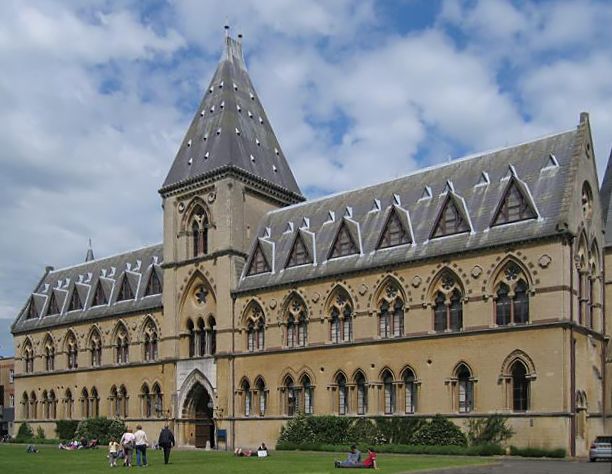
Oxford University Museum of Natural History
51.7590° N · 1.2564° W · Museum
Photo: The original uploader was MykReeve at English Wikipedia. · CC BY-SA 3.0 · Wikimedia Commons
Oxford University Museum of Natural History is a museum in Oxford, United Kingdom. The museum building opened to the public in 1860. The free Lokali audio guide runs 6 minutes.
✓ Published October 2026 · how we write these guides
Visitor facts
| Lokali audio guide | 6 min · free |
|---|---|
| Type | Museum |
| Location | Oxford, United Kingdom |
| Coordinates | 51.7590, -1.2564 |
| Official website | oum.ox.ac.uk |
| Languages | 50+, in the Lokali app |
The story
Step through the doors and look up. Light pours down through a roof of glass, held up by slender columns of cast iron. The iron branches out above you like the ribs of a leaf. Below, the stone floor is cool and pale, and the air carries a faint smell of old wood and polished display cases. Voices soften here. Footsteps echo across the open court... and somewhere above, a skeleton seems to watch you arrive.
Welcome to the Oxford University Museum of Natural History. The building opened in 1860, and it was designed to do something unusual for its time. Oxford was a place of theology, classics and law. Science had no proper home. The physician Henry Acland campaigned for a building that would bring the sciences together under one roof, and this museum is the result.
The architects were the Irish firm of Thomas Deane and Benjamin Woodward. They worked in the Gothic Revival style, a nineteenth-century return to the pointed arches and carved stone of medieval churches. The critic John Ruskin championed the project. He believed that a building should teach, and that honest craftsmanship could show the beauty of nature. So this is, in a sense, a cathedral built for science.
Now look closely at the columns around the edge of the court. Here is a detail many visitors walk straight past. Each column is cut from a different British stone. Granites, marbles, limestones, serpentines... and each one is labelled with its type and origin. The building itself is a geology lesson. Run your eye along them and notice how the colours shift from deep red to grey-green to cream.
Then look at the tops of the columns. The capitals are carved with plants — leaves, flowers, fruit, ferns — drawn from real botanical specimens. Much of this work was done by the O'Shea brothers, stone carvers from Ireland. Their carving is lively and close to nature. Legend has it that one of the brothers fell out with the university authorities and, in revenge, carved parrots and owls with faces that mocked them. It is a popular story, though it is more folklore than firm record.
The O'Sheas never finished everything. Outside, around the entrance, some of the stonework was left plain or only partly carved. Money ran short, and the decorative programme stopped. So when you leave, look at the front of the building. Those blank or rough areas are not damage. They are a pause in the work that was never resumed.
This building also hosted one of the most famous arguments in the history of science. In 1860, just months after Charles Darwin published On the Origin of Species, scientists gathered here for a meeting of the British Association. A debate on evolution followed. Thomas Henry Huxley, a defender of Darwin, faced Samuel Wilberforce, the Bishop of Oxford. Accounts of the exchange differ, and the exact words are still disputed. But the event became a symbol of science and religion meeting face to face.
Among the collections, one small display draws people from around the world. It holds the remains of a dodo, the flightless bird from Mauritius that was hunted to extinction in the seventeenth century. This museum keeps what is often described as the only surviving soft tissue of a dodo — part of a head and a foot. Most dodo models you see elsewhere are reconstructions. This is the real bird.
The dodo has a literary connection too. Charles Dodgson, a mathematician at Christ Church, knew this museum well. He brought the young Liddell children here. Under the name Lewis Carroll, he later wrote Alice's Adventures in Wonderland, and a dodo appears in the story. Many people believe Carroll took his inspiration from the bird in this collection. Some say the stammering author saw himself in the name — Do-Do-Dodgson.
Now turn to the dinosaurs. Here you will find bones of Megalosaurus, the first dinosaur ever given a scientific name. The Oxford geologist William Buckland described it in 1824, before the word dinosaur even existed. These fossils came from quarries not far from Oxford. Nearby stands a cast of Tyrannosaurus rex, which often holds the attention of younger visitors for a long time. And on the lawn outside, look for large footprints set into the ground — casts of real dinosaur tracks.
Here is a second surprise. Look up toward the tower. Since the 1940s, swifts have nested in the ventilation holes of this building. Oxford scientists have studied this colony for decades, making it one of the longest-running studies of a single bird species anywhere. In summer, you may hear their high, screaming calls overhead. These birds spend almost their whole lives in the air, and they return to this tower each year to breed.
The museum also invites you to use your hands. Some specimens are placed out for touching — you can feel the texture of animal fur or the cold weight of a meteorite. Around the court stand statues of famous thinkers in science, from ancient philosophers to modern naturalists. And at the back of the hall, a doorway leads into the Pitt Rivers Museum, with its dense cases of anthropology and archaeology. The two buildings are connected, so you can move from one world to the other.
Before you go, stand once more in the centre of the court. Listen to the soft echo of voices under the glass. Watch how the light changes on the iron and stone as clouds pass over Oxford. Look at a single carved leaf on a capital, then at a skeleton beside it. Stone, iron, bone and glass... all gathered here to help us understand the living world. As you walk out onto Parks Road, glance back at that unfinished doorway. The work stopped long ago. The questions it was built to ask are still open.
Key facts
What to look for
Practical tips
Common questions
Is there a free audio guide to Oxford University Museum of Natural History?
Yes — the Lokali app narrates Oxford University Museum of Natural History free of charge in 50+ languages. The guide runs about 6 minutes, covers the history, what to look for on site and practical tips, and works offline once downloaded.
Where is Oxford University Museum of Natural History?
Oxford University Museum of Natural History is in Oxford, United Kingdom, at 51.7590, -1.2564. Tap the map link on this page for directions from where you are.
What is Oxford University Museum of Natural History known for?
The museum building opened to the public in 1860. Architects Deane and Woodward designed it in Gothic Revival style.
What should you look for at Oxford University Museum of Natural History?
Columns cut from different British stones, each labelled. Carved plant capitals at the top of each column. Cast-iron branches holding up the glass roof.
What should you know before visiting Oxford University Museum of Natural History?
Visit the Pitt Rivers Museum through the doorway at the back. Come in summer to hear swifts circling the tower.
When is the best time to visit Oxford University Museum of Natural History?
Come in summer to hear swifts circling the tower.
On the map
Opens directions to Oxford University Museum of Natural History from your location.
More to see in Oxford


Hear Oxford University Museum of Natural History in your language
The full story, narrated, in 50+ languages. Download it before you go and it plays offline, at your own pace, with no ticket and no tour group.