
Photo: Rhododendrites · CC BY-SA 4.0 · Wikimedia Commons
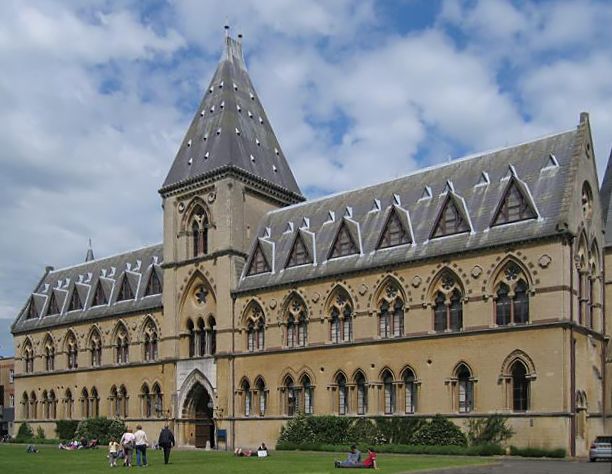
Pitt Rivers Museum is a museum in Oxford, England, UK. Founded in 1884 with Augustus Pitt-Rivers's collection. The free Lokali audio guide runs 7 minutes.
✓ Published October 2026 · how we write these guides
Visitor facts
| Lokali audio guide | 7 min · free |
|---|---|
| Type | Museum |
| Location | Oxford, United Kingdom |
| Coordinates | 51.7586, -1.2550 |
| Official website | prm.ox.ac.uk |
| Languages | 50+, in the Lokali app |
The story
Step through the far doorway of the natural history museum, and the light changes. The bright glass roof behind you gives way to something dimmer, warmer, close. Your eyes need a moment. Then the shapes appear. There are dark wooden cases, rows upon rows of them, packed from floor to gallery rail. The air is still. Somewhere a floorboard creaks. This is the Pitt Rivers Museum, and few places on Earth feel quite like it.
Here is the first surprise. This museum has no front door of its own. To reach it, every visitor walks through the Oxford University Museum of Natural History, past the dinosaur skeletons and under that great iron and glass roof. The two buildings are joined like rooms in one house. One holds the story of the natural world. The other holds the story of what people have made with their hands.
The museum began in 1884. That year, a soldier and collector named Augustus Pitt-Rivers gave his collection to the University of Oxford. It held many thousands of objects — weapons, tools, musical instruments, charms, and everyday things from across the world. He attached a condition to the gift. The university had to display the objects in a particular way, and it had to employ someone to lecture on them. That condition shaped everything you see around you today.
So what was his particular way? Most museums arrange objects by place. You walk through a room for Egypt, then a room for China, then a room for Africa. Pitt-Rivers did something different. He grouped objects by type. Look at any case near you. You might see fire-making tools from five continents side by side. Or masks. Or locks and keys. Or boats. The question here is not where something comes from. The question is how different people solved the same problem.
Pitt-Rivers had his own theories behind this arrangement. He was influenced by the ideas about evolution that filled Victorian science. He believed that objects, like living things, developed step by step from simple forms to complex ones. Many of those ideas are now seen as flawed, and some carried the prejudices of their age. But the arrangement itself survived. Today, it lets visitors compare human ingenuity across cultures in a way almost no other museum allows.
The collection did not stop growing. The founding gift was large, but later curators, researchers, and donors added far more. The museum now holds several hundred thousand objects, along with photographs and archives. Only a fraction can be shown at once, and yet the cases still feel crowded. That density is deliberate. The museum has kept much of its Victorian character — the tall cabinets, the narrow aisles, the drawers you are often allowed to open.
Yes — the drawers. Many of the cases have shallow drawers beneath them. Some can be pulled out gently, and inside you may find more objects, carefully laid on fabric. This is the second surprise most visitors miss. Half the museum is hidden at knee height. Take your time. Slide a drawer open, look, and close it softly. It is a quiet, private way to discover things that nobody else in the room has noticed.
Now look at the labels. Some are typed, some are printed, and some older ones are written by hand, in faded ink. Reading them is like reading the notes of earlier generations of curators. The handwriting tells its own story about how the museum was built, one object at a time. Some labels use language that sounds outdated today. The museum has been reviewing and rewriting many of them, and you may see newer panels that explain this work.
Raise your eyes toward the upper levels and you will find one of the tallest objects in the building. A carved totem pole from Haida Gwaii, an island group off the Pacific coast of Canada, rises through the open galleries. The Haida people carved such poles from great cedar trunks to tell family histories and record important events. Standing at its base and looking up, you get a sense of how much height the museum had to give it.
Legend and local belief also have a place here. One small object is a silver bottle that, according to the story attached to it, contains a witch. It was donated in the early twentieth century, with a warning that great trouble would follow if anyone opened it. Nobody has. Whether you believe the tale or not, it shows how the museum collects not only things, but the stories and fears people attach to them.
The museum also faces harder questions. Many objects arrived during the era of the British Empire, and some were taken in ways that would not be accepted today. In recent years, the museum has looked closely at this past. It has removed certain human remains from display, including the shrunken heads that once drew crowds. It now works with communities around the world to understand the objects better, and in some cases to return them.
For some visitors, the museum also has a literary echo. Readers of Philip Pullman's novels may recognise it, because his young characters visit a museum very much like this one in his fantasy Oxford. Many people say the place feels like a story waiting to begin. Children press their faces to the glass. Researchers lean over drawers with notebooks. The low light keeps everyone a little quieter, a little more curious.
Before you leave, stop for a moment in one of the aisles. Listen to the soft footsteps around you, and the murmur of voices kept low by habit. Look at the object closest to your hand. Someone, somewhere, made it, used it, and perhaps loved it. Then walk back toward the bright glass roof of the natural history museum. Notice how the light opens up again — and how the world outside feels just a little larger than it did before.
Key facts
What to look for
Practical tips
Common questions
Is there a free audio guide to Pitt Rivers Museum?
Yes — the Lokali app narrates Pitt Rivers Museum free of charge in 50+ languages. The guide runs about 7 minutes, covers the history, what to look for on site and practical tips, and works offline once downloaded.
Where is Pitt Rivers Museum?
Pitt Rivers Museum is in Oxford, United Kingdom, at 51.7586, -1.2550. Tap the map link on this page for directions from where you are.
What is Pitt Rivers Museum known for?
Founded in 1884 with Augustus Pitt-Rivers's collection. Objects are grouped by type, not by region.
What should you look for at Pitt Rivers Museum?
Faded handwritten labels on older objects in the cases. The Haida totem pole rising through the galleries. Shallow drawers hiding extra objects at knee height.
What should you know before visiting Pitt Rivers Museum?
Allow extra time to open the drawers beneath the cases. Let your eyes adjust to the low light first.
When is the best time to visit Pitt Rivers Museum?
Come early on weekdays for quieter, less crowded aisles.
On the map
Opens directions to Pitt Rivers Museum from your location.
More to see in Oxford


Hear Pitt Rivers Museum in your language
The full story, narrated, in 50+ languages. Download it before you go and it plays offline, at your own pace, with no ticket and no tour group.