
Photo: Guilhem Vellut from Paris, France · CC BY 2.0 · Wikimedia Commons
Institut du monde arabe is a French cultural institute dedicated to the Arab world. It is in Paris, France. Opened in 1987 as a France and Arab League partnership. The free Lokali audio guide runs 6 minutes.
✓ Published October 2026 · how we write these guides
Visitor facts
| Lokali audio guide | 6 min · free |
|---|---|
| Type | Museum |
| Location | Paris, France |
| Coordinates | 48.8489, 2.3570 |
| Official website | imarabe.org |
| Languages | 50+, in the Lokali app |
The story
Stand close to the south wall and look up. The building looks like a giant camera, or a chessboard made of metal and glass. Each square holds a pattern of small round openings, a little like the shutter inside an old lens. On some days, if the light changes, you may see a few of them move. Listen for a faint mechanical whirr above the traffic of the riverbank.
This is the Institut du monde arabe, the Arab World Institute. It sits on the Left Bank of the Seine, along the Quai Saint-Bernard, a short walk from the islands at the heart of Paris. It is part museum, part library, part cultural centre. And it is one of the most unusual buildings of late twentieth-century Paris, a city better known for honey-coloured stone than for steel.
The idea behind the institute was diplomatic as much as cultural. In the 1980s, France and a group of Arab states agreed to create a shared space in Paris. Its purpose was to present the languages, arts, sciences and history of the Arab world to a European public. The building opened in 1987. It belongs to the same era as the glass pyramid at the Louvre, when the French state commissioned a series of large, ambitious public buildings.
The architect was Jean Nouvel, working with the firm Architecture-Studio. Nouvel was not yet the global name he later became. Many people date his international reputation to this commission. The design won the Aga Khan Award for Architecture, a prize that honours buildings serving Muslim communities and cultures. For a European steel-and-glass building, that recognition was a surprise to many observers.
Now look again at that south façade. Those metal openings are a modern version of the mashrabiya. A mashrabiya is a carved wooden screen found on traditional houses across the Middle East and North Africa. It lets air and soft light into a room while it keeps out heat and prying eyes. Nouvel turned that idea into a machine. The openings were designed to widen and narrow according to the strength of the sun, like the iris of an eye.
Here is a detail most visitors miss. The mechanism has been famously temperamental. For long periods, many of the apertures did not move at all, and the system has needed repair over the years. So if the panels stay still while you watch, you are not missing anything wrong. You are seeing what the building often looks like. Step inside, though, and the real effect becomes clear: the light that falls on the floor makes geometric patterns that shift through the day.
Walk around to the north side, facing the river, and the mood changes. Here the building is smooth glass, and it curves gently. That curve follows the line of the Seine and the road beside it. Look closely at the glass. Faint images of the Paris skyline are printed onto it, so the building carries a ghostly picture of the city it faces. One side looks south toward the Arab world, and the other side looks north at Paris.
Between the two halves, look for a narrow gap. This slot cuts through the building and leads toward an inner courtyard. Walking through it feels like moving through a narrow lane in an old city, with walls close on both sides. It is a small, quiet space compared with the open quay outside. Many people pass the building without ever finding it.
Inside, the museum covers a very long sweep of time. Its collections include objects from the ancient Near East, the early centuries of Islam, and the modern Arab world. You can expect manuscripts, ceramics, metalwork, textiles and scientific instruments, such as astrolabes. An astrolabe is a hand-held brass device that astronomers and travellers once used to read the position of the stars. The institute also hosts large temporary exhibitions, and these often draw the biggest crowds.
The library deserves a moment too. One of its most photographed features is a spiralling tower of books, wrapped in glass. A ramp winds up around the shelves, so readers climb slowly through the collection. It is a calm space, and it reminds visitors that this building is a working centre for study, not only a gallery. Conferences, films, concerts and language classes take place here as well.
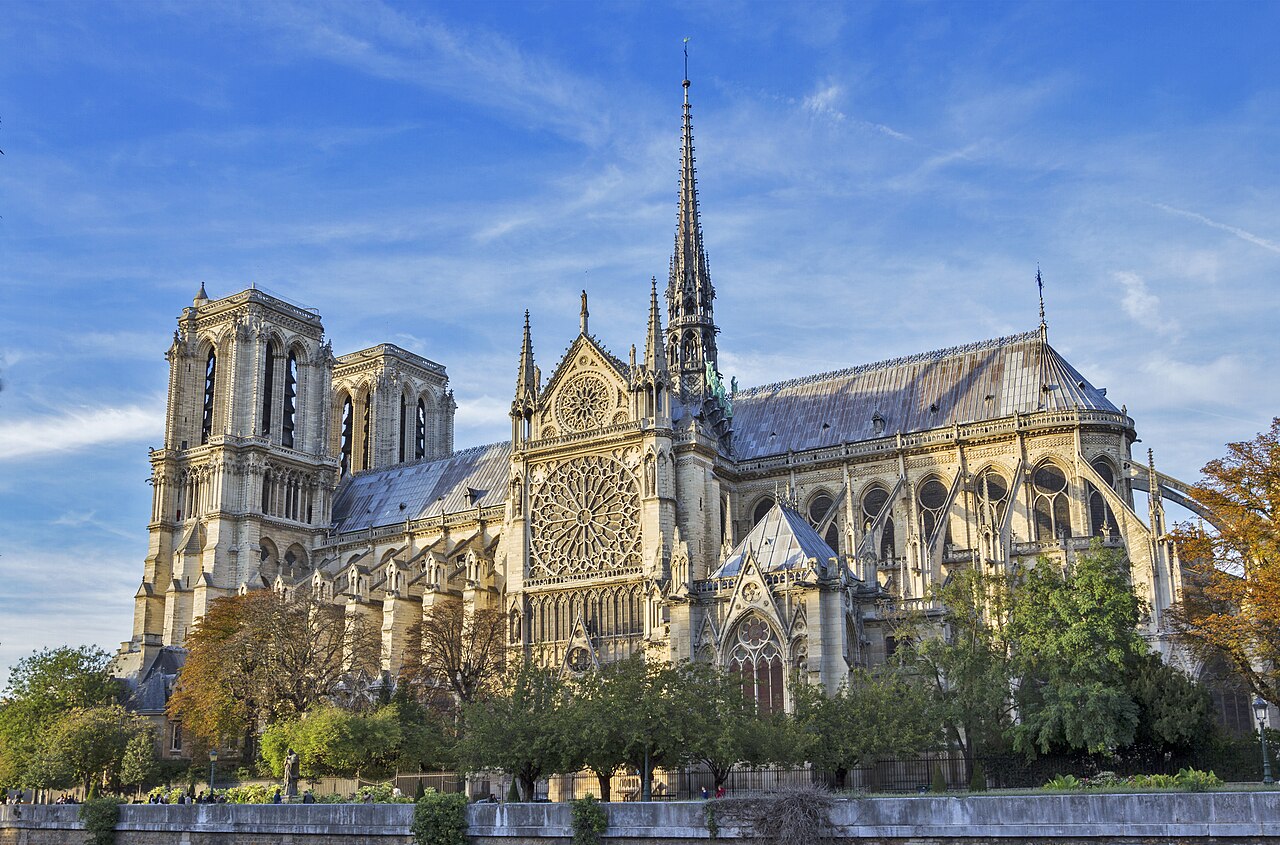
Now for the second surprise. Take the lift to the rooftop terrace. From the top, you look across the Seine toward the Île Saint-Louis and the Île de la Cité. The view of Notre-Dame from this side, seen from behind and above, is one of the less crowded viewpoints in central Paris. Many locals come up just for this panorama. Look for the bridges, the grey zinc roofs, and the river boats sliding underneath.
The neighbourhood around you has its own character. Just behind the institute stands a large university campus, so students fill the streets during term time. Nearby, the Jardin des Plantes, the city's botanical garden, spreads out to the east. A little to the south is the Great Mosque of Paris, with its green-tiled roofs and its tea room. Together, these places make this corner of the Left Bank a natural walk for anyone curious about the meeting of cultures.
Before you leave, stand back from the south wall one more time. Watch how the sun catches the metal squares. Notice the small differences between one panel and the next, where some openings sit wider and some narrower. Then turn toward the river and listen to the water and the traffic on the quay. You are standing at the line where a traditional Arab screen meets a Parisian riverbank... and the building was made to hold both at once.
Key facts
What to look for
Practical tips
Common questions
Is there a free audio guide to Institut du monde arabe?
Yes — the Lokali app narrates Institut du monde arabe free of charge in 50+ languages. The guide runs about 6 minutes, covers the history, what to look for on site and practical tips, and works offline once downloaded.
Where is Institut du monde arabe?
Institut du monde arabe is in Paris, France, at 48.8489, 2.3570. Tap the map link on this page for directions from where you are.
What is Institut du monde arabe known for?
Opened in 1987 as a France and Arab League partnership. Designed by Jean Nouvel with the firm Architecture-Studio.
What should you look for at Institut du monde arabe?
Camera-like metal apertures covering the south façade. Faint Paris skyline images printed on the north glass. Narrow slot between the two halves leading to a courtyard.
What should you know before visiting Institut du monde arabe?
Take the lift to the rooftop terrace for river views. Check the programme for large temporary exhibitions before visiting.
On the map
Opens directions to Institut du monde arabe from your location.
More to see in Paris


Hear Institut du monde arabe in your language
The full story, narrated, in 50+ languages. Download it before you go and it plays offline, at your own pace, with no ticket and no tour group.