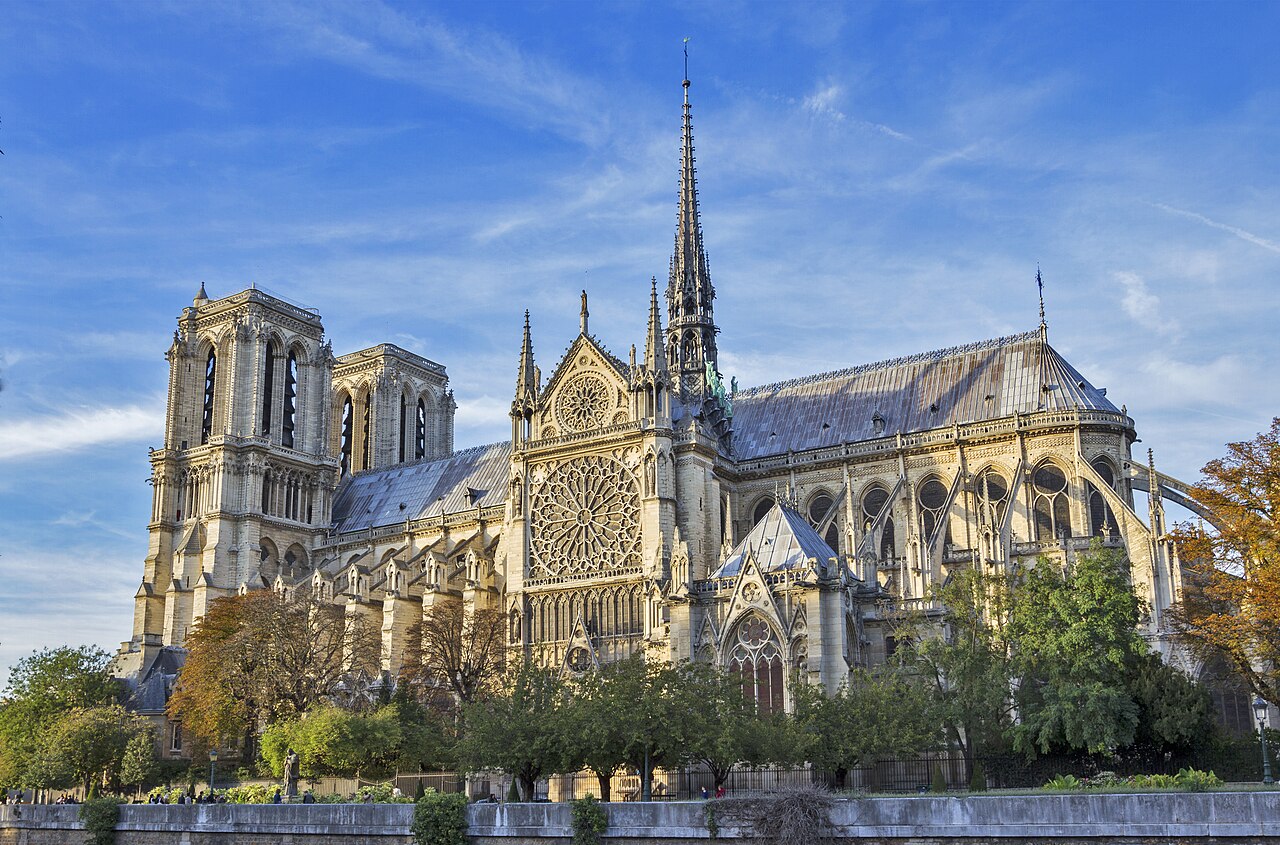
Notre-Dame Cathedral is a cathedral in Paris, France. Medieval Gothic masterpiece begun in 1163, famous for its rose windows, flying buttresses, and gargoyles. Most visitors spend 30–45 min here. The free Lokali audio guide runs 5 minutes.
✓ Verified August 2026 · how we write these guides
Visitor facts
| Time needed | 30–45 min |
|---|---|
| Lokali audio guide | 5 min · free |
| Type | Cathedral |
| Best for | History |
| Location | Paris, France |
| Coordinates | 48.8530, 2.3499 |
| Languages | 45, in the Lokali app |
The story
On an island in the middle of the Seine rises one of the great churches of the world, its twin towers, flying buttresses, and rose windows the very image of the Gothic cathedral. This is Notre-Dame de Paris, a building more than eight centuries old that sits at the historic and symbolic heart of the city.
Work on the cathedral began in 1163 and went on for the best part of two centuries, an enormous effort that helped define the Gothic style. Its pointed arches, ribbed vaults, and great stained-glass rose windows were a leap in how high and how light a stone building could be made to feel.
The flying buttresses that ring the outside are not mere decoration but clever engineering, propping the high walls from outside so that they could be opened up with windows within. Walking around the back of the cathedral shows this skeleton of stone at its most dramatic.
For centuries Notre-Dame has stood at the centre of French life, the setting for coronations, state funerals, and moments of national mourning and joy. Distances across the whole country are even measured from a point on the square in front of it.
In 2019 a terrible fire tore through the cathedral, destroying its roof and the tall spire and shocking the world. The great stone structure and many treasures survived, and a vast restoration has since repaired the damage and returned the building to use, a remarkable feat of craft.
The restoration drew on both old skills and new study, with carpenters, stonemasons, and other craftspeople working as their medieval forebears did. The reopened cathedral lets visitors see the building cleaned and renewed, in some ways closer to its original brightness than it had been for generations.
Inside, the scale and the light are the wonder. The great rose windows glow in deep blues and reds, the stone columns soar, and the long nave draws the eye toward the altar. It is a working cathedral, so services and music are part of its daily life.
The towers, when open, reward the climb up a tight spiral stair with a close view of the famous carved gargoyles and grotesques, and a wide outlook over the rooftops of the city. The carved creatures, both drainspouts and decoration, are among the cathedral's best-loved details.
The setting on the island is part of the experience. The square in front gives the classic view of the west front with its towers and central rose window, and the riverbanks and the garden behind offer quieter angles on the building.
The cathedral sits at the very centre of old Paris, within easy walking distance of other great sights, so it falls naturally into a day exploring the island and the riverbanks on foot.
A few practical notes. Entry to the cathedral itself is free, though queues can be long, and tower climbs or special areas may be ticketed and best booked ahead. Check current arrangements, as access has changed with the restoration, and dress modestly as in any church.
Stand on the square and take in the west front, then step inside into the coloured light, and consider that this building has stood, burned, and risen again across more than eight centuries. Few monuments carry a city's identity so completely. When you walk back along the river, the towers stay in view above the rooftops.
Key facts
What to look for
Practical tips
Common questions
How long do you need at Notre-Dame Cathedral?
Plan 30–45 min. That is the time most visitors spend at Notre-Dame Cathedral. The free Lokali audio guide adds about 5 minutes of narration you can listen to as you walk, so it fits inside your visit rather than adding to it.
Is there a free audio guide to Notre-Dame Cathedral?
Yes — the Lokali app narrates Notre-Dame Cathedral free of charge in 50+ languages. It covers the history, what to look for on site and practical tips, and it works offline once downloaded.
Where is Notre-Dame Cathedral?
Notre-Dame Cathedral is in Paris, France, at 48.8530, 2.3499. Tap the map link on this page for directions from where you are.
What should you know before visiting Notre-Dame Cathedral?
Entry is free, but the queues can be long.
What is Notre-Dame Cathedral known for?
A great Gothic cathedral on an island in the Seine.
What is the best time to visit Notre-Dame Cathedral?
Walk around the building's exterior and the Île de la Cité to see the restoration work.
On the map
Opens directions to Notre-Dame Cathedral from your location.
Reference
More to see in Paris




Hear Notre-Dame Cathedral in your language
The full story, narrated, in 50+ languages. Download it before you go and it plays offline, at your own pace, with no ticket and no tour group.