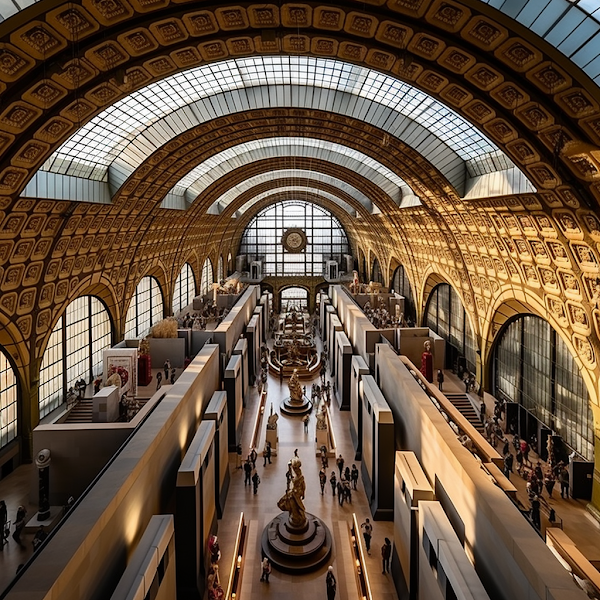
Musée d'Orsay is a museum in Paris, France. Former railway station (1900) housing the world's finest Impressionist and Post-Impressionist collection. Most visitors spend 1–3 hours here. The free Lokali audio guide runs 3 minutes.
✓ Verified August 2026 · how we write these guides
Visitor facts
| Time needed | 1–3 hours |
|---|---|
| Lokali audio guide | 3 min · free |
| Type | Museum |
| Best for | Editors' pick |
| Location | Paris, France |
| Coordinates | 48.8601, 2.3265 |
| Languages | 45, in the Lokali app |
The story
The building tells the first part of the story. The Musee d'Orsay occupies the former Orsay railway station, built for the 1900 Universal Exhibition and transformed into a museum that opened to the public in December 1986.
Its official identity is unusually focused: works produced from 1848 to 1914. That short period is the museum's strength. It lets visitors follow the move from academic painting and Realism to Impressionism, Post-Impressionism, Symbolism, early photography, sculpture, decorative arts, and architecture.
The central nave still feels like a station. Light pours through the glass and iron structure, and sculpture occupies the old travel hall. The paintings upstairs do not float outside history; they belong to the same century of railways, industry, leisure, urban change, and new ways of seeing.
The museum is also changing in the present. Official 2026 information notes work to improve visitor access and restore historic structures while the museum remains open. For a live guide, that means access conditions should be checked before promising a fixed route.
Musee d'Orsay is sometimes reduced to Impressionism, but that is too narrow. Its official frame is 1848 to 1914, a period of political upheaval, industrial change, new urban life, photography, colonial expansion, and artistic experiment. Impressionism is one chapter inside that wider nineteenth-century story.
The former railway station is not a neutral shell. Built for the 1900 Universal Exhibition, it gives the museum a long central nave, visible clocks, metal structure, and a sense of movement. The building already belonged to modernity before it became a museum of modern artistic change.
Use the museum to connect academic painting, Realism, Impressionism, Post-Impressionism, sculpture, decorative arts, architecture, and photography. The point is not to choose one camp as the winner, but to see how artists and institutions argued over what modern life should look like.
The museum has announced building work to improve visitor experience while staying open, so a fixed audio route should be treated carefully during this period. The main guide can remain accurate by focusing on the collection's date range, the station-to-museum conversion, and the breadth of media rather than promising exact circulation.
Key facts
What to look for
Practical tips
Common questions
How long do you need at Musée d'Orsay?
Plan 1–3 hours. That is the time most visitors spend at Musée d'Orsay. The free Lokali audio guide adds about 3 minutes of narration you can listen to as you walk, so it fits inside your visit rather than adding to it.
Is there a free audio guide to Musée d'Orsay?
Yes — the Lokali app narrates Musée d'Orsay free of charge in 50+ languages. It covers the history, what to look for on site and practical tips, and it works offline once downloaded.
Where is Musée d'Orsay?
Musée d'Orsay is in Paris, France, at 48.8601, 2.3265. Tap the map link on this page for directions from where you are.
What should you know before visiting Musée d'Orsay?
Check current access conditions during the museum's building-work period.
What is Musée d'Orsay known for?
The building was originally the Orsay railway station for the 1900 Universal Exhibition.
What is the best time to visit Musée d'Orsay?
The top-floor galleries under the mansard roof are quieter and offer softer natural light ideal for viewing Impressionist paintings.
On the map
Opens directions to Musée d'Orsay from your location.
Reference
More to see in Paris





Hear Musée d'Orsay in your language
The full story, narrated, in 50+ languages. Download it before you go and it plays offline, at your own pace, with no ticket and no tour group.