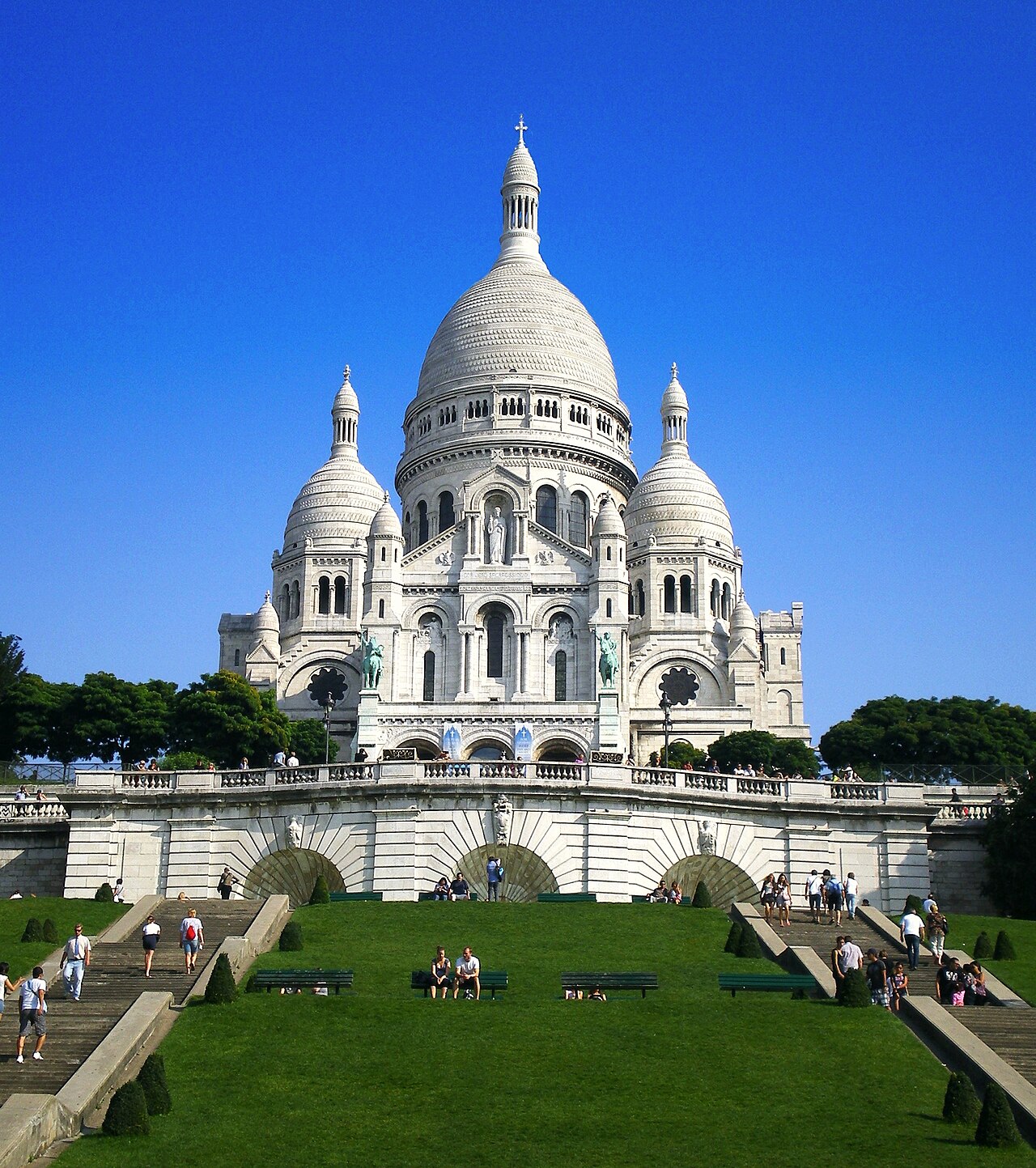
Sacré-Cœur Basilica is a basilica in Paris, France. White Romano-Byzantine basilica crowning Montmartre hill, completed in 1914. Most visitors spend 45–90 min here. The free Lokali audio guide runs 5 minutes.
✓ Verified August 2026 · how we write these guides
Visitor facts
| Time needed | 45–90 min |
|---|---|
| Lokali audio guide | 5 min · free |
| Type | Basilica |
| Best for | Romantic |
| Location | Paris, France |
| Coordinates | 48.8867, 2.3431 |
| Languages | 45, in the Lokali app |
The story
High on the hill above the city, a white domed church gleams against the sky, visible from streets all over Paris and reached by a long climb up steps and slopes. This is the Sacré-Cœur, the basilica that crowns the hill of Montmartre and offers one of the widest views over the capital.
The basilica is younger than it looks. It was built between the 1870s and the early twentieth century, in a striking pale, domed style drawing on Romanesque and Byzantine churches rather than the Gothic of older Paris. Its rounded domes set it apart from anything else in the city.
The stone itself keeps the church white. It is built of a travertine that, in rain, releases a substance that bleaches the surface, so the basilica stays pale and clean while other buildings darken with age. That brightness is part of why it stands out so sharply on the hill.
The basilica was raised in a mood of national mourning and devotion after a hard period in French history, intended as a place of prayer and pilgrimage. That purpose continues, and visitors are asked to respect the quiet of a working church inside.
Inside, the eye is drawn upward to a vast mosaic in the apse, one of the largest of its kind, showing Christ with arms outstretched in shining gold. The dim, incense-scented interior is a calm contrast to the crowds and views outside.
The great draw for most visitors is the view. The steps and terrace in front of the basilica look out over the whole of Paris spread below, and on a clear day the city runs to the horizon. It is free, and one of the finest panoramas in the city.
You can climb higher still, up into the dome, for an even wider outlook, though the basilica's hilltop terrace already gives most of the reward without the extra stairs. Sunset and early evening, when the city lights come on, are especially beautiful.
Getting up the hill is part of the experience. You can climb the long flights of steps through a small park, or ride a short funicular railway that carries you up beside them, saving your legs for the wandering at the top.
The basilica sits at the summit of Montmartre, the old hilltop village of artists, so a visit naturally combines with exploring the lanes, squares, and cafes of that quarter just behind the church. The two are best seen together.
The terrace is a gathering place, busy with visitors, buskers, and sometimes sellers, so it has a lively, occasionally chaotic feel. Keep an eye on your belongings in the crowds, and be wary of anyone trying to tie a friendship bracelet onto your wrist for a fee.
A few practical notes. Entry to the basilica is free; the dome climb is ticketed. Dress modestly to go inside, come early or at sunset for the best light and fewer crowds, and use the funicular if the steps are too much.
Climb to the terrace, turn your back on the white domes for a moment, and take in the whole of Paris laid out below, then step inside into the gold and the quiet. The hill has drawn pilgrims and painters alike for well over a century. When you head back down, the city rises to meet you.
Key facts
What to look for
Practical tips
Common questions
How long do you need at Sacré-Cœur Basilica?
Plan 45–90 min. That is the time most visitors spend at Sacré-Cœur Basilica. The free Lokali audio guide adds about 5 minutes of narration you can listen to as you walk, so it fits inside your visit rather than adding to it.
Is there a free audio guide to Sacré-Cœur Basilica?
Yes — the Lokali app narrates Sacré-Cœur Basilica free of charge in 50+ languages. It covers the history, what to look for on site and practical tips, and it works offline once downloaded.
Where is Sacré-Cœur Basilica?
Sacré-Cœur Basilica is in Paris, France, at 48.8867, 2.3431. Tap the map link on this page for directions from where you are.
What should you know before visiting Sacré-Cœur Basilica?
Entry is free; the dome climb is ticketed.
What is Sacré-Cœur Basilica known for?
A white domed basilica crowning Montmartre hill.
What is the best time to visit Sacré-Cœur Basilica?
Arrive early morning or late afternoon to avoid tour groups.
On the map
Opens directions to Sacré-Cœur Basilica from your location.
More to see in Paris



Hear Sacré-Cœur Basilica in your language
The full story, narrated, in 50+ languages. Download it before you go and it plays offline, at your own pace, with no ticket and no tour group.