
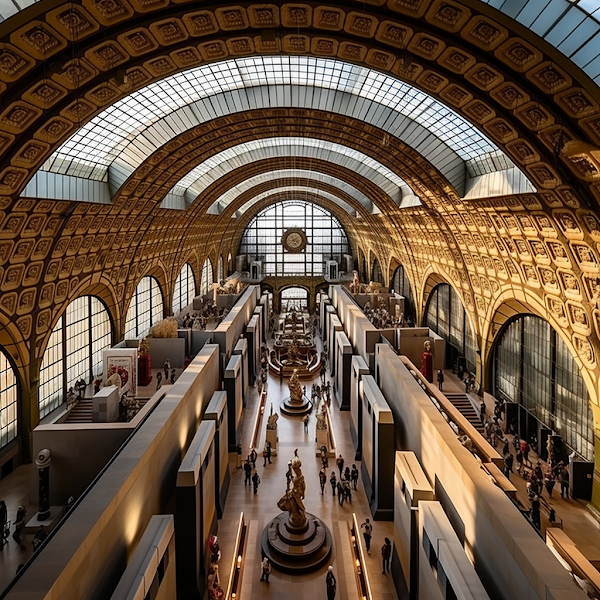
Photo: Traktorminze · CC BY-SA 3.0 · Wikimedia Commons
Musée de l'Orangerie is an art museum in Paris, France. Built in the 1850s to shelter the Tuileries orange trees. The free Lokali audio guide runs 8 minutes.
✓ Published October 2026 · how we write these guides
Visitor facts
| Lokali audio guide | 8 min · free |
|---|---|
| Type | Museum |
| Location | Paris, France |
| Coordinates | 48.8638, 2.3225 |
| Official website | musee-orangerie.fr |
| Languages | 50+, in the Lokali app |
The story
Listen for a moment. Behind you, the gravel of the Tuileries Garden crunches under hundreds of feet. Somewhere beyond the trees, traffic circles the Place de la Concorde. But inside these pale stone walls, the sound drops away. The light turns soft and even, almost like being underwater. That is not an accident. Everything about the rooms you are about to enter was planned around one painter, one garden, and one idea of what looking at a painting could feel like.
Start with the building itself. It is long, low, and plain, with tall windows facing the river. It was never meant to hold art. It was built in the 1850s, during the reign of Napoleon the Third, as a winter shelter for orange trees. Every autumn, the citrus trees in their large wooden boxes were carried inside, away from the Paris frost. Every spring, they were rolled back out into the garden. That is where the name comes from. An orangerie is simply a house for oranges.
Now look across the garden, towards the far side near the Rue de Rivoli. You may see a twin building. That is the Jeu de Paume, built in the same period and in a similar style. It was first used for real tennis, an early indoor form of the game. So the two buildings sit like bookends at the western edge of the Tuileries. One sheltered fruit trees. The other sheltered a ball game. Both ended up as places for art.
The change came through Claude Monet. By the early twentieth century, Monet was an old man living at Giverny, a village northwest of Paris. There he had created a water garden. He diverted a small stream, dug a pond, and planted water lilies, irises, and weeping willows. A green Japanese-style footbridge crossed the water. For the last decades of his life, this pond became almost his only subject. He painted it again and again, at every hour and in every season.
He did not stop at ordinary canvases. Monet began to work on enormous panels, so large that he built a special studio at Giverny to hold them. His idea was bold. He wanted the viewer to stand inside the pond, surrounded by water on every side, with no horizon and no shore. Here is the first thing many visitors miss. Monet offered these paintings to the French state in November 1918, just after the armistice that ended the First World War. It was his gift to a nation in mourning... a place of calm after years of slaughter.
His friend Georges Clemenceau, the wartime prime minister, helped to make the gift happen. After a long search for the right building, the choice fell on this former orangerie. The architect Camille Lefèvre adapted the interior to Monet's wishes. Two oval rooms were built side by side. Together, their shape suggests the sign for infinity. They run along the same east-to-west line as the Seine outside, so the paintings follow the path of the sun across the sky.
Monet never saw the rooms finished. He died in December 1926, and the installation opened to the public a few months later, in 1927. So when you walk in, you are seeing something he planned in great detail but never stood inside himself. That gives the space a quiet weight. Notice, too, the bare white vestibule before the oval rooms. It works like a pause. It gives your eyes a moment to rest before the colour begins.
Now step into the first oval room. The panels curve around you, each one about two metres high, stretching from wall to wall. There is no frame to tell you where the pond ends. Look for the reflections of clouds drifting across the water. Look for the long, dark trunks and hanging branches of willows at the edges of some panels. In places, the surface of the pond and the sky reflected in it seem to become the same thing. You are looking down and up at once.
Light is the key to everything here. Monet wanted these rooms lit by daylight from above, so the paintings would change with the weather outside. On a grey morning the greens and blues turn cool and deep. When the sun breaks through, the pinks and golds rise to the surface. Come back on another day and you will see slightly different paintings. Few museums let the sky outside play such a direct part in what you see on the walls.
Here is the second surprise. For a long time, that daylight was lost. In the decades after Monet's death, his late style went out of fashion, and the rooms received little attention. Later works added floors above the oval rooms, and the paintings sat under artificial light. A major renovation in the early 2000s removed that upper level and opened the ceilings to the sky again. The museum reopened in 2006, and Monet's original idea was finally restored.
Take a seat on one of the benches in the centre. This is the best way to see the paintings. Stand close and the surface breaks apart into thick strokes, scrapes, and layers of paint. You can see the speed of the brush and the pressure of the hand. Step back and the strokes join again into water, light, and leaves. Monet's eyesight was failing in his later years because of cataracts. Some of the strong reds and heavy textures may reflect how he saw the world at the end.
When you are ready, go down to the lower level. A very different collection waits there. It was assembled by the art dealer Paul Guillaume in the early twentieth century, and later expanded by his widow, Domenica, and her second husband, Jean Walter. It came to the French state in the decades after the Second World War. Here you find Renoir and Cézanne, Matisse and Picasso, Modigliani and Soutine, and the dreamlike jungles of Henri Rousseau. The rooms are smaller and more intimate, like a private home.
The contrast is part of the pleasure. Upstairs, one painter tries to dissolve the edges of the world. Downstairs, a group of painters builds the world back up with strong outlines, solid fruit, and portraits that look straight back at you. Moving between the two levels is a short lesson in how quickly painting changed in the years around the First World War. You do not need to know the names to feel the shift.
When you step back outside, pause on the terrace. The river runs beside you. The willows and lawns of the Tuileries spread out ahead, and the light moves across the water of the garden basins. After the oval rooms, you may notice the surface of that water a little differently... the clouds held in it, the way a breeze breaks it into pieces. That, perhaps, is the real gift Monet left here. Not only the paintings, but a new way of looking at the ordinary world around you.
Key facts
What to look for
Practical tips
Common questions
Is there a free audio guide to Musée de l'Orangerie?
Yes — the Lokali app narrates Musée de l'Orangerie free of charge in 50+ languages. The guide runs about 8 minutes, covers the history, what to look for on site and practical tips, and works offline once downloaded.
Where is Musée de l'Orangerie?
Musée de l'Orangerie is in Paris, France, at 48.8638, 2.3225. Tap the map link on this page for directions from where you are.
What is Musée de l'Orangerie known for?
Built in the 1850s to shelter the Tuileries orange trees. Monet offered the Water Lilies to France in November 1918.
What should you look for at Musée de l'Orangerie?
Daylight falling through the ceiling onto the curved panels. Dark willow trunks framing the edges of some panels. Cloud reflections floating among the water lilies.
What should you know before visiting Musée de l'Orangerie?
Arrive early in the day for quieter oval rooms. Book a timed entry in advance during busy seasons.
When is the best time to visit Musée de l'Orangerie?
Arrive early in the day for quieter oval rooms.
On the map
Opens directions to Musée de l'Orangerie from your location.
More to see in Paris



Hear Musée de l'Orangerie in your language
The full story, narrated, in 50+ languages. Download it before you go and it plays offline, at your own pace, with no ticket and no tour group.