
Photo: Limbourg Brothers · Public domain · Wikimedia Commons
Palais de la Cité is a former royal palace in Paris, now the Palace of Justice. Medieval kings of France ruled from here for centuries. The free Lokali audio guide runs 7 minutes.
✓ Published October 2026 · how we write these guides
Visitor facts
| Lokali audio guide | 7 min · free |
|---|---|
| Type | Palace |
| Location | Paris, France |
| Coordinates | 48.8564, 2.3456 |
| Languages | 50+, in the Lokali app |
The story
Stand on the stone quay beside the Seine and look up. Grey towers with pointed slate roofs rise straight from the river wall, like the edge of a castle that never quite left the city. Behind you, traffic hums across the bridges. In front of you, water slaps softly against old stone. This long, mixed building is the Palais de la Cité, and for centuries it was the beating heart of royal France.
The island under your feet, the Île de la Cité, is where Paris began. Long before there was a France, people settled here because the river gave them a natural moat. In Roman times, an official residence stood near this western end of the island. Later, the early Frankish kings used the site too. So when the medieval kings of France built their palace here, they were building on top of a very old idea — whoever held the island, held the city.
From roughly the tenth century to the fourteenth century, the Capetian kings, the royal family that shaped medieval France, ruled from this palace. It was not one building but a small walled world. There were royal apartments, great halls, gardens, kitchens, chapels, and offices for the clerks who ran the kingdom. Kings lived here, held court here, and received foreign visitors here. Think of it as a medieval Versailles, but squeezed onto an island in the middle of a crowded town.
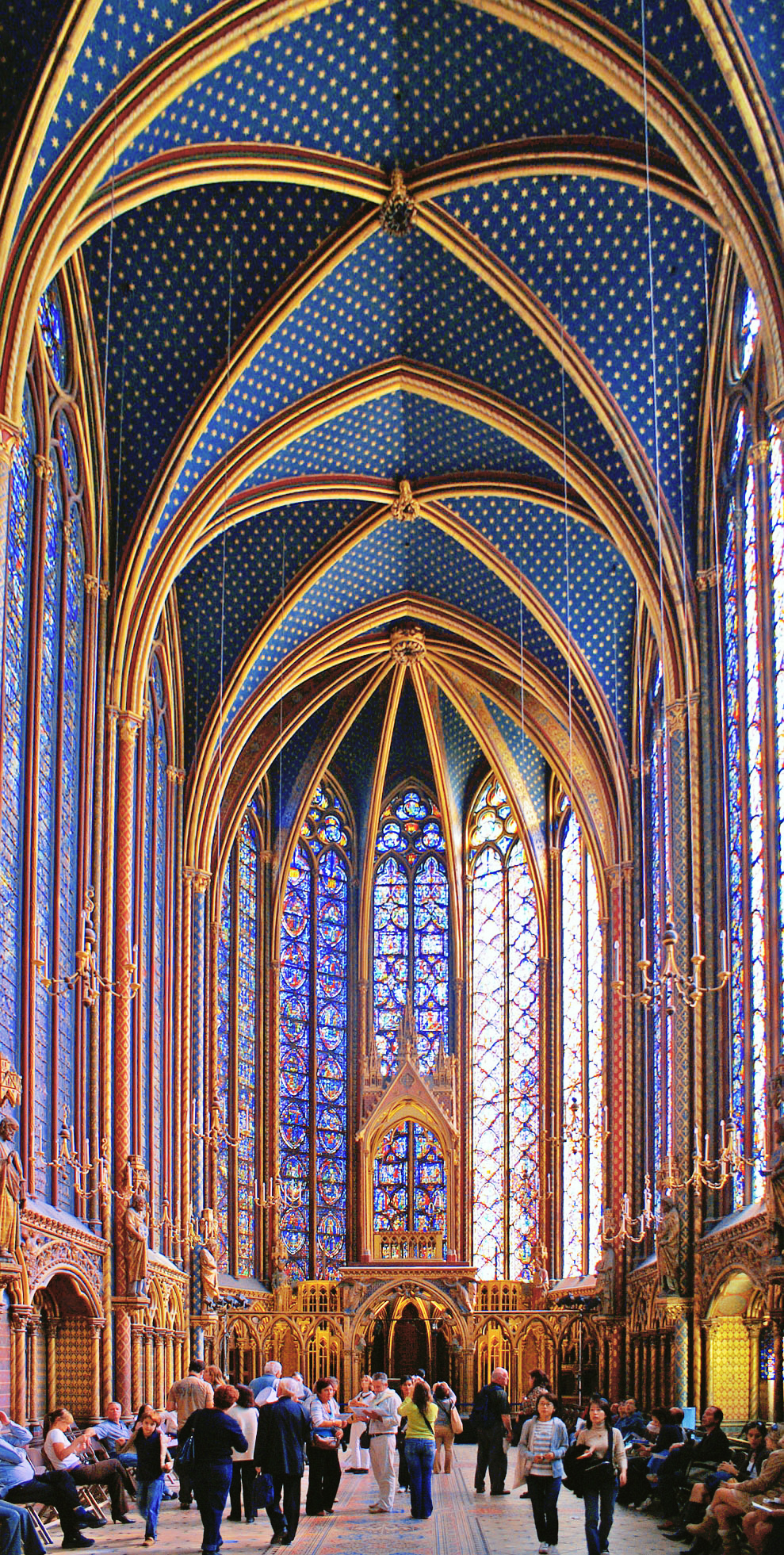
The jewel of the old palace still stands inside the courtyard behind these walls. It is the Sainte-Chapelle, the Holy Chapel. King Louis the Ninth, later made a saint, built it in the thirteenth century to hold sacred relics he had acquired, including what was venerated as the Crown of Thorns. The chapel was consecrated in 1248. Its upper level is almost entirely glass. On a sunny day, the walls seem to dissolve into deep blues and reds, and the whole room glows like the inside of a lantern.
Here is a detail many visitors miss. The chapel has two levels for a reason. The lower chapel, with its low painted vaults, served the people who worked in the palace. The upper chapel was reserved for the king, his family, and his guests. Even inside a house of prayer, the building kept everyone in their place. When you climb the narrow spiral stair from the lower room to the upper one, you are walking the line between servant and king.
Now turn your eyes to the towers on the river side. Their names are worth knowing. One is called the Tour César, the Caesar Tower. Another is the Tour d'Argent, the Silver Tower, where, tradition says, royal treasure was once kept. The smallest, with crenellations along the top, is the Tour Bonbec. Its name means something like the tower of the good beak. According to a grim popular tale, prisoners questioned inside it were soon persuaded to talk.
At the corner of the palace, where the quay meets the boulevard, stands a square tower with a large, richly decorated clock. This is the Tour de l'Horloge, the Clock Tower. A clock was installed here in the late fourteenth century, and it is often described as the first public clock in Paris. Before that, most people told time by church bells. The current face, with its gold and blue ornament and carved figures, dates from a later renaissance redecoration. Pause under it for a moment. This corner gave the city a shared hour.
So why did the kings leave? In the mid fourteenth century, Paris rose up in a violent revolt, and royal advisers were killed inside the palace in front of the future King Charles the Fifth. He did not forget it. As king, he moved his household to other residences, including the Louvre, which was then a fortress on the edge of town. The palace did not empty, though. It changed jobs. It became the home of royal justice and administration.
The most powerful tenant was the Parlement of Paris. Despite the name, this was not a parliament in the modern sense. It was the highest court of the kingdom. It registered royal laws and judged major cases. And the person in charge of the building, keeping order and holding the keys, carried the title of concierge. That is where the name Conciergerie comes from. Today, that word means a doorman in a hotel. Here, it came to mean a prison.
Inside the Conciergerie, you can walk through the Hall of the Men-at-Arms, built in the early fourteenth century under King Philip the Fourth, known as Philip the Fair. It is one of the largest surviving Gothic halls of its time in Europe. Gothic, here, means the medieval style of pointed arches and ribbed vaults. Rows of columns march down the room, holding up the ceiling like a stone forest. Once, this was a dining hall for hundreds of palace staff. Now it is cool, quiet, and echoing.
The darkest chapter came with the French Revolution. In the 1790s, the Revolutionary Tribunal sat in the palace and sent many people to the guillotine. The Conciergerie held prisoners waiting for their trials, and often for their deaths. Its most famous prisoner was Queen Marie Antoinette. She was held here in 1793, in a small cell, before her execution that October. Later, under the restored monarchy, a memorial chapel was created on the site of her cell. People still come to stand in silence there.
As you walk around the outside, notice how mixed the building looks. Medieval towers sit beside grand classical façades, with columns and tall windows added in later centuries. Fire damaged parts of the palace more than once, including during the uprising of the Paris Commune in 1871. Each rebuilding added a new layer. The large section facing the boulevard is the Palais de Justice, the Palace of Justice. Courts still sit here today, so lawyers in black robes may hurry past you on the pavement.
Before you move on, look once more at the river side. The towers stand where they have stood for centuries, reflected in the water. A tour boat might be sliding under the bridge. A cyclist might be crossing the quay. Kings, judges, guards, and prisoners all walked inside these walls, and now you are part of that long line of footsteps. As you walk away, listen for the traffic, the river, and perhaps the clock — the same corner, still keeping time for Paris.
Key facts
What to look for
Practical tips
Common questions
Is there a free audio guide to Palais de la Cité?
Yes — the Lokali app narrates Palais de la Cité free of charge in 50+ languages. The guide runs about 7 minutes, covers the history, what to look for on site and practical tips, and works offline once downloaded.
Where is Palais de la Cité?
Palais de la Cité is in Paris, France, at 48.8564, 2.3456. Tap the map link on this page for directions from where you are.
What is Palais de la Cité known for?
Medieval kings of France ruled from here for centuries. Sainte-Chapelle was consecrated in 1248 under Louis the Ninth.
What should you look for at Palais de la Cité?
The ornate clock face on the corner Clock Tower. The small crenellated Tour Bonbec beside the larger towers. Rows of Gothic columns in the Hall of the Men-at-Arms.
What should you know before visiting Palais de la Cité?
Book Sainte-Chapelle in advance to shorten the security wait. Visit Sainte-Chapelle on a sunny day for the brightest glass.
On the map
Opens directions to Palais de la Cité from your location.
More to see in Paris


Hear Palais de la Cité in your language
The full story, narrated, in 50+ languages. Download it before you go and it plays offline, at your own pace, with no ticket and no tour group.