
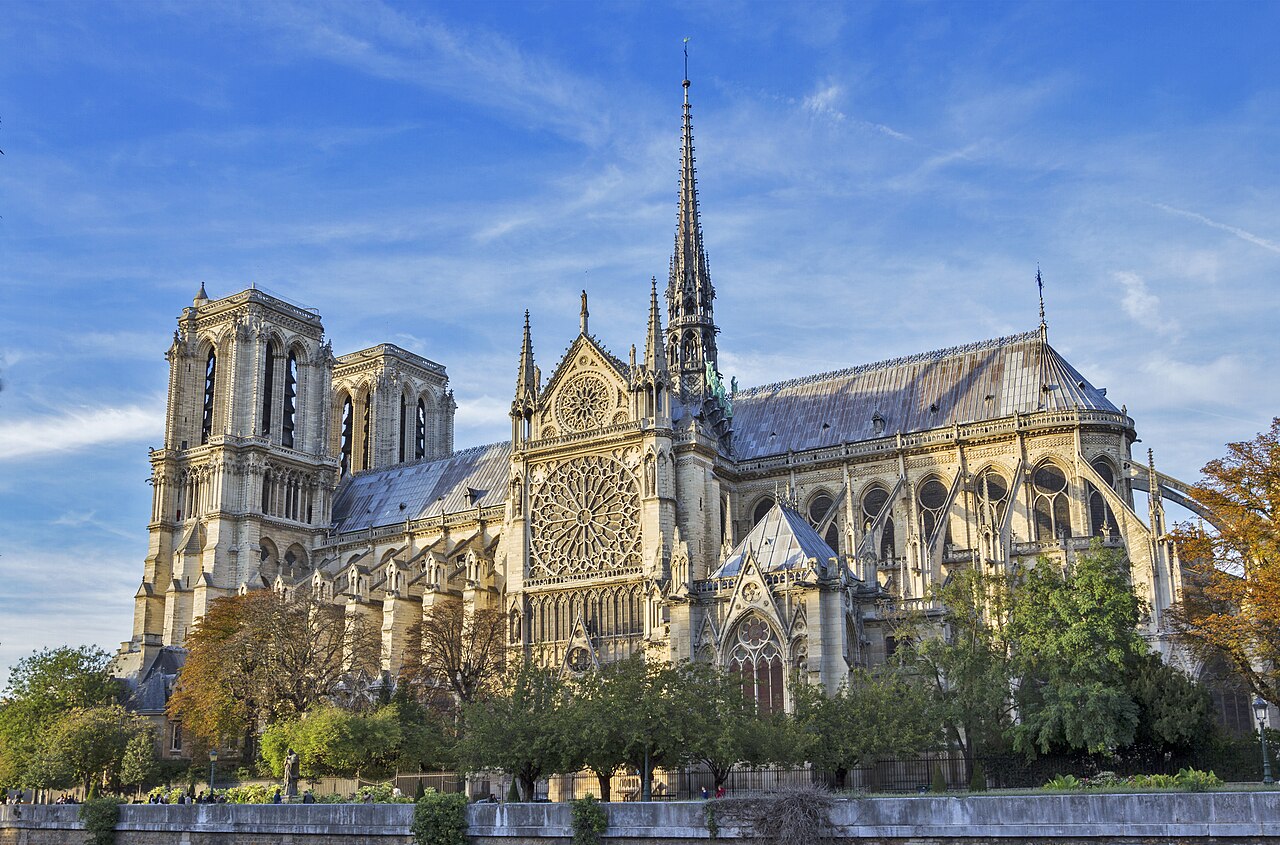
Photo: Baldiri · CC BY-SA 3.0 · Wikimedia Commons
Saint-Julien-le-Pauvre is a church located in Paris, in France. Construction began in the second half of the twelfth century. The free Lokali audio guide runs 7 minutes.
✓ Published October 2026 · how we write these guides
Visitor facts
| Lokali audio guide | 7 min · free |
|---|---|
| Type | Church |
| Location | Paris, France |
| Coordinates | 48.8520, 2.3471 |
| Official website | sjlpmelkites.com |
| Languages | 50+, in the Lokali app |
The story
Listen for a moment. The traffic of the Left Bank fades here into gravel, birdsong, and the low murmur of people on park benches. In front of you stands a small, weathered church of pale stone. It looks almost shy beside the city around it. Across the river, the towers of Notre-Dame rise above the trees. You are standing beside one of the oldest religious buildings in Paris, and most people walking past never notice it.
This is Saint-Julien-le-Pauvre, which means Saint Julian the Poor. Construction began in the second half of the twelfth century. That puts it in the same generation as Notre-Dame, its much larger neighbour across the water. The two buildings grew up together. One became the great cathedral of the nation. The other stayed modest, tucked into a quiet corner of the Latin Quarter, the old student district on the south bank of the Seine.
The name itself holds a small puzzle. Two saints called Julian have been linked to this church. One is Julian the Hospitaller, a figure from medieval legend who helped travellers cross a river. The other is Julian of Le Mans, an early bishop known for giving away his wealth, which may explain the word "poor." Historians do not fully agree on which saint was meant first. Over the centuries, the two stories have blended together.
The legend of the Hospitaller fits this spot well. According to the tale, Julian carried travellers across a river as penance for a terrible crime. Here, so close to the Seine and to the old crossing toward the island, that story feels natural. On a nearby street, Rue Galande, look for an old stone relief above a doorway. It shows Saint Julian in a boat, ferrying a passenger. It is a short walk away and easy to miss.
Now look closely at the front of the church. Something seems slightly wrong, and you are right to feel it. The original building was longer. In the seventeenth century, the nave was shortened, because the old structure had fallen into poor condition. A new, simpler façade was built further back. So the wall in front of you is younger than the church behind it. The medieval heart sits deeper inside.
In the Middle Ages, this church had an unusual role. The University of Paris, one of the oldest universities in Europe, held meetings and elections here. Students and teachers gathered under these vaults to choose their leaders. But students in medieval Paris were famous for their tempers. In the sixteenth century, a dispute turned into a riot, and the building was damaged. After that, the university stopped using the church for its assemblies.
Step inside, and the mood changes again. The interior is dim and close. The stone feels cool, and the air carries a faint trace of wax and incense. Your eyes may go straight to a wooden screen covered in painted icons, standing between you and the altar. This is an iconostasis. It is a feature of Eastern Christian churches, not the Roman Catholic churches you see across most of Paris.
Here is the surprise. Since the late nineteenth century, Saint-Julien-le-Pauvre has served the Melkite Greek Catholic community. Melkites are Christians from the Middle East, mainly from Syria, Lebanon, and nearby lands. They follow Byzantine traditions of worship, often in Greek and Arabic, while remaining united with the Pope in Rome. So inside one of the oldest churches in Paris, you may hear prayers and chants that come from far to the east.
Look up at the columns and their carved tops, called capitals. Some show leaves curling outward, a style typical of early Gothic building. Gothic architecture, the style of pointed arches and tall windows, was being born in and around Paris at exactly this time. Here you see it in an early, compact form. Take your time with the carvings. Small faces and plant shapes appear where you least expect them.
The church has also attracted some unlikely visitors. In 1921, a group of Dada artists chose this place for one of their first public events in Paris. Dada was an artistic movement that mocked tradition and loved the absurd. They organised a mock guided tour of the church and its garden. Few people came, and it rained. Yet the event is remembered today as an early moment in the history of modern art.
When you step back outside, walk into the small park beside the church, Square René Viviani. Look for a tree leaning heavily on a concrete support. This is a black locust, a tree first brought to Europe from North America. It is often described as the oldest tree in Paris, said to have been planted in the early seventeenth century. Its trunk is twisted and scarred, yet it still produces leaves each spring.
From this garden, you have one of the calmest views of Notre-Dame in the city. The cathedral sits across the river, framed by branches. The church behind you, the old tree, and the cathedral ahead form a small triangle of Paris history. Nearby streets add to the picture. The famous English-language bookshop, Shakespeare and Company, is only steps away. Its green front is easy to spot.
If you have time, check whether a concert is scheduled. The church regularly hosts evenings of classical music, often chamber works or piano recitals. The small space and the stone walls hold sound closely. Sitting here as music fills the vaults is a very different experience from visiting by day. It brings the building back to one of its oldest purposes: gathering people together under one roof.
Before you leave, pause once more in front of the doorway. Feel the uneven stone under your feet. Notice how the walls are darker where centuries of rain have run down them. Listen to the park, the voices, the distant river traffic. Saint-Julien-le-Pauvre never tried to be grand. It simply stayed. And as you walk away toward the river, you carry with you a corner of Paris that many visitors pass without ever seeing.
Key facts
What to look for
Practical tips
Common questions
Is there a free audio guide to Saint-Julien-le-Pauvre?
Yes — the Lokali app narrates Saint-Julien-le-Pauvre free of charge in 50+ languages. The guide runs about 7 minutes, covers the history, what to look for on site and practical tips, and works offline once downloaded.
Where is Saint-Julien-le-Pauvre?
Saint-Julien-le-Pauvre is in Paris, France, at 48.8520, 2.3471. Tap the map link on this page for directions from where you are.
What is Saint-Julien-le-Pauvre known for?
Construction began in the second half of the twelfth century. Built in the same generation as nearby Notre-Dame.
What should you look for at Saint-Julien-le-Pauvre?
The painted wooden iconostasis screen in front of the altar. Carved leaf patterns on the early Gothic column capitals. The leaning black locust tree on its concrete support.
What should you know before visiting Saint-Julien-le-Pauvre?
Check the church's schedule for evening classical concerts. Visit Square René Viviani next door for river views.
When is the best time to visit Saint-Julien-le-Pauvre?
Come early in the morning for a calm, empty garden.
On the map
Opens directions to Saint-Julien-le-Pauvre from your location.
More to see in Paris



Hear Saint-Julien-le-Pauvre in your language
The full story, narrated, in 50+ languages. Download it before you go and it plays offline, at your own pace, with no ticket and no tour group.