
Saint-Pierre de Montmartre
48.8867° N · 2.3419° E · Church
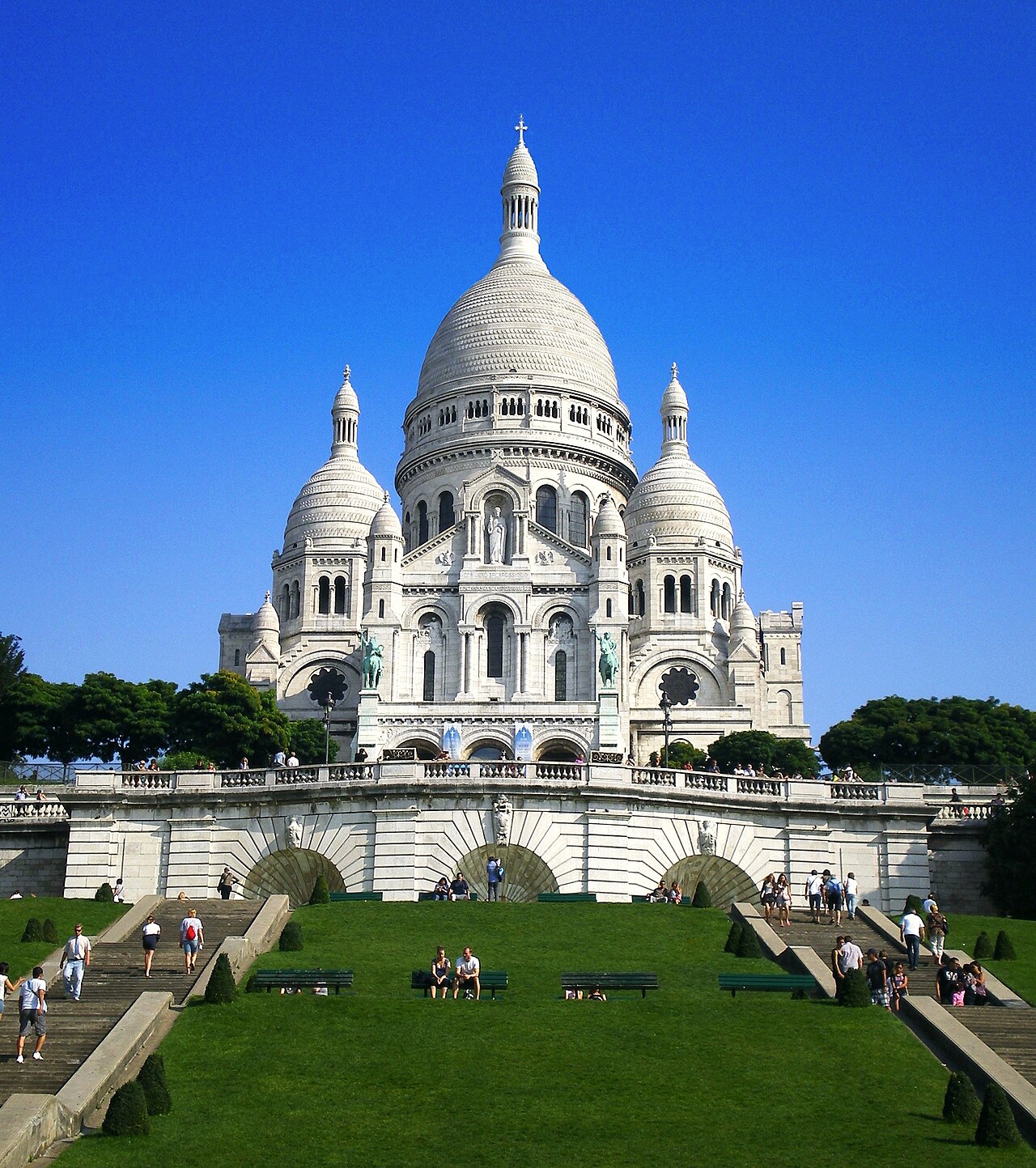
Photo: Stephen Lea · CC BY-SA 3.0 · Wikimedia Commons
Saint-Pierre de Montmartre is a church located in Paris, in France. Consecrated in 1147 by Pope Eugene the Third. The free Lokali audio guide runs 7 minutes.
✓ Published October 2026 · how we write these guides
Visitor facts
| Lokali audio guide | 7 min · free |
|---|---|
| Type | Church |
| Location | Paris, France |
| Coordinates | 48.8867, 2.3419 |
| Official website | saintpierredemontmartre.net |
| Languages | 50+, in the Lokali app |
The story
Step through the doors and the noise of the hilltop falls away. Outside, there are painters calling out to passers-by, the clink of café cups, and the shuffle of a thousand shoes on cobblestones. Inside, the air is cool and smells faintly of old stone and candle wax. The light is soft and coloured. Your eyes need a moment to adjust... and when they do, you are standing in one of the oldest churches in Paris.
Most visitors walk straight past this building. They come up the hill for the white domes of Sacré-Cœur, just a few steps away, and they never notice the modest grey church beside it. That is the first surprise of Montmartre. The famous basilica is a late nineteenth century newcomer. This small church was already old when the Gothic cathedrals of France were still being planned.
Saint-Pierre began as part of a royal abbey. In the 1130s, King Louis the Sixth and his queen, Adelaide of Maurienne, founded a community of Benedictine nuns here on the hill. The queen took a special interest in the abbey. She retired here in her final years, and she was buried here. Her memory is still part of this place, nearly nine centuries later.
The church was consecrated in 1147 by Pope Eugene the Third. It was a grand occasion for such a small hilltop. Tradition holds that Bernard of Clairvaux, the great monastic reformer of the age, stood among the witnesses. Picture it — a pope, a king's court, and the leading churchmen of France, all climbing this muddy hill outside the city walls. In those days, Montmartre was not part of Paris at all. It was countryside, with fields and vineyards on its slopes.
Now look carefully at the columns. Near the entrance, and again up in the choir, you will find a few shafts of dark marble that do not match the pale stone around them. These columns are much older than the church. They are generally thought to come from a Roman-era building that once stood on this hill. Their capitals were added later. So the builders of the twelfth century simply reused what they found lying here. Here is a piece of Roman Paris, still holding up a medieval church.
The name of the hill itself carries layers of story. One explanation links Montmartre to a Roman temple, perhaps to the god Mars or Mercury. A more famous tradition links it to the martyrs. According to the old legend, Saint Denis, the first bishop of Paris, was beheaded on this hill. The tale says he then picked up his own head and walked away, preaching as he went. It is folklore, not history. But it gave Montmartre its sacred reputation for centuries.
Raise your eyes toward the choir, at the far end. The stone ribs that cross the ceiling there are important. They are among the earliest Gothic rib vaults in Paris. In simple terms, these crossing arches let builders carry weight on thin lines of stone, rather than on heavy walls. That idea would soon allow walls to become windows, and churches to rise much higher. Some of the first experiments with it happened right above your head.
The church you see today is a patchwork. The choir keeps much of its twelfth century character. The nave vault was rebuilt in the fifteenth century. The front facade came much later, in the eighteenth century, with a calmer classical style. Walk slowly from the doors to the altar, and you move through several centuries of building in just a few dozen steps. Each part shows a different period, and the joins are not hidden.
Then came the Revolution, and the abbey's long life ended. In the 1790s, the religious communities of France were dissolved. The nuns were expelled. The last abbess, an elderly aristocrat, was sent to the guillotine during the Terror. The abbey buildings were mostly lost. The church itself survived, but it was used for other purposes. For a time, it even carried a strange piece of new technology on its roof.
That technology was the optical telegraph. It was a tall wooden signal mast with moving arms. Operators changed the position of the arms to send coded messages from one hilltop to the next. Montmartre, high above the city, was a natural relay point. So for a while, this old abbey church helped carry government messages across France. It is a surprising image — a medieval church, topped with a signalling machine of the revolutionary age.
By the nineteenth century, the building was in poor condition. There was even talk of demolishing it. Instead, it was restored at the end of the century, as Sacré-Cœur was rising next door. Later, during the Second World War, the old windows were destroyed. The stained glass you see now dates from after the war. It was designed by the glass artist Max Ingrand, and its deep blues and reds give the interior its quiet, coloured glow.
Before you leave, take a close look at the main doors. They are made of bronze and are modern, from the late twentieth century. They show scenes of Saint Peter, the patron of the church, along with Saint Denis and the Virgin Mary. Beside the church lies the small Calvary Cemetery, one of the oldest in Paris. It is rarely opened to the public, but you can sense its stillness behind the walls.
This is still a working parish church. People come here to pray, to light a candle, or simply to sit. Services take place here, so move quietly and keep your voice low. Many visitors find this the calmest corner of the whole hill. You may hear only footsteps, a cough, or the soft click of a candle being placed in its stand.
When you step back outside, pause at the doorway. Behind you are those Roman columns and that early Gothic vault. In front of you, the easels of the Place du Tertre, and the white stone of Sacré-Cœur. Two ages of Montmartre stand side by side here. As you walk on, listen for the moment the quiet ends and the hilltop noise returns... and remember that this small grey church was here first.
Key facts
What to look for
Practical tips
Common questions
Is there a free audio guide to Saint-Pierre de Montmartre?
Yes — the Lokali app narrates Saint-Pierre de Montmartre free of charge in 50+ languages. The guide runs about 7 minutes, covers the history, what to look for on site and practical tips, and works offline once downloaded.
Where is Saint-Pierre de Montmartre?
Saint-Pierre de Montmartre is in Paris, France, at 48.8867, 2.3419. Tap the map link on this page for directions from where you are.
What is Saint-Pierre de Montmartre known for?
Consecrated in 1147 by Pope Eugene the Third. Founded with a royal Benedictine abbey in the 1130s.
What should you look for at Saint-Pierre de Montmartre?
Dark marble Roman-era columns near the entrance. Matching reused columns standing up in the choir. Early stone rib vaults crossing above the choir.
What should you know before visiting Saint-Pierre de Montmartre?
Visit before crossing to Sacré-Cœur, while the hilltop is quieter. Keep voices low; this is an active parish church.
On the map
Opens directions to Saint-Pierre de Montmartre from your location.
More to see in Paris



Hear Saint-Pierre de Montmartre in your language
The full story, narrated, in 50+ languages. Download it before you go and it plays offline, at your own pace, with no ticket and no tour group.