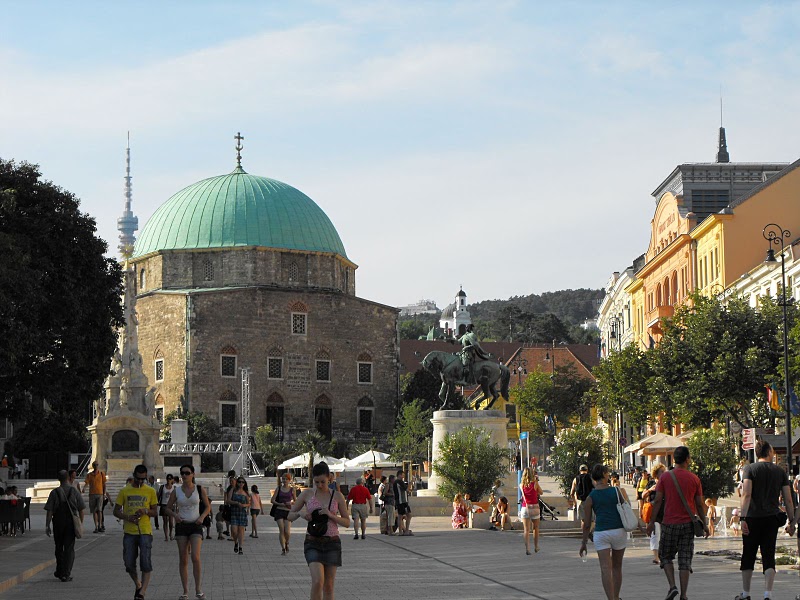
Downtown Candlemas Church of the Blessed Virgin Mary
46.0769° N · 18.2281° E · Mosque
Photo: Jozsef TOTH · CC BY-SA 1.0 · Wikimedia Commons
Downtown Candlemas Church of the Blessed Virgin Mary is a church in Pécs, Hungary. Built as a mosque by Pasha Qasim in the sixteenth century. The free Lokali audio guide runs 7 minutes.
✓ Published October 2026 · how we write these guides
Visitor facts
| Lokali audio guide | 7 min · free |
|---|---|
| Type | Mosque |
| Location | Pécs, Hungary |
| Coordinates | 46.0769, 18.2281 |
| Official website | dzsami.hu |
| Languages | 50+, in the Lokali app |
The story
Stand at the top of Széchenyi Square and feel the ground tilt under your feet. The whole square slopes downhill, paved in pale stone, and at its highest point sits a building that seems to belong to two worlds at once. A broad green dome rises over thick, cream-coloured walls. And at the very top of that dome, look closely, a golden crescent holds up a cross.
That small metal ornament tells the whole story of this place in a single shape. This is the Downtown Candlemas Church of the Blessed Virgin Mary. Most people in Pécs, however, still call it by an older name, the Mosque of Pasha Qasim. Both names are correct. The building has been a church, then a mosque, and then a church again. Over five centuries it has carried the faith of very different people, and it still shows the marks of each of them.
The story begins long before the dome. In the Middle Ages, a Christian church dedicated to Saint Bartholomew stood on or near this spot. It served the townspeople of medieval Pécs, which was then one of the important cities of the Kingdom of Hungary. The town already had deep roots. The Romans knew this area as Sopianae, and early Christian burial chambers from that era lie beneath the streets nearby. Those tombs are now a UNESCO World Heritage Site, a short walk from where you stand.
In the sixteenth century, everything changed. The Ottoman Empire, the Turkish state that controlled much of southeastern Europe, captured Pécs in 1543. The Ottomans held the town for nearly a century and a half. During that time, a governor named Pasha Qasim ordered a mosque to be built in the heart of the town. According to accounts of the period, builders used stones from the old Church of Saint Bartholomew to raise it. So the walls in front of you may hold pieces of the medieval church they replaced.
Look at the shape of the building again. The square body below and the round dome above follow a classic Ottoman design. Builders solved the problem of placing a circle on a square with clever transitions inside the corners. Notice the windows too. Many end in pointed arches, a form common in Islamic architecture. Once, a tall slender minaret stood beside the mosque. From its balcony, a crier called the faithful to prayer five times a day. That sound once carried across this sloping square.
The Ottoman period ended in 1686, when Christian armies retook Pécs. Soon after, the Jesuits, a Catholic religious order known for its schools and missions, took over the mosque. They turned it into a church. Over the following decades, the building lost much of its Islamic character. The minaret came down in the eighteenth century. Inside, walls were covered, and the space was fitted with Baroque decoration, the ornate, dramatic style popular across Catholic Europe at that time.
Here is the first surprise. For a long time, many people walking past would not have recognised this as a former mosque at all. Its Ottoman features lay hidden under later layers of plaster and decoration. It was only during restoration work in the twentieth century that experts uncovered much of the original structure. They removed later additions and brought the Ottoman elements back into view. What you see now is partly the result of that careful work of peeling back time.
When you step inside, let your eyes adjust to the light under the dome. The space feels wide and calm, with a sense of air above you. On one wall, look for a shallow, decorated niche. This is the mihrab, the prayer niche that shows Muslim worshippers the direction of Mecca. Around the walls, you can also find fragments of Arabic writing. These are verses and inscriptions from the mosque period, painted in elegant script and preserved during restoration.
Now comes the second surprise. A Catholic church usually points its altar toward the east. A mosque points toward Mecca, which from Hungary lies to the southeast. Because this building began as a mosque, its inner geometry does not follow the usual rules of a church. Pay attention to how the benches and the altar sit within the space. The building was not designed for Christian worship, and the arrangement inside quietly shows that history.
The church also grew beyond its Ottoman shell. On the northern side, a later extension adds room for a larger congregation. From the outside, you can see where the newer section meets the older body of the former mosque. The join is not hidden. It is simply part of the building's honest record of change. Many visitors who walk around the exterior notice this difference in mass and style before they understand what it means.
Today, this building is widely described as the largest surviving structure from the Ottoman period in Hungary. That makes it important far beyond Pécs. It stands as a reminder that this part of Europe was, for generations, a meeting point of empires, languages, and faiths. Pécs embraced that mixed heritage when it served as a European Capital of Culture in 2010. The city often presents this church as a symbol of that layered identity.
Before you leave, turn around and look down the square. In front of the church stands the Holy Trinity column, a common sight in Central European towns, often raised in thanks after an epidemic ended. Further down, look for the Zsolnay fountain with its small ox heads. It is made with the shimmering glaze of the local Zsolnay porcelain factory, which changes colour in the sunlight. The square below you is a living room for the city, with cafés, students, and slow evening walks.
Take one last look up at that dome and its crescent and cross. Hear the footsteps on the stone, the voices from the cafés, perhaps a church bell from somewhere in the old town. Centuries ago, a call to prayer echoed from this same hilltop. Today, Mass is still held inside. As you walk away down the slope, notice how the dome stays in view behind you... green against the sky, still crowning the centre of Pécs.
Key facts
What to look for
Practical tips
Common questions
Is there a free audio guide to Downtown Candlemas Church of the Blessed Virgin Mary?
Yes — the Lokali app narrates Downtown Candlemas Church of the Blessed Virgin Mary free of charge in 50+ languages. The guide runs about 7 minutes, covers the history, what to look for on site and practical tips, and works offline once downloaded.
Where is Downtown Candlemas Church of the Blessed Virgin Mary?
Downtown Candlemas Church of the Blessed Virgin Mary is in Pécs, Hungary, at 46.0769, 18.2281. Tap the map link on this page for directions from where you are.
What is Downtown Candlemas Church of the Blessed Virgin Mary known for?
Built as a mosque by Pasha Qasim in the sixteenth century. Ottoman forces held Pécs from 1543 until 1686.
What should you look for at Downtown Candlemas Church of the Blessed Virgin Mary?
Golden crescent topped by a cross on the dome. The mihrab prayer niche on the interior wall. Fragments of Arabic inscriptions painted on the walls.
What should you know before visiting Downtown Candlemas Church of the Blessed Virgin Mary?
Dress modestly, since this is an active Catholic church. Avoid visiting during Mass so you can move freely inside.
When is the best time to visit Downtown Candlemas Church of the Blessed Virgin Mary?
Visit the nearby early Christian necropolis on the same walk.
On the map
Opens directions to Downtown Candlemas Church of the Blessed Virgin Mary from your location.
More to see near Downtown Candlemas Church of the Blessed Virgin Mary

Hear Downtown Candlemas Church of the Blessed Virgin Mary in your language
The full story, narrated, in 50+ languages. Download it before you go and it plays offline, at your own pace, with no ticket and no tour group.