
Yakovalı Hasan Paşa Mosque
46.0741° N · 18.2211° E · Museum
Photo: own photo · CC0 · Wikimedia Commons
Yakovalı Hasan Paşa Mosque is a mosque in Hungary. Only Ottoman mosque in Hungary with its minaret intact. The free Lokali audio guide runs 6 minutes.
✓ Published October 2026 · how we write these guides
Visitor facts
| Lokali audio guide | 6 min · free |
|---|---|
| Type | Museum |
| Location | Pécs, Hungary |
| Coordinates | 46.0741, 18.2211 |
| Languages | 50+, in the Lokali app |
The story
Stand still for a moment on the pavement of Rákóczi Road. Traffic hums past, and tram-era buildings line the street. Then your eye moves up a slender white shaft, past a small railed balcony, to a pointed cap against the sky. It is a minaret, rising from an ordinary street in a Hungarian city. That pairing of the everyday and the unexpected is the first thing this place gives you.
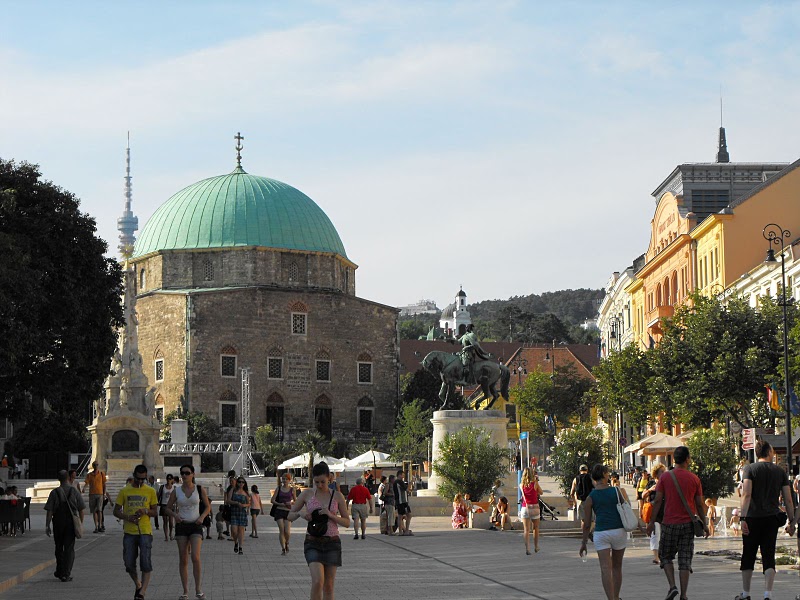
This is the Yakovalı Hasan Paşa Mosque. It is a modest building, with a square prayer hall and a dome on top. Beside it, the minaret climbs higher than everything around it. In the whole of Hungary, this is the only Ottoman mosque that still has its minaret standing. Elsewhere in the country you can find a lone minaret without its mosque, or a mosque without its minaret. Here, both survive together.
To understand why a mosque stands in Pécs at all, go back to the sixteenth century. In 1543, the Ottoman army took the city. For nearly a century and a half, Pécs was part of the Ottoman world. It was a provincial centre, with officials, soldiers, merchants and scholars. The Ottomans rebuilt parts of the town in their own image. They added baths, mosques, schools and lodges for religious brotherhoods.
This mosque was built in the second half of the sixteenth century. It carries the name of Yakovalı Hasan Pasha. His title, pasha, marks him as a high-ranking Ottoman official. The word Yakovalı simply means a man from Yakova. That points to a town in the Balkans, the region the Ottomans controlled for centuries. Beyond his name, the details of his life are thin. It is better to let the building speak through what you can actually see.
The mosque did not stand alone. It was once part of a small complex. There was a lodge for dervishes, members of a Sufi brotherhood, which is a mystical tradition within Islam. There was probably also a school. Today, the mosque is what remains. Picture the open ground around it filled with low buildings, courtyards, and the quiet routines of prayer and study. The street outside would have sounded very different.
Now look closely at the shape of the building. The base is a square block of stone. Above it, the walls step inward to carry the dome. This shift from square to circle is the central problem of every domed building. Ottoman builders solved it with great skill and great economy. From the outside, you can see the transition as a band of angled surfaces below the dome. Inside, it becomes a smooth, calm space with no columns at all.
The minaret deserves its own look. It is slender, many-sided, and joined to the side of the prayer hall. Near the top is the small balcony, called a şerefe. From there, a man called the muezzin once sang the call to prayer, five times a day. His voice would have carried over the rooftops of Ottoman Pécs. Today the balcony stays empty. Still, the shape keeps its purpose clear to anyone who looks up.
Here is something many visitors miss. Pécs once had another, much larger mosque. It is the great domed building on Széchenyi Square, in the heart of the old town. After the Ottomans left, it became a Catholic church, and its minaret was taken down. If you visit both, you can compare them. One was absorbed into Christian worship. This smaller one, by chance, kept more of its original form.
The Ottoman period ended in 1686, when Christian armies took the city back. Across Hungary, many Ottoman buildings were destroyed or changed beyond recognition. This mosque survived, but not untouched. It was turned to Christian use, and for a long time it served as part of a hospital site. Walls were altered, and the building lost some of its original character. Yet the minaret stayed, and so did the core of the prayer hall.
In the twentieth century, restorers took a fresh look at the building. They worked to bring back its Ottoman form, removing later additions where they could. The result is what you see now: a mosque that reads clearly as a sixteenth-century Ottoman building. Some parts are original stone, and some parts are careful restoration. Part of the pleasure here is learning to tell the two apart.
If the doors are open, step inside. The building now works as a small museum space, with objects from the Ottoman era. You may see textiles, ceramics, prayer rugs, and pieces of decorative craft. Look for the mihrab, the niche in the wall that shows the direction of Mecca. Every mosque has one, and it orients the entire room. Notice how the light falls from the windows, and how the dome gathers sound.
Think, too, about what this building says about Pécs as a whole. This is a city of layers. Below the cathedral district lie Roman-era tombs from early Christianity. Above them stand medieval churches, Ottoman domes, and baroque houses. This small mosque is one clear page in that long story. It reminds you that borders and empires moved across this region many times, and each one left something behind.
Before you walk on, take one more look from across the road. See the white minaret against the sky, the dome sitting low beside it, and the modern city all around. Listen to the cars, the footsteps, the ordinary sounds of a Hungarian afternoon. Four centuries ago, a different voice called from that small balcony. Now the street is quieter in its own way... and the minaret simply stands, keeping its place.
Key facts
What to look for
Practical tips
Common questions
Is there a free audio guide to Yakovalı Hasan Paşa Mosque?
Yes — the Lokali app narrates Yakovalı Hasan Paşa Mosque free of charge in 50+ languages. The guide runs about 6 minutes, covers the history, what to look for on site and practical tips, and works offline once downloaded.
Where is Yakovalı Hasan Paşa Mosque?
Yakovalı Hasan Paşa Mosque is near Pécs, Hungary, at 46.0741, 18.2211. Tap the map link on this page for directions from where you are.
What is Yakovalı Hasan Paşa Mosque known for?
Only Ottoman mosque in Hungary with its minaret intact. Built in the second half of the sixteenth century.
What should you look for at Yakovalı Hasan Paşa Mosque?
The small railed balcony near the top of the minaret. Angled stone bands where the square base meets the dome. The mihrab niche pointing toward Mecca inside.
What should you know before visiting Yakovalı Hasan Paşa Mosque?
Cross Rákóczi Road to frame the full minaret. Pair this visit with the domed church on Széchenyi Square.
When is the best time to visit Yakovalı Hasan Paşa Mosque?
Come in late afternoon for softer light on stone.
On the map
Opens directions to Yakovalı Hasan Paşa Mosque from your location.
More to see near Yakovalı Hasan Paşa Mosque
Hear Yakovalı Hasan Paşa Mosque in your language
The full story, narrated, in 50+ languages. Download it before you go and it plays offline, at your own pace, with no ticket and no tour group.