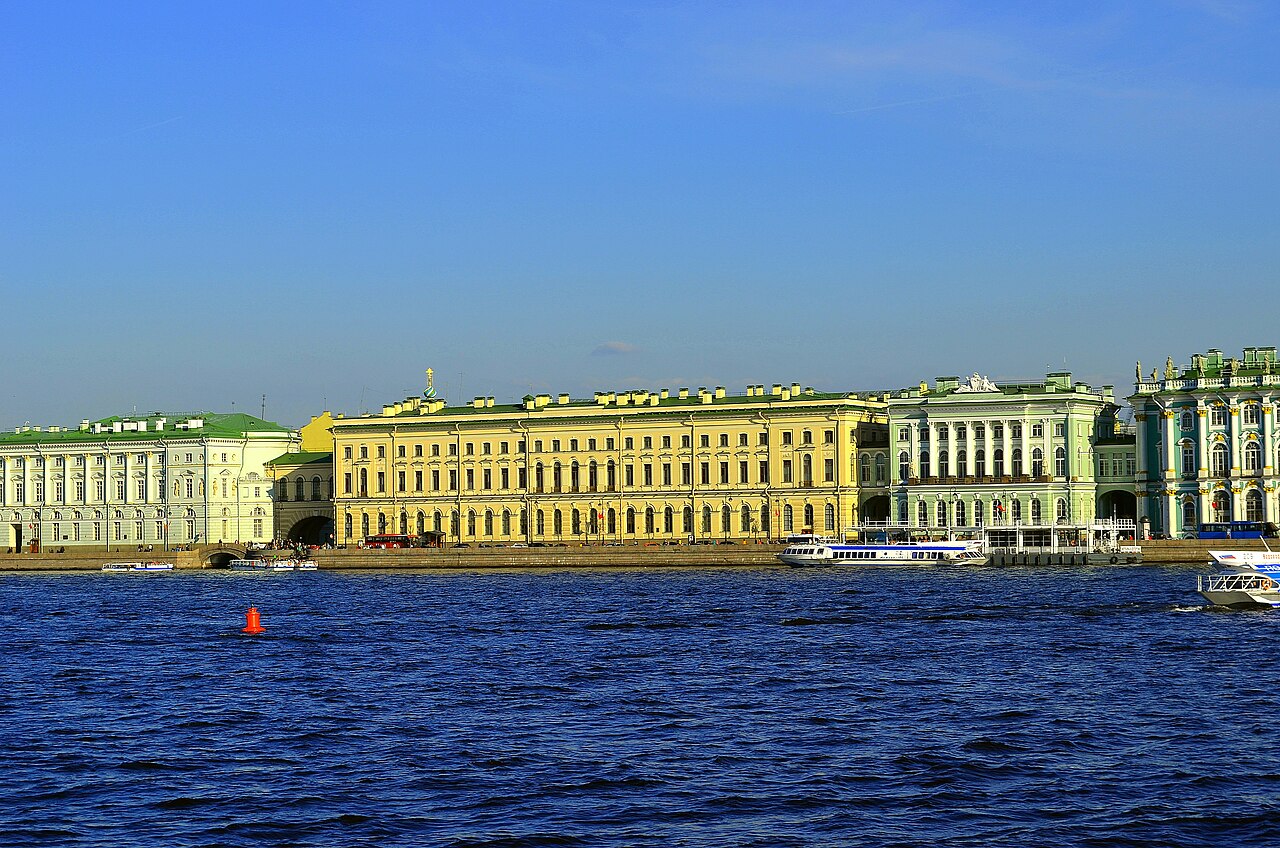
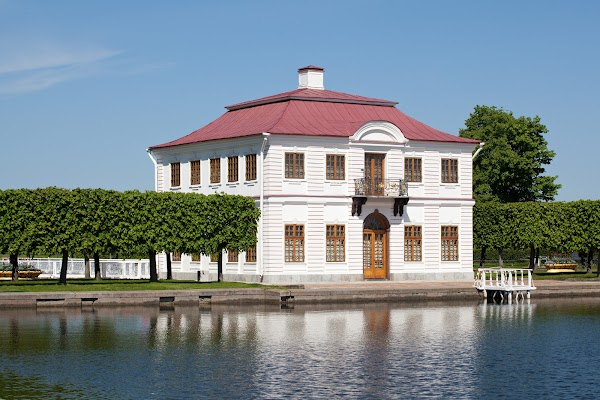
Hermitage Pavilion is a small two-storey baroque building in the Lower Park designed as a private dining retreat. It is in Peterhof, Russia. Most visitors spend 30–40 min here. The free Lokali audio guide runs 5 minutes.
✓ Verified August 2026 · how we write these guides
Visitor facts
| Time needed | 30–40 min |
|---|---|
| Lokali audio guide | 5 min · free |
| Type | Pavilion |
| Best for | History |
| Location | Peterhof, Russia |
| Coordinates | 59.8808, 29.9078 |
| Languages | 45, in the Lokali app |
The story
A narrow building stands near the shore, ringed by a dry moat. A single small bridge crosses to its door. Two floors, tall windows, pale walls, a light roof. From the upper room you can look out and see the open sea. This is the Hermitage at Peterhof. The word means a place to be alone, away from the world.
A hermitage like this was a fashion in the eighteenth century. Across Europe, rulers built small houses for private meals and quiet talk. Here, a few guests could dine far from the noise and watching eyes of the court. The whole point was privacy. Only a chosen few were ever invited inside these walls.
This pavilion was built in the early 1720s, in the time of Peter the Great. The architect Johann Braunstein drew the plans. He also shaped several other buildings in the park. The Hermitage was the first of its kind in Russia. The idea pleased people so much that later rulers copied it in other palaces and gardens.
Notice the moat that runs around the walls. Once, a drawbridge crossed it. When the bridge was raised, no one on foot could enter or leave. The guests upstairs were sealed off, alone with their meal and their conversation. The narrow water and the raised bridge together made the small house feel like its own tiny island.
Now climb to the upper floor, where the true wonder waits. The dining table here could move. The central part of the table was built to rise and to sink on a hidden mechanism. Servants on the floor below would set the dishes in place. Then the loaded section was lifted up through an opening in the floor to the guests waiting above.
Think about what that quietly meant. The guests dined with no servants standing in the room. No one waited and listened by the wall. When a guest wanted a fresh dish, a written note was sent down below, and the food rose up to them. The whole table could be lowered, cleared, reset, and raised again, full once more.
There was even a lifting chair. To reach the upper floor without the stairs, a guest could sit in a special seat. The seat was then raised smoothly through an opening, like a small private lift. It saved the climb and added to the sense of wonder. For the eighteenth century, these simple machines felt close to magic.
Look out through the tall windows. The Hermitage stands very close to the Gulf of Finland. From the upper room, the open sea fills the view on one side, wide and always changing. The green park spreads on the other side. Guests could eat slowly through the afternoon and watch the water shift in color as the light moved across it.
The dining room itself is simple and bright. Paintings cover the walls, hung close together from the floor all the way up to the ceiling. Daylight comes in from windows on every side. The room is made for a small, easy group, not for a crowd. Everything in it is turned toward comfort and toward quiet pleasure.
The Second World War reached this shore as well. Peterhof was occupied, and its buildings were damaged or destroyed. The Hermitage was harmed like all the rest around it. After the war, it was carefully and patiently restored. The moat, the rooms, and the famous lifting table were all brought back, so that the old idea could be seen and understood again.
The Hermitage shows a wish that never really grows old. People with power often long, more than anything, to be left alone. Here, real machines were built just to grant a few quiet hours of privacy. The effort seems very great for one simple meal. Yet that effort tells us plainly how rare true quiet was for a ruler.
Stand for a while in the small upper room. Picture the table loaded and slowly rising through the floor. Picture the servants working unseen below your feet. Picture the guests laughing, free for one evening from every watching eye. The building is small, but the idea behind it is large, and it still feels clever today.
Before you cross the bridge back, pause on the threshold. Imagine the bridge raised, the table sinking down through the floor, the sea filling the bright windows. A few people, a quiet meal, the water all around them. Then picture the table rising once more, and the soft sound of voices in a small room above the shore.
Key facts
What to look for
Practical tips
Common questions
How long do you need at Hermitage Pavilion?
Plan 30–40 min. That is the time most visitors spend at Hermitage Pavilion. The free Lokali audio guide adds about 5 minutes of narration you can listen to as you walk, so it fits inside your visit rather than adding to it.
Is there a free audio guide to Hermitage Pavilion?
Yes — the Lokali app narrates Hermitage Pavilion free of charge in 50+ languages. It covers the history, what to look for on site and practical tips, and it works offline once downloaded.
Where is Hermitage Pavilion?
Hermitage Pavilion is in Peterhof, Russia, at 59.8808, 29.9078. Tap the map link on this page for directions from where you are.
What should you know before visiting Hermitage Pavilion?
Climb upstairs to the small dining room.
What is Hermitage Pavilion known for?
Built in the early 1720s under Peter the Great.
What is the best time to visit Hermitage Pavilion?
The ground floor served as a kitchen; a mechanical table elevated dishes to the upper dining room, allowing meals without servants present.
On the map
Opens directions to Hermitage Pavilion from your location.
Reference
More to see in Peterhof


Hear Hermitage Pavilion in your language
The full story, narrated, in 50+ languages. Download it before you go and it plays offline, at your own pace, with no ticket and no tour group.