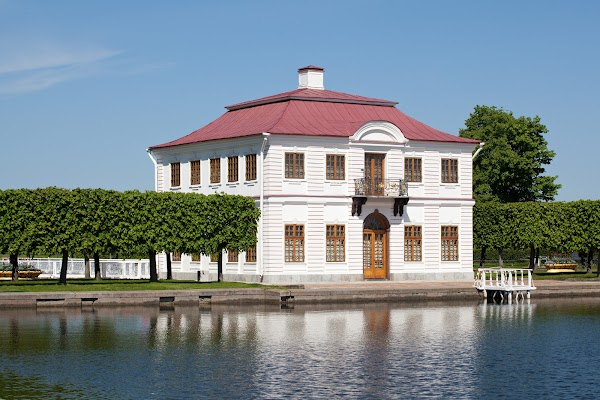
Marli Palace is a modest two-storey baroque residence in the western Lower Park, modelled after Louis XIV's hunting lodge at Marly-le-Roi. It is in Peterhof, Russia. Most visitors spend 40–50 min here. The free Lokali audio guide runs 5 minutes.
✓ Verified August 2026 · how we write these guides
Visitor facts
| Time needed | 40–50 min |
|---|---|
| Lokali audio guide | 5 min · free |
| Type | Palace |
| Best for | Local life |
| Location | Peterhof, Russia |
| Coordinates | 59.8815, 29.8950 |
| Languages | 45, in the Lokali app |
The story
Water lies still on both sides of the path. To your left, a wide pond reflects the open sky. To your right, smaller pools hold the same soft grey light. Ahead stands a small white building, square and calm, doubled in the water before it. This is Marli. It marks the western edge of the Lower Park at Peterhof, where the great gardens come to a quiet end.
The name comes from France. Peter the Great once visited Marly-le-Roi, a royal retreat near Paris. He liked its quiet scale and its order. When he built here, he borrowed the name for his own small house. So a modest Russian palace by the cold northern sea carries the memory of a warm French garden far away.
Marli is small. It has only two floors. Its shape is simple, almost a perfect cube, painted white with plain, even windows. There is no great staircase, no row of tall columns, no heavy carving on the front. Peter did not want grandeur in this corner. He wanted a neat, useful house at the end of the park, standing close beside the water.
Builders raised Marli in the early 1720s. The work followed designs by the architect Johann Braunstein, who shaped several buildings across Peterhof. The palace was finished as the park around it slowly took form. From the very start, it was meant to close the long western view with a single bright, white point that draws the eye down the path.
Look at the large pond beside the palace. It was dug by hand as part of the design. In Peter's time, the ponds were filled with fish. A bell would ring, and the fish would gather at the surface to be fed. Visitors today still pause by the same water. The ponds remain calm and full, holding the white walls in their still reflection.
Inside, the rooms are modest in size but carefully kept. Marli was used to store personal things that belonged to Peter. His clothes, his everyday items, and many small objects were held here. Over the years, the palace slowly became a kind of memorial to him. To step inside is to come close to the plain details of his daily life.
Move from room to room. The spaces are small and human in scale. Light falls through the windows onto wood, plaster, and simple furniture. You can see how a ruler might truly rest here, away from ceremony and crowds. There is a plain dignity in these rooms. Nothing shouts for attention. Everything has its own clear place.
Step outside again and look toward the gentle slope. Nearby stands a cascade of water set against a wall of gold-colored steps. Water slides down it in a bright, thin sheet that catches the light. This cascade and the palace were planned together as a pair. The white house and the shining water answer each other across the green lawns between them.
Around Marli, the garden is laid out in straight, clear lines. The paths cross one another at sharp, careful angles. Fruit trees and flower beds were planted here in Peter's day, and the pattern still holds. The order is gentle rather than strict. The whole design quietly leads your eye back toward the palace and the still water beside it.
Marli did not escape the Second World War. The front line reached Peterhof, and the buildings here were badly harmed. After the war, the small palace was carefully restored. Workers rebuilt what was lost and returned the objects that had been saved. Today Marli stands white and quiet again, much as it did three centuries ago.
This corner of the park is calmer than the busy center. The crowds thin out as you walk west. The sound of the great fountains slowly fades behind you. Here you hear wind moving in the trees and water lapping gently at the edges of the ponds. Many visitors pause at Marli simply to rest, to sit by the water, and to breathe.
The light changes the place through the day. In the morning, the white walls look soft and cool. At midday, they grow bright against the green. In the low evening sun, the palace turns faintly gold, and its image in the pond glows with it. The same small house seems to shift with the passing hours.
Before you turn back, stand still by the pond. See the white palace doubled in the water below it. Think of the French garden that gave this place its name, and the ruler who wanted only a small, clear corner at the end of his park. The water holds the image, steady and bright, and then a soft breeze lets it go.
Key facts
What to look for
Practical tips
Common questions
How long do you need at Marli Palace?
Plan 40–50 min. That is the time most visitors spend at Marli Palace. The free Lokali audio guide adds about 5 minutes of narration you can listen to as you walk, so it fits inside your visit rather than adding to it.
Is there a free audio guide to Marli Palace?
Yes — the Lokali app narrates Marli Palace free of charge in 50+ languages. It covers the history, what to look for on site and practical tips, and it works offline once downloaded.
Where is Marli Palace?
Marli Palace is in Peterhof, Russia, at 59.8815, 29.8950. Tap the map link on this page for directions from where you are.
What should you know before visiting Marli Palace?
Walk west to escape the crowds at the center.
What is Marli Palace known for?
Marli Palace was built in the early 1720s.
What is the best time to visit Marli Palace?
The palace sits on a small peninsula with water views on three sides.
On the map
Opens directions to Marli Palace from your location.
More to see in Peterhof


Hear Marli Palace in your language
The full story, narrated, in 50+ languages. Download it before you go and it plays offline, at your own pace, with no ticket and no tour group.