
Bang Pa-In Royal Palace
14.2325° N · 100.5792° E · Archaeological Site
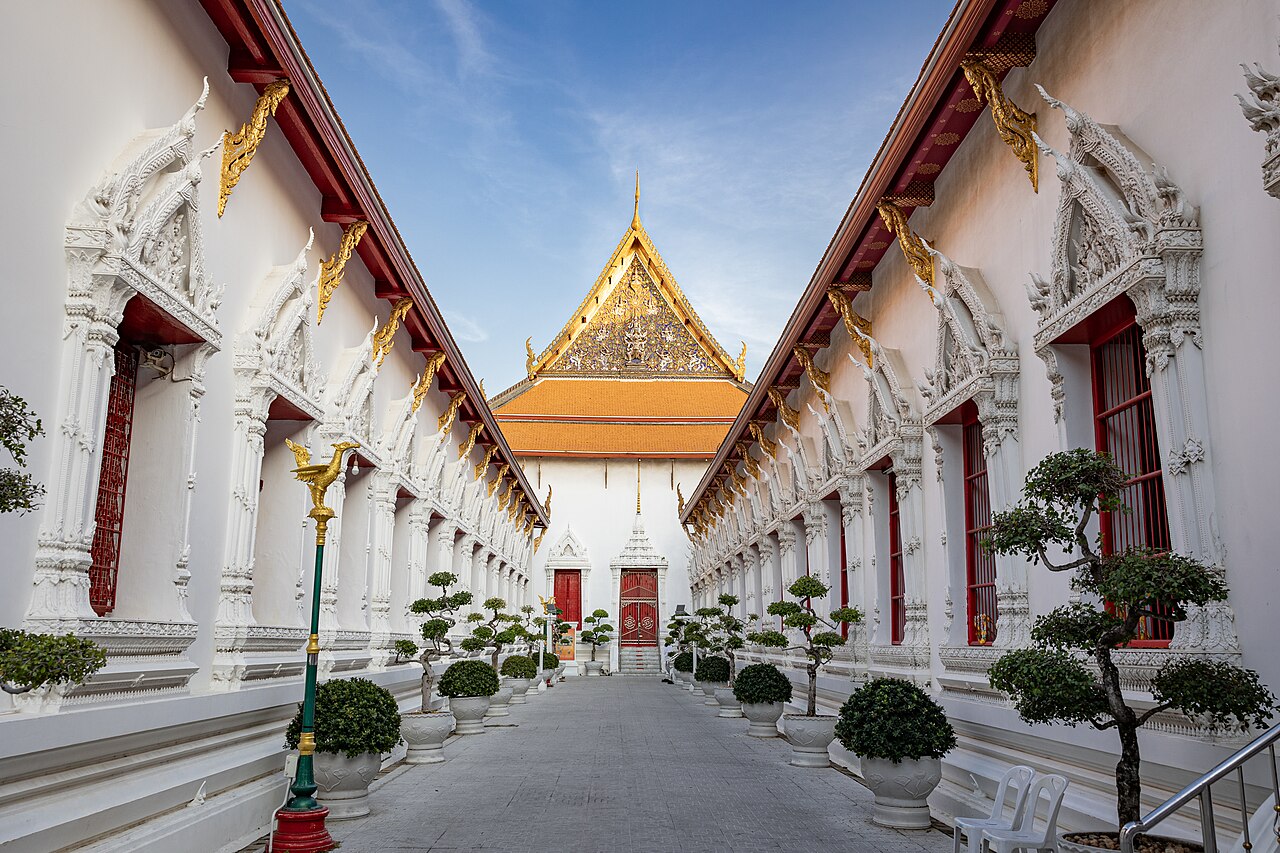
Photo: Chainwit. · CC BY 4.0 · Wikimedia Commons
Bang Pa-In Royal Palace is a Thai royal palace complex. It is near Phra Nakhon Si Ayutthaya, Thailand. First palace here built by King Prasat Thong, seventeenth century. The free Lokali audio guide runs 7 minutes.
✓ Published October 2026 · how we write these guides
Visitor facts
| Lokali audio guide | 7 min · free |
|---|---|
| Type | Archaeological Site |
| Location | Phra Nakhon Si Ayutthaya, Thailand |
| Coordinates | 14.2325, 100.5792 |
| Languages | 50+, in the Lokali app |
The story
Listen first. Water laps against stone steps. Somewhere a gardener's shears click through a hedge, and a breeze carries the green smell of clipped grass across the lawns. In the middle of a still pond, a small pavilion sits on the water, its tiered roof pointing up into the Thai sky. This is Bang Pa-In, a royal summer palace on the Chao Phraya River, south of the old capital of Ayutthaya.
The story here begins in the seventeenth century, with King Prasat Thong of the Ayutthaya kingdom. He built a palace on this river island, and tradition links the site to his early life. Locals say he was born nearby. Whatever the truth of that tale, the island became a royal retreat. Kings travelled here by boat from Ayutthaya, leaving the crowded capital behind for a quieter place on the water.
Then came silence. In 1767, a Burmese army destroyed Ayutthaya, and the old kingdom fell. The court moved south, and eventually the new capital rose at Bangkok. For roughly a century, this island was left to the river and the weeds. Most of what you see today is not the seventeenth-century palace at all. It is a later rebuilding, and that rebuilding changes how you should read every building around you.
King Mongkut, the fourth king of the Chakri dynasty, began to revive the site in the nineteenth century. His son, King Chulalongkorn, finished the work on a grand scale. Chulalongkorn was a modernising monarch. He travelled to Europe, studied foreign ideas, and worked to keep Siam independent while colonial powers pressed on its borders. Bang Pa-In shows his thinking in architecture. Thai, Chinese, and European styles stand side by side here, on purpose.
Look again at the pavilion in the pond. Its name is Aisawan Thiphya-Art, often translated as the Divine Seat of Personal Freedom. It is built in classic Thai style, with a slender spire and layered roofs. Many visitors know its shape without realising it. The pavilion appears often in Thai imagery, and it has become one of the clearest pictures of the palace. Stand by the water's edge and notice how the reflection doubles the spire on a calm day.
Now turn toward the buildings that look as if they belong in a European country house. Warophat Phiman Hall, with its columns and formal facade, was used as a royal residence and throne hall. Nearby, painted wooden houses and neat lawns feel more like a nineteenth-century estate than a tropical palace. This was a message. Siam could speak the visual language of Europe fluently — and still remain itself.
For a surprise, find the Chinese-style hall called Wehart Chamrunt. Its red and gold, its carved details, and its heavy roof come from an entirely different world. The hall was built with the support of the Chinese merchant community in Siam, and it was presented as a gift to the king. Inside, the decoration is rich and dense. It reminds us that Chinese families were part of Siamese trade and society for centuries.
Climb the small tower called Withun Thatsana, if it is open, and the whole garden spreads out below you. The name means something like the sage's lookout. From the top, you can see how the buildings sit among canals, bridges, and ponds. You can also understand the original idea. This was a place to look out over water and gardens, and to feel cool air after the heat of the plains.
Not every corner here is cheerful. In 1880, Queen Sunanda Kumariratana, one of King Chulalongkorn's queens, drowned in the Chao Phraya River while travelling by boat toward Bang Pa-In. Her young daughter died with her. The story most often told says that onlookers did not help, because ordinary people were forbidden to touch royalty. Historians still discuss the details. What is certain is the king's grief.
Chulalongkorn built a white marble memorial to the queen and her children here in the palace grounds. Read the inscription if you can find a translation nearby. The words come from a husband, not from an official. Many visitors walk past this monument quickly, on the way to the famous pavilion. It is worth a few quiet minutes. The reform of laws on royal contact in Siam is often connected with this loss.
The gardens deserve slow attention too. Look for the topiary — hedges clipped into the shapes of animals, including elephants. Small bridges cross the canals, and some of the gates between the inner and outer courts were once closed to all but the royal household. The palace is still used by the royal family on some occasions. That is why parts of it may be closed, and why respectful dress matters here.
Across the river stands one more unusual building. Wat Niwet Thammaprawat is a Buddhist temple built in the style of a Gothic church, with pointed windows and stained glass. King Chulalongkorn sponsored it. Visitors usually cross the water in a small cable car, pulled across on a line. Inside, a Buddha image sits where a European visitor might expect an altar. It is a temple that looks like a church, and it still functions as a temple.
When you put these pieces together, Bang Pa-In becomes more than a pleasant garden. It is a record of a kingdom deciding how to face the modern world. The Thai pavilion, the European halls, the Chinese hall, and the Gothic temple are all part of one argument. Siam could choose from many traditions, and still keep its own centre. Few royal palaces show that choice so openly.
Before you leave, go back to the water. Watch the light move on the pond, and the pavilion's reflection break and settle as the breeze changes. Listen for the river beyond the walls, the same river that carried kings here and took a queen away. As you walk out, notice the small things — a clipped hedge, a painted shutter, a stone step worn smooth by many feet.
Key facts
What to look for
Practical tips
Common questions
Is there a free audio guide to Bang Pa-In Royal Palace?
Yes — the Lokali app narrates Bang Pa-In Royal Palace free of charge in 50+ languages. The guide runs about 7 minutes, covers the history, what to look for on site and practical tips, and works offline once downloaded.
Where is Bang Pa-In Royal Palace?
Bang Pa-In Royal Palace is near Phra Nakhon Si Ayutthaya, Thailand, at 14.2325, 100.5792. Tap the map link on this page for directions from where you are.
What is Bang Pa-In Royal Palace known for?
First palace here built by King Prasat Thong, seventeenth century. Abandoned after Ayutthaya fell to Burmese forces in 1767.
What should you look for at Bang Pa-In Royal Palace?
Aisawan pavilion reflected in the pond on calm days. Hedges clipped into elephant shapes in the gardens. White marble memorial to Queen Sunanda and her children.
What should you know before visiting Bang Pa-In Royal Palace?
Cover shoulders and knees; the palace keeps a dress code. Arrive early to walk the gardens before midday heat.
When is the best time to visit Bang Pa-In Royal Palace?
Arrive early to walk the gardens before midday heat.
On the map
Opens directions to Bang Pa-In Royal Palace from your location.
More to see near Bang Pa-In Royal Palace



Hear Bang Pa-In Royal Palace in your language
The full story, narrated, in 50+ languages. Download it before you go and it plays offline, at your own pace, with no ticket and no tour group.