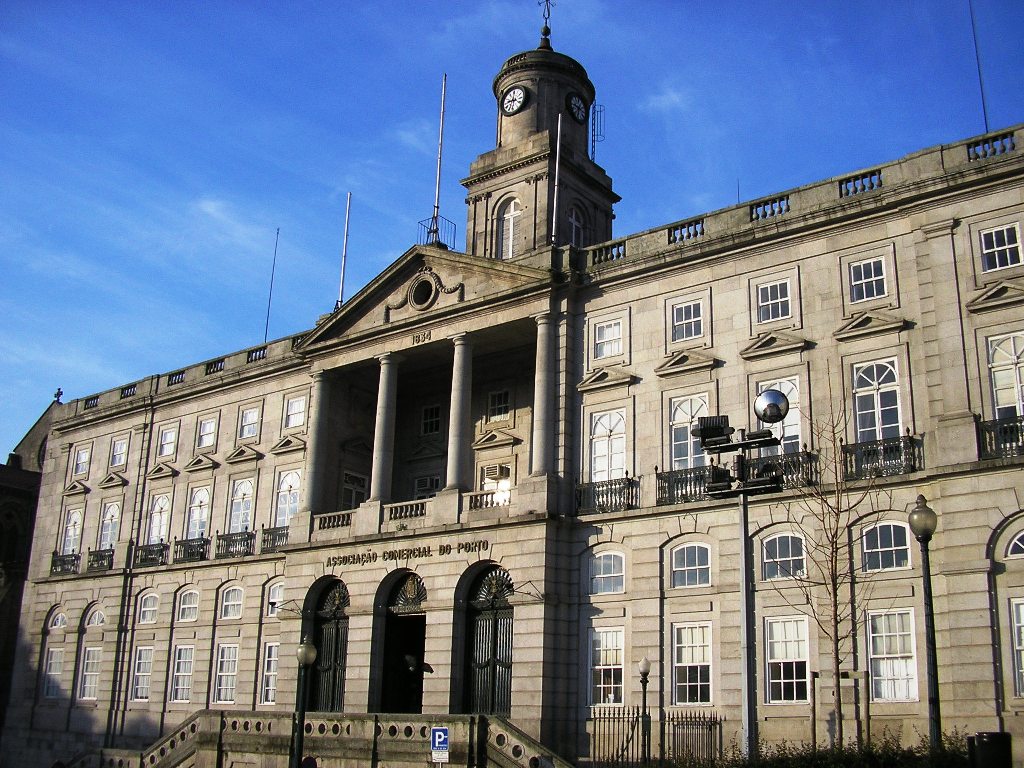
Photo: Manuel de Sousa · Public domain · Wikimedia Commons
Palácio da Bolsa is a building in Porto, Porto District, Portugal. Built by the Commercial Association of Porto, still its headquarters. The free Lokali audio guide runs 7 minutes.
✓ Published October 2026 · how we write these guides
Visitor facts
| Lokali audio guide | 7 min · free |
|---|---|
| Type | Palace |
| Location | Porto, Portugal |
| Coordinates | 41.1414, -8.6157 |
| Official website | palaciodabolsa.com |
| Languages | 50+, in the Lokali app |
The story
Stand still for a moment on the square outside. Underfoot, the paving stones slope gently toward the river. Gulls call above the rooftops, and the air carries a faint smell of salt from the Douro just below. In front of you rises a long, pale facade of grey granite, calm and symmetrical, with tall windows in measured rows. This is the Palácio da Bolsa, the old stock exchange palace of Porto. From the outside, it looks serious and restrained. Inside, it is anything but.
To understand why this building exists, picture Porto in the early nineteenth century. This was a city of merchants. Wine, textiles and goods moved up and down the river and out to the Atlantic. The traders of Porto wanted a home for their business, a place to meet, negotiate and show the world that their city meant serious money. The Commercial Association of Porto took on that task, and this palace became its headquarters. The building still belongs to the association today.
The site itself has a dramatic story. This ground once belonged to the Convent of Saint Francis. In the 1830s, Portugal was torn by civil war between liberals and absolutists, and Porto lived through a long and painful siege. During that conflict, a fire destroyed the convent buildings. Only the church survived. It still stands right beside the palace, and you can see its Gothic stonework just next door. The merchants built their temple of commerce on the ashes of a house of prayer.
Construction began in 1842, under the Portuguese architect Joaquim da Costa Lima Júnior. He chose a neoclassical style — a nineteenth-century return to the clean columns, balanced proportions and calm order of ancient Greece and Rome. But this was not a quick project. Work on the interiors continued for decades, and different artists and designers added their own chapters. The decoration was not fully complete until the early twentieth century. So when you walk through, you are really walking through several generations of taste.
Visits happen with a guide, so you will enter as part of a small group. The first space usually stops people in their tracks. This is the Hall of Nations, a large covered courtyard at the heart of the building. Look up. A dome of iron and glass lets daylight pour down onto the floor. Iron and glass together were the bold building materials of the industrial age, and here they sit inside a classical stone frame — old and new in the same breath.
Now follow the line where the dome meets the walls. You will see a ring of painted coats of arms. These belong to the countries that traded with Portugal when the hall was decorated. It is a kind of map of commercial friendships, painted in heraldry. Then look down. The floor is a detailed mosaic, inspired by the patterns of Greek and Roman antiquity. Many visitors walk right across it while staring at the ceiling... it is worth slowing down and looking at your feet.
From the courtyard, a grand staircase climbs to the upper floor. It is built of granite, the same hard grey stone that shapes so much of Porto. Bronze lamps light the way, and sculpture appears along the route. Two of the finest Portuguese sculptors of the nineteenth century, António Soares dos Reis and António Teixeira Lopes, both contributed work to this building. Take the steps slowly. The staircase was designed to impress visiting merchants and diplomats, and it still does exactly that.
Upstairs, the rooms change mood one after another. One of them is the Courtroom, where the commercial court once sat to settle disputes between traders. Think about what that meant. Contracts, debts, cargoes lost at sea — all argued out in a room of carved wood and painted panels. Commerce here was not only about making deals. It was also about trust, and about having a respected place to resolve it when trust broke down.
Other rooms show the ceremonial side of the palace. There are spaces of polished wood, gilded detail and heavy chandeliers, made for meetings, banquets and official visits. Notice the craftsmanship in the doors and ceilings. Much of it was carved and finished by hand. The point of all this richness was simple. The merchants of Porto wanted their visitors to leave convinced that this city was prosperous, confident and worth doing business with.
And then comes the surprise that most people remember long after they leave — the Arab Room. After all the restrained classical order downstairs, you step into a space covered in gold. This room was designed in the Moorish Revival style, inspired by the Islamic palaces of southern Spain, especially the Alhambra in Granada. Its designer was Gustavo Adolfo Gonçalves e Sousa, and the work took many years to complete. Every surface carries patterns of stucco, colour and gilding.
Look closely at the walls and the arches. Geometric shapes repeat and interlock. Bands of flowing Arabic-style script run through the decoration. Coloured glass softens the light. The effect is warm and almost overwhelming, especially after the grey granite outside. Here is another detail many visitors miss — this room is still in use. Portugal has used it to receive heads of state and important guests, and it still hosts formal dinners and concerts. It is not only a museum piece.
Why would a Portuguese stock exchange build a room like this? In the nineteenth century, much of Europe was fascinated by the Islamic world, and Moorish styles were very fashionable. For Porto's merchants, the room was also a statement. It said that this city looked outward, toward distant markets and other cultures. The palace is part of the historic centre of Porto, which UNESCO listed as a World Heritage Site in 1996, and this room is one reason why.
When the tour ends, step back out into the square. Let your eyes adjust to the daylight. In front of you is the Praça do Infante Dom Henrique, with its statue of Prince Henry the Navigator, who is remembered for sponsoring Portugal's early sea voyages. Just downhill lies the Ribeira, the old riverside quarter, with its stacked houses and narrow lanes. Turn around once more and look at the palace facade. Calm, grey and orderly... and now you know the gold that hides behind it.
Key facts
What to look for
Practical tips
Common questions
Is there a free audio guide to Palácio da Bolsa?
Yes — the Lokali app narrates Palácio da Bolsa free of charge in 50+ languages. The guide runs about 7 minutes, covers the history, what to look for on site and practical tips, and works offline once downloaded.
Where is Palácio da Bolsa?
Palácio da Bolsa is in Porto, Portugal, at 41.1414, -8.6157. Tap the map link on this page for directions from where you are.
What is Palácio da Bolsa known for?
Built by the Commercial Association of Porto, still its headquarters. Construction began in 1842 on a burned convent site.
What should you look for at Palácio da Bolsa?
Iron-and-glass dome above the Hall of Nations. Ring of painted national coats of arms below the dome. Greco-Roman style mosaic floor in the central courtyard.
What should you know before visiting Palácio da Bolsa?
Join a guided tour, since visits inside are guide-led. Book ahead in summer, when tour groups fill quickly.
When is the best time to visit Palácio da Bolsa?
Book ahead in summer, when tour groups fill quickly.
On the map
Opens directions to Palácio da Bolsa from your location.
More to see in Porto


Hear Palácio da Bolsa in your language
The full story, narrated, in 50+ languages. Download it before you go and it plays offline, at your own pace, with no ticket and no tour group.